Back to Evidence Hub
Case Study S047
2022 Release

Agam 2022: Diastolic SCG vs Echo

Ahmad Agam et al.
Access Paper

Quick Conclusion: Validates SCG’s potential for evaluating diastolic function. Note: This source was previously referenced as S038 in some contexts.


📊 Key Accuracy Metrics

MetricResult
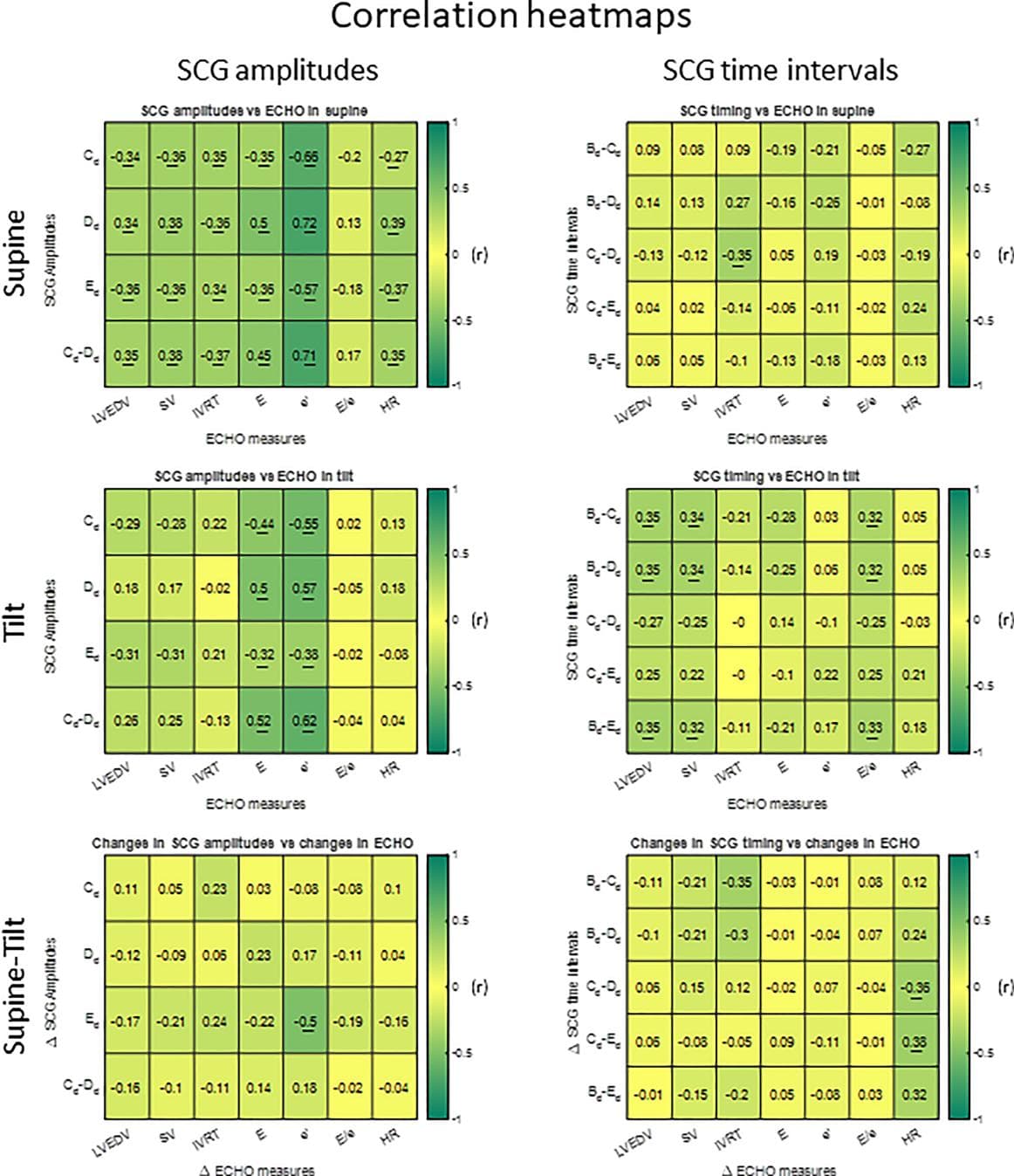
Correlation with e'r=0.713 (P<0.001) for peak-to-peak diastolic SCG
Intrasubject correlation (supine vs tilt)r=0.90 for peak-to-peak Cd-Dd
Preload sensitivityOnly Ed amplitude significantly altered by tilt


🔍 Study Analysis

Objective & Population

Observational / Validation Study with Preload Challenge. Cohort: 45 healthy subjects (Age 20-80) (N=45).

What it Supports

This study reports significant correlation between diastolic SCG amplitudes and echocardiographic e' velocity.

What it Does Not Support

The study does not provide diagnostic cut-offs for heart failure with preserved ejection fraction (HFpEF), though it points in that direction. It also does not support using Ed amplitude as an absolute estimator of intersubject variability.


🛠 Technical Context

Featured Illustration

Figure 1 Heatmap demonstrating Pearson’s correlation between the diastolic seismocardiography variables and the echocardiography variables.  The four top figures illustrate correlation between seismocardiography measures and echocardiography when the patients were in supine and tilted  position. The two lower figures illustrate the correlation between changes in seismocardiography and echocardiography when the subject change  from to supine position and tilt position. Underlined numbers are significant correlations (P < 0.05).

Figure 1 Heatmap demonstrating Pearson’s correlation between the diastolic seismocardiography variables and the echocardiography variables. The four top figures illustrate correlation between seismocardiography measures and echocardiography when the patients were in supine and tilted position. The two lower figures illustrate the correlation between changes in seismocardiography and echocardiography when the subject change from to supine position and tilt position. Underlined numbers are significant correlations (P < 0.05).

Study Snapshot

Metadata Summary

Target Population

45 healthy subjects (Age 20-80)

N

Sample Size

45 Subjects

Validated Metric

r=0.713 (P<0.001) for peak-to-peak diastolic SCG

Critical Appraisal
supporting

Demonstrated significant correlation between diastolic SCG amplitudes and echocardiographic e' velocity.