Computer-Aided Detection of Fiducial Points in Seismocardiography through Dynamic Time Warping
Executive Summary
This study introduces a dynamic time warping (DTW)-based quasi-synchronous alignment method for detecting fiducial points in seismocardiography (SCG) signals. By leveraging reference signals and DTW, the method mitigates misalignment errors inherent in conventional approaches. Key findings include strong correlations between SCG-derived cardiac indexes (PEP/LVET ratio and Tei index) and left ventricular ejection fraction (LVEF), with R2 values of 0.768 and 0.86, respectively, and ROC curve analysis demonstrating >92% accuracy in identifying heart failure patients with reduced ejection fraction (HFrEF). This approach has potential for standardizing SCG fiducial point detection and enabling machine learning applications in cardiac monitoring.
Answer Machine Insights
Q: How does the DTW-based method improve fiducial point detection in SCG?
The DTW-based method eliminates timing errors by aligning SCG signals to reference signals without rescaling, ensuring accurate fiducial point detection.
Compared to the conventional quasi-synchronous alignment, DTW-based quasi-synchronous alignment eliminates the fiducial point detection error due to the stretching (or squeezing) manipulation.
Q: What is the clinical significance of the PEP/LVET ratio and Tei index derived from SCG?
These indexes are negatively correlated with LVEF and serve as reliable predictors for assessing myocardial contractility and identifying heart failure patients.
Favorable R2 values were obtained, R2 = 0.768 for PEP/LVET versus LVEF and R2 = 0.86 for Tei index versus LVEF.
Key Results
R2 = 0.768 for PEP/LVET ratio versus LVEF.
ROC curve analysis showed >92% accuracy in identifying HFrEF patients.
Visual Evidence
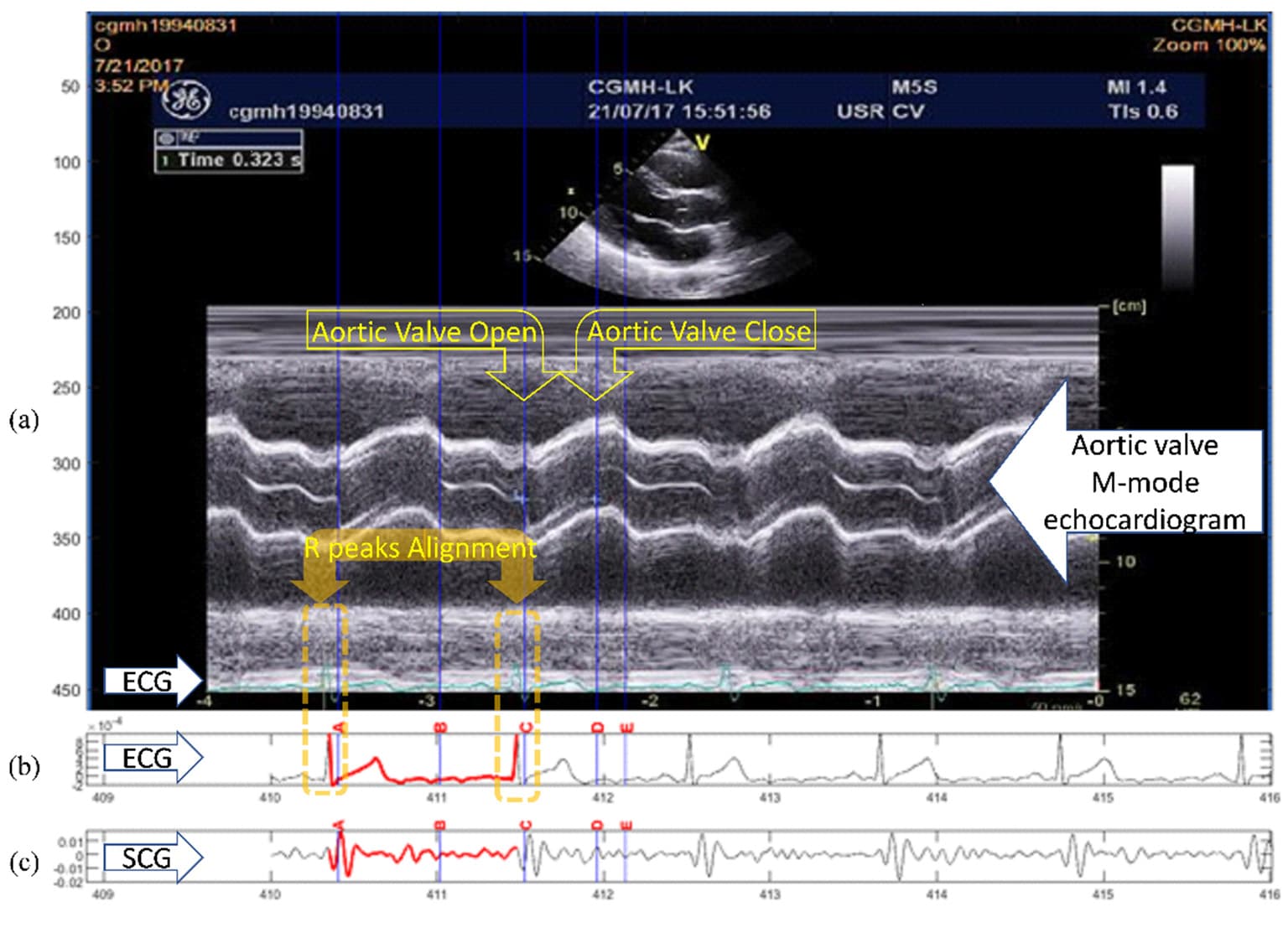
Figure 1. Example of the quasi-synchronous alignment for an echocardiogram image and an SCG measurement: (a) M-mode echocardiogram image of the aortic valve (with an ECG signal at the bottom of the image); (b) ECG signal simultaneously measured with SCG signal; (c) SCG signal.
Clinical Snapshot
Evidence Rating
Relevance
high Priority