Contactless Seismocardiography via Deep Learning Radars
Executive Summary
This study introduces RF-SCG, a contactless seismocardiography system leveraging millimeter-wave radar and deep learning to reconstruct SCG waveforms and time five key cardiovascular events with high accuracy. The system employs a hybrid architecture combining a 4D Cardiac Beamformer, an RF-to-SCG Translator, and a modified U-Net for automatic labeling. Empirical evaluation on 21 subjects demonstrated median timing errors of 0.26%-1.29%, comparable to gold-standard cardiac ultrasound, highlighting its potential for passive, long-term cardiovascular monitoring.
Answer Machine Insights
Q: What is the accuracy of RF-SCG in timing micro-cardiac events?
RF-SCG achieves median timing errors between 0.26%-1.29%, comparable to gold-standard cardiac ultrasound.
Specifically: When RF-SCG is tested on subjects that it has not been trained on, it achieves a median error between 0.26%-1.29% in timing each of the five fiducial points.
Q: How does RF-SCG compare to conventional methods in reconstructing SCG waveforms?
RF-SCG achieves correlation coefficients exceeding 0.72 across all subjects, significantly outperforming conventional methods.
The figure shows that RF-SCG’s correlation coefficient is higher than that of the baseline across all subjects.
Key Results
Median timing errors for five fiducial points ranged from 0.26%-1.29%, equivalent to 2-12 ms.
RF-SCG achieved waveform correlation coefficients exceeding 0.72 across all subjects, outperforming baseline methods by 3-12×.
Visual Evidence
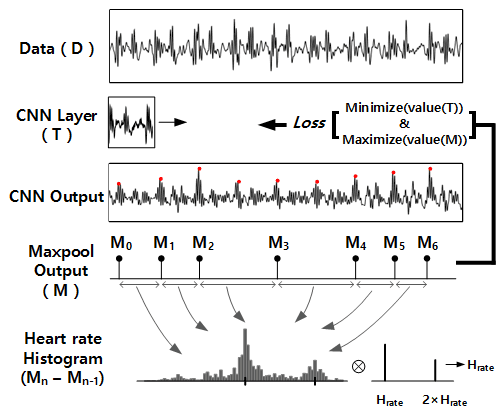
Figure 3—CNN-assisted Template Matching. The figure shows the different stages of RF-SCG’s segmentation algorithm. After the CNN and Maxpool layers, each segment between neighboring M’s is a candidate for the hearbeat period (or heart rate). The final stage involves heart rate estimation using a histogram.
Clinical Snapshot
Evidence Rating
Relevance
high Priority