Back to Evidence Hub
Case Study S032
2020 Release

Ha 2020: Contactless SCG via Radars

Ha et al.
Access Paper

Quick Conclusion: Explores the feasibility of passive, contact-free cardiac monitoring using millimeter-wave technology.


📊 Key Accuracy Metrics

MetricResult
Median Error0.26%-1.29% for all events
Timing Error range2-12 ms
Total heartbeats analyzed40,000+
Precision (Labeling)~90%


🔍 Study Analysis

Objective & Population

Technical Development & Validation Study. Cohort: Healthy subjects (N=21).

What it Supports

Reports median errors of 0.26%-1.29% for contactless SCG acquisition using deep learning radars.

What it Does Not Support

The study does not support the use of contactless SCG for subjects who are moving significantly or are more than 0.5 meters away from the radar. It has not yet been validated for clinical diagnosis in patients with heart disease.


đź›  Technical Context

Featured Illustration

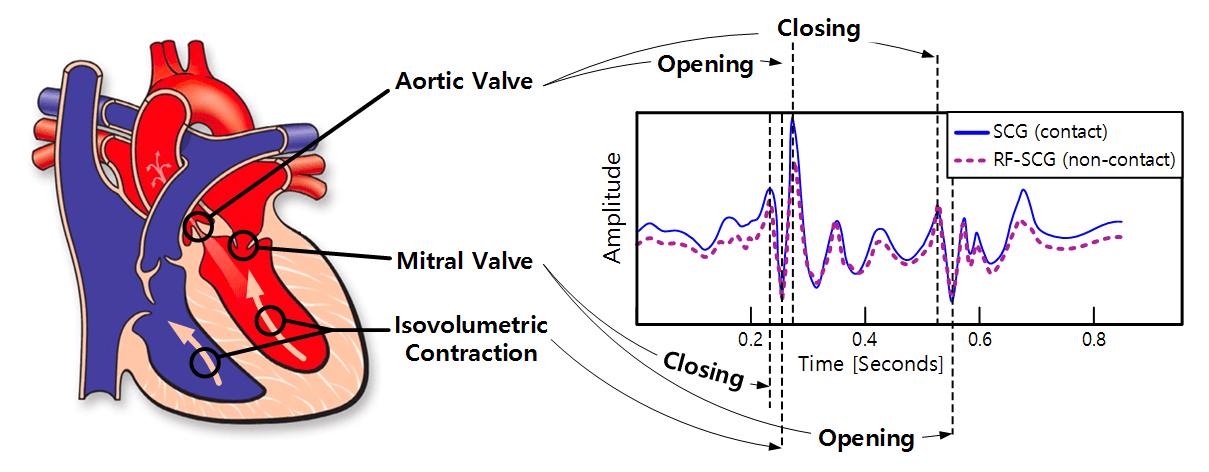
Figure 1—Contactless SCG Recording. The plot to the right shows SCG recordings of a single heartbeat obtained from an accelerometer strapped to the apex of the heart (in blue) and from RF-SCG without any body contact (in purple). RF-SCG can also precisely time five micro-cardiac movements: opening and closing of the aortic valve, opening and closing of the mitral valve, and isovolumetric contraction (of the ventricles).

Figure 1—Contactless SCG Recording. The plot to the right shows SCG recordings of a single heartbeat obtained from an accelerometer strapped to the apex of the heart (in blue) and from RF-SCG without any body contact (in purple). RF-SCG can also precisely time five micro-cardiac movements: opening and closing of the aortic valve, opening and closing of the mitral valve, and isovolumetric contraction (of the ventricles).

Study Snapshot

Metadata Summary

Target Population

Healthy subjects

N

Sample Size

21 Subjects

Validated Metric

0.26%-1.29% for all events

Critical Appraisal
supporting

“Validated the feasibility of high-accuracy contactless SCG sensing using mmWave radar in controlled settings.”