Quick Conclusion: S016 is a vital clinical validation for OpenSCG’s heart failure monitoring use case. By proving that SCG can track the clinical improvement from hospital admission to discharge, it establishes SCG as a sensitive 'digital biomarker' for hemodynamic congestion and recovery, potentially more sensitive than heart rate alone.
📊 Key Accuracy Metrics
| Metric | Result |
|---|---|
| GSS Decompensated HF | 44.4 ± 4.9 |
| GSS Compensated HF | 35.2 ± 10.5 |
| P-value (Comp vs Decomp) | < 0.001 |
| GSS Admission to Discharge (N=6) | 44 ± 4.1 to 35 ± 3.9 (P < 0.05) |
🔍 Study Analysis
Objective & Population
Observational Study with Longitudinal follow-up. Cohort: Heart failure patients (Compensated N=32, Decompensated N=13) (N=45).
What it Supports
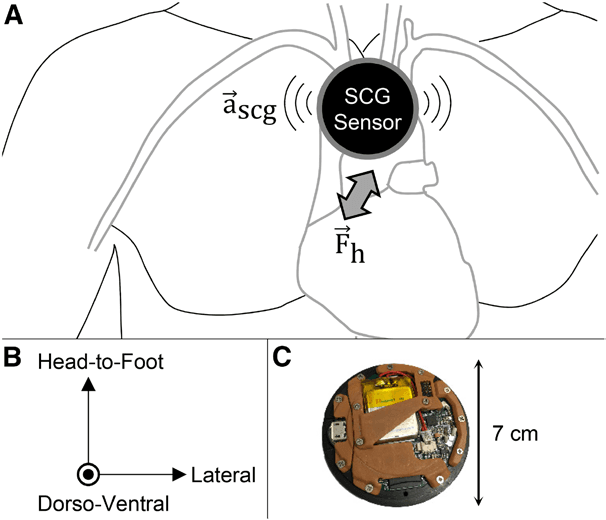
The study supports using wearable SCG sensors to assess the physiological 'cardiovascular reserve' of heart failure patients. It demonstrates that spectral changes in SCG after a submaximal exercise challenge (6MWT) can objectively distinguish between compensated (stable) and decompensated (worsening) HF states.
What it Does Not Support
The study does not support the use of SCG for heart failure diagnosis without an exercise challenge (at rest). It also does not yet provide a fully automated 'red-flag' system ready for consumer use without medical oversight.
🛠 Technical Context
- DOI: 10.1161/CIRCHEARTFAILURE.117.004313
- Authors: Omer T. Inan et al.
- Confidence Tier: Supporting