Back to Evidence Hub
Case Study S026
2018 Release

Lahdenoja 2018: AF Detection via Smartphone

Olli Lahdenoja et al.
Access Paper

Quick Conclusion: Established the technical feasibility of smartphone-only arrhythmia screening.


📊 Key Accuracy Metrics

MetricResult
Accuracy97.4%
Sensitivity93.8%
Specificity100%


🔍 Study Analysis

Objective & Population

Technical Development / Algorithm Validation. Cohort: 16 patients with AF, 14 controls in SR (N=30).

What it Supports

The study supports the use of multi-axial smartphone sensors to detect Atrial Fibrillation with 97%+ accuracy without external hardware.

What it Does Not Support

This study does not provide evidence for detection during activity.


🛠 Technical Context

Featured Illustration

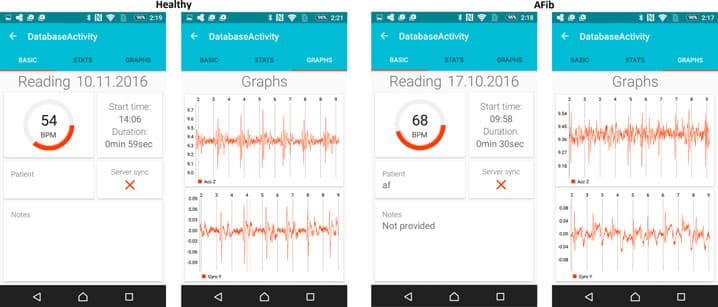
Fig. 6. Two screenshots from the AFib detection application running in Sony Xperia Z3. On the left a normal subject, and on the right an AFib subject. The data is shown only in (ACCZ and GYROY) axes. Before starting the measurement, the information of the user is filled in, and after the measurement the application informs the user whether he/she has AFib. The patient in this case suffered from chronic AFib, where the heart rate is made lower by medication and therefore the heart rate of the AFib patient is relatively low.

Fig. 6. Two screenshots from the AFib detection application running in Sony Xperia Z3. On the left a normal subject, and on the right an AFib subject. The data is shown only in (ACCZ and GYROY) axes. Before starting the measurement, the information of the user is filled in, and after the measurement the application informs the user whether he/she has AFib. The patient in this case suffered from chronic AFib, where the heart rate is made lower by medication and therefore the heart rate of the AFib patient is relatively low.

Study Snapshot

Metadata Summary

Target Population

16 patients with AF, 14 controls in SR

N

Sample Size

30 Subjects

Validated Metric

97.4%

Critical Appraisal
supporting

Proven feasibility of high-accuracy AF detection using consumer smartphone inertial sensors.