Back to Evidence Hub
Case Study S018
2018 Release

MODE-AF Study: Mobile Phone Detection of AF

Tero Koivisto et al.
Access Paper

Quick Conclusion: Validates the effectiveness of combined accelerometer and gyroscope data for heart rhythm screening without external hardware.


📊 Key Accuracy Metrics

MetricResult
Sensitivity95.3%
Specificity96.0%
Positive Predictive Value (PPV)96.0%
Negative Predictive Value (NPV)95.4%
Kappa coefficient0.913 (near-perfect agreement)


🔍 Study Analysis

Objective & Population

Case-control study. Cohort: 150 patients in AF, 150 age- and sex-matched controls in sinus rhythm (SR) (N=300).

What it Supports

Reports 95.3% sensitivity and 96.0% specificity for detecting Atrial Fibrillation via smartphone mechanocardiography.

What it Does Not Support

The study does not support the diagnosis of AF in patients with marked sinus arrhythmia or severe pulmonary edema without risk of false positives. It is not a replacement for a full 12-lead ECG for diagnostic confirmation.


🛠 Technical Context

Featured Illustration

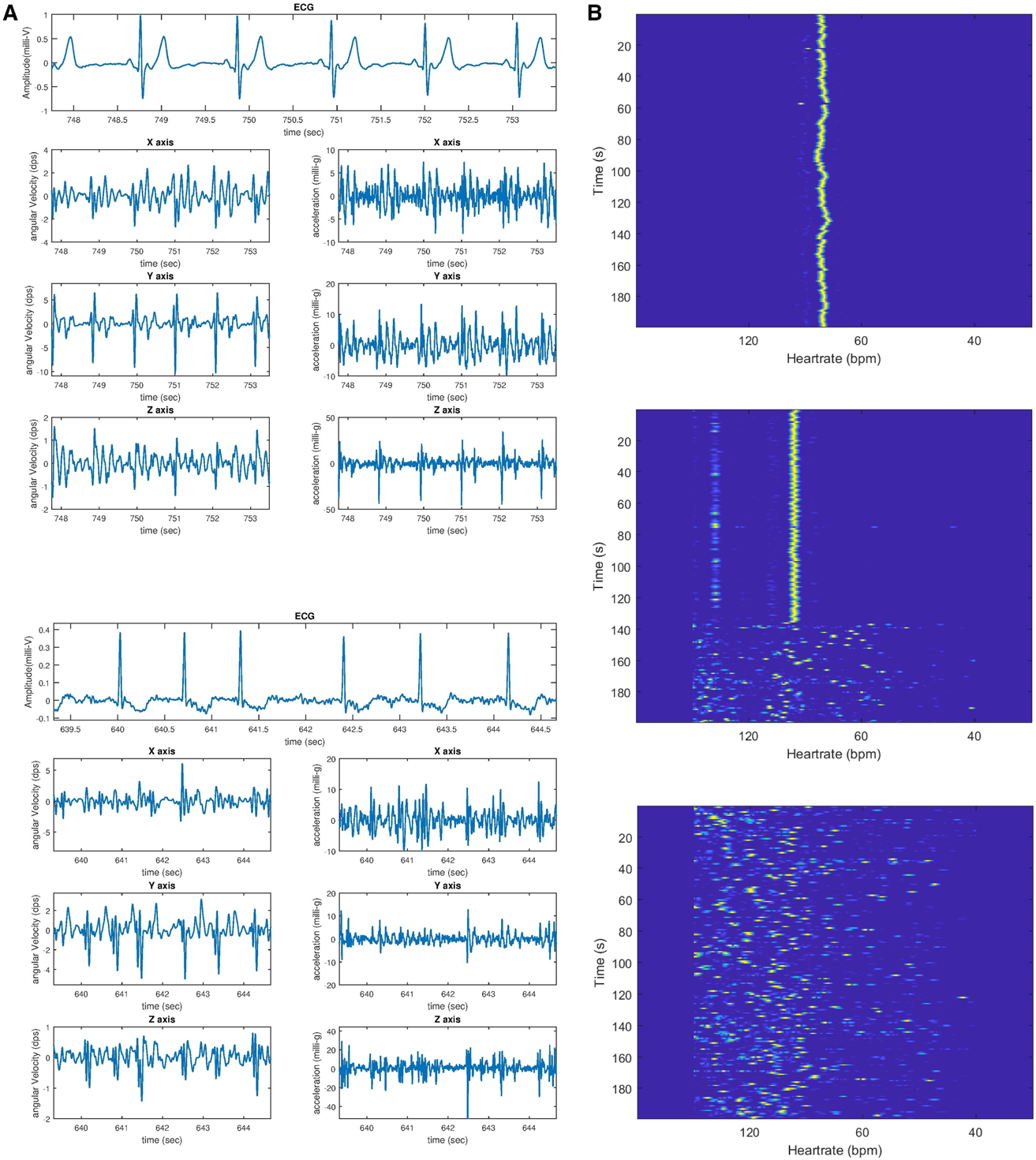
Figure. Visual presentation of mechanocardiography data.   A, Electrocardiographic, accelerometer, and gyroscope signals are presented in sinus rhythm (top) and atrial fibrillation (bot- tom). The corresponding heartbeats can be located in both the mechanical and the electrocardiographic signals during sinus  rhythm and atrial fibrillation. Because the different axes of the accelerometer and gyroscope signals appear to vary in quality,  our algorithm takes advantage of combining the information from various axes to provide a reliable estimate of the heart  rhythm. B, Mechanocardiography signal periodicity is represented visually in sinus rhythm (top), sinus rhythm converting to  atrial fibrillation (middle), and atrial fibrillation (bottom). The vertical axis represents time in seconds, and the horizontal axis  represents the instant period of the signal converted into beats per minute to denote heart rate. A continuous signal shape is  observed during a regular heart rhythm such as sinus rhythm (top), whereas a scattered pattern is observed during an irregular  rhythm such as atrial fibrillation (bottom). Middle, Sinus rhythm abruptly converts to atrial fibrillation at ≈140 seconds.

Figure. Visual presentation of mechanocardiography data. A, Electrocardiographic, accelerometer, and gyroscope signals are presented in sinus rhythm (top) and atrial fibrillation (bot- tom). The corresponding heartbeats can be located in both the mechanical and the electrocardiographic signals during sinus rhythm and atrial fibrillation. Because the different axes of the accelerometer and gyroscope signals appear to vary in quality, our algorithm takes advantage of combining the information from various axes to provide a reliable estimate of the heart rhythm. B, Mechanocardiography signal periodicity is represented visually in sinus rhythm (top), sinus rhythm converting to atrial fibrillation (middle), and atrial fibrillation (bottom). The vertical axis represents time in seconds, and the horizontal axis represents the instant period of the signal converted into beats per minute to denote heart rate. A continuous signal shape is observed during a regular heart rhythm such as sinus rhythm (top), whereas a scattered pattern is observed during an irregular rhythm such as atrial fibrillation (bottom). Middle, Sinus rhythm abruptly converts to atrial fibrillation at ≈140 seconds.

Study Snapshot

Metadata Summary

Target Population

150 patients in AF, 150 age- and sex-matched controls in sinus rhythm (SR)

N

Sample Size

300 Subjects

Validated Metric

95.3%

Critical Appraisal
cornerstone

Clinically validated smartphone-based screening for Atrial Fibrillation with near-perfect agreement to telemetry ECG.