Back to Evidence Hub
Case Study S030
2024 Release

Rahmani 2024: EmoWear Dataset

A. Rahmani et al.
Access Paper

Quick Conclusion: S030 (EmoWear) is a pioneer in 'Everyday SCG'. While most studies focus on medical diagnosis, EmoWear proves that SCG can capture subtle physiological changes related to human emotions and daily actions. This is key for OpenSCG’s vision of a holistic 'Health & Well-being' monitor that understands the user’s context.


📊 Key Accuracy Metrics

MetricResult
Total Data~70 hours of recordings
Sensors3x ST SensorTile.box, Zephyr BH3, Empatica E4
ActivitiesStationary video watching, walking, talking, drinking
SNR Range21.9 dB to 49.8 dB


🔍 Study Analysis

Objective & Population

Dataset Description / Multimodal Study. Cohort: 49 healthy adults (Age 21-45) (N=49).

What it Supports

The study supports the use of SCG for non-clinical applications such as emotion recognition and context-awareness. It provides a unique multimodal dataset (EmoWear) that allows for the validation of heart and breathing signals from IMUs against medical-grade reference sensors (ECG, BVP) during both rest and activity.

What it Does Not Support

This study does not provide clinical diagnostic tools for heart disease, as its focus is on affective computing (emotions) and general context-awareness.


🛠 Technical Context

Featured Illustration

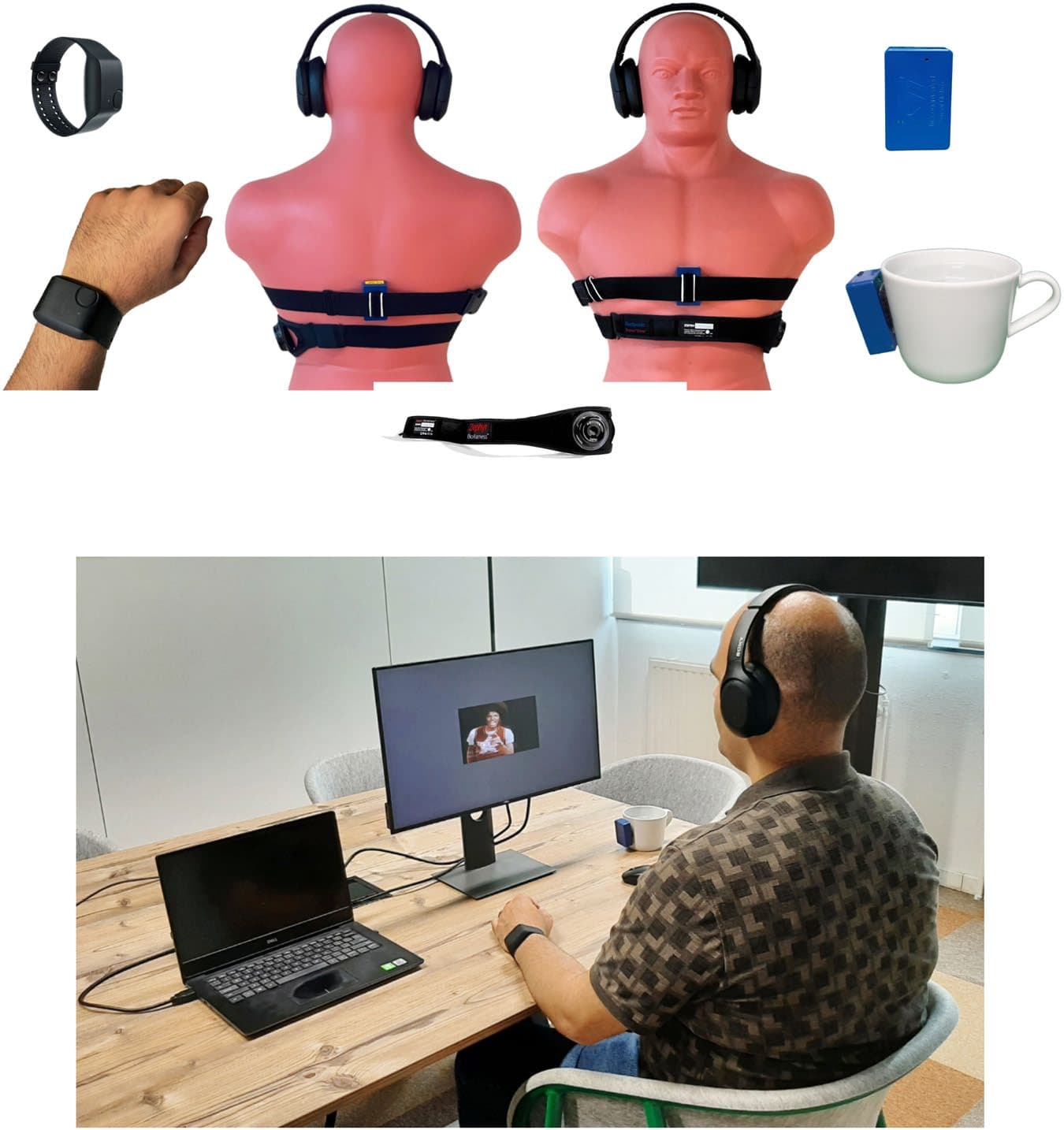
Fig. 1  (a) Sensor setup used in the dataset. Wearable hardware included: two ST SensorTile.boxes secured  with elastic strap, Zephyr BioHarness 3 strap worn on left body side, and Empatica E4 wristband, all having  contact with the body skin. An additional ST SensorTile.box was connected to a cup of water. Arrows indicate  the positive direction of the Cartesian coordinate system for each sensor, based on which acceleration data is  reported in the mat and csv packages. Reprinted with permission from IEEE55, slightly modified afterwards.  (b) An author demonstrates the complete experimental setup in action.

Fig. 1  (a) Sensor setup used in the dataset. Wearable hardware included: two ST SensorTile.boxes secured with elastic strap, Zephyr BioHarness 3 strap worn on left body side, and Empatica E4 wristband, all having contact with the body skin. An additional ST SensorTile.box was connected to a cup of water. Arrows indicate the positive direction of the Cartesian coordinate system for each sensor, based on which acceleration data is reported in the mat and csv packages. Reprinted with permission from IEEE55, slightly modified afterwards. (b) An author demonstrates the complete experimental setup in action.

Study Snapshot

Metadata Summary

Target Population

49 healthy adults (Age 21-45)

N

Sample Size

49 Subjects

Validated Metric

~70 hours of recordings

Critical Appraisal
supporting

Demonstrated the feasibility of using a single chest-worn IMU for concurrent emotion and context (gait, voice, drinking) sensing.