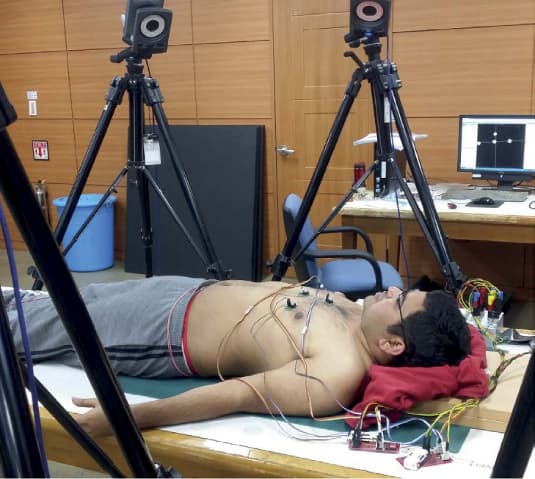
Quick Conclusion: S036 (Shafiq 2016) is a foundational paper for OpenSCG’s automated processing pipeline. By moving beyond lab-only supine measurements to seated trials and achieving millisecond-level precision, it validates the core algorithms needed for practical, non-invasive STI monitoring.
📊 Key Accuracy Metrics
| Metric | Result |
|---|---|
| AO Detection Error | Within ±2 ms for most cycles |
| AC Detection LoA (Supine) | 16.1 ms |
| AC Detection LoA (Seated) | 42.9 ms |
| Outliers (AO, Supine) | 0.37% |
🔍 Study Analysis
Objective & Population
Technical Development & Validation Study. Cohort: 7 healthy subjects (Age 28.7 ± 1.89) (N=7).
What it Supports
The study supports the use of sliding-template ensemble averaging to automatically identify systolic time intervals (STI) from SCG signals. It demonstrates that automated annotation is robust even in seated positions, which are more realistic for everyday wearable use than the traditional supine position.
What it Does Not Support
The study does not provide high-level clinical validation across a large or pathological population. It also does not prove reliability during active movement, but rather in a relatively static seated position.
🛠 Technical Context
- DOI: 10.1038/srep37524
- Authors: Ghufran Shafiq et al.
- Confidence Tier: Supporting