Back to Evidence Hub
Case Study S010
2025 Release

Wang 2025: Cardiac Output Prediction

T. Wang et al.
Access Paper

Quick Conclusion: S010 represents a major technical leap for SCG by moving from simple timing estimation to direct Cardiac Output prediction using Deep Learning. Validating against the gold standard RHC in a real-world heart failure cohort makes this a key supporting document for OpenSCG’s clinical monitoring claims.


📊 Key Accuracy Metrics

MetricResult
CO Bias (CO < 6 L/min)0.01 L/min
CO LoA (CO < 6 L/min)0.88 to 0.87 L/min
CI Bias (CI < 2.2 L/min/m2)0.07 L/min/m2
CI LoA (CI < 2.2 L/min/m2)0.35 to 0.48 L/min/m2
RMSE%22% for CO, 20% for CI


🔍 Study Analysis

Objective & Population

Retrospective / Deep Learning Development & Validation. Cohort: Heart failure patients (NYHA class II-IV, predominantly HFrEF) (N=73).

What it Supports

The study supports the use of Deep Learning and triaxial SCG (combined with ECG and BMI) to non-invasively estimate Cardiac Output in adult heart failure patients. It is particularly effective in low-output states (CO < 6 L/min), which are of high clinical concern.

What it Does Not Support

The study does not support high-accuracy monitoring in subjects with high cardiac output (>= 6 L/min). It is not yet validated for independent clinical diagnostic use without invasive catheterization as a baseline in diverse clinical settings.


🛠 Technical Context

Featured Illustration

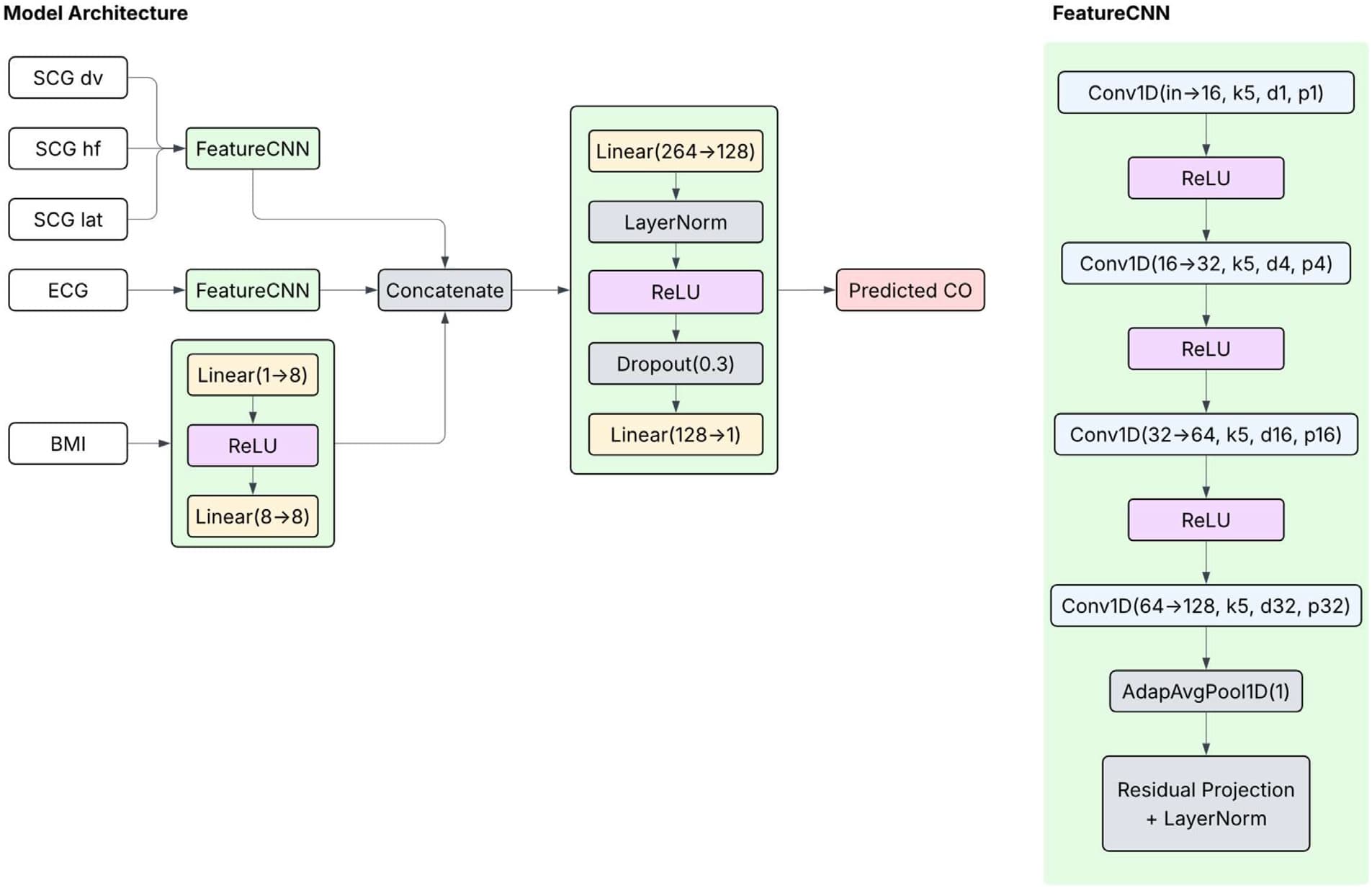
Figure 2. Schematic overview of the deep learning model for CO prediction. Tri-axial SCG and single-lead ECG serve as inputs to parallel convolutional subnetworks (FeatureCNN). A linear layer refers to a fully connected layer that maps a specified number of inputs to a specified number of output units. Dropout, with a given probability p, randomly sets a pro- portion of activations to zero during training to limit overfitting. A 1D convolutional layer (Conv1D) applies a set number of filters of specified kernel size along the temporal axis, with configurable dilation and padding settings to control the receptive field and output size. Adaptive average pooling (AdapAvgPool1D) performs averaging over the temporal axis to produce a fixed-length output, regardless of the input size. BMI = body mass index; CO = cardiac output; ECG = electrocardiogram; SCG = seismocardiogram.

Figure 2. Schematic overview of the deep learning model for CO prediction. Tri-axial SCG and single-lead ECG serve as inputs to parallel convolutional subnetworks (FeatureCNN). A linear layer refers to a fully connected layer that maps a specified number of inputs to a specified number of output units. Dropout, with a given probability p, randomly sets a pro- portion of activations to zero during training to limit overfitting. A 1D convolutional layer (Conv1D) applies a set number of filters of specified kernel size along the temporal axis, with configurable dilation and padding settings to control the receptive field and output size. Adaptive average pooling (AdapAvgPool1D) performs averaging over the temporal axis to produce a fixed-length output, regardless of the input size. BMI = body mass index; CO = cardiac output; ECG = electrocardiogram; SCG = seismocardiogram.

Study Snapshot

Metadata Summary

Target Population

Heart failure patients (NYHA class II-IV, predominantly HFrEF)

N

Sample Size

73 Subjects

Validated Metric

0.01 L/min

Critical Appraisal
supporting

Demonstrated feasibility of non-invasive Cardiac Output estimation in heart failure patients using Deep Learning on SCG/ECG signals.