Back to Evidence Hub
Case Study S024
2022 Release

Zia 2022: Quality Indexing and Classification

Jonathan Zia et al.
Access Paper

Quick Conclusion: Provides the technical foundation for robust signal quality control in mobile SCG monitoring.


šŸ“Š Key Accuracy Metrics

MetricResult
Classification Accuracy91.8%
Correlation (Quality Index)r=0.89


šŸ” Study Analysis

Objective & Population

Technical Development / Algorithm Validation. Cohort: 20 healthy subjects (N=20).

What it Supports

The study supports the use of automated quality indexing to filter out noisy SCG data, ensuring that only high-quality signals are used for clinical interpretation.

What it Does Not Support

The study does not support the use of low-quality signals for diagnosis without filtering.


šŸ›  Technical Context

Featured Illustration

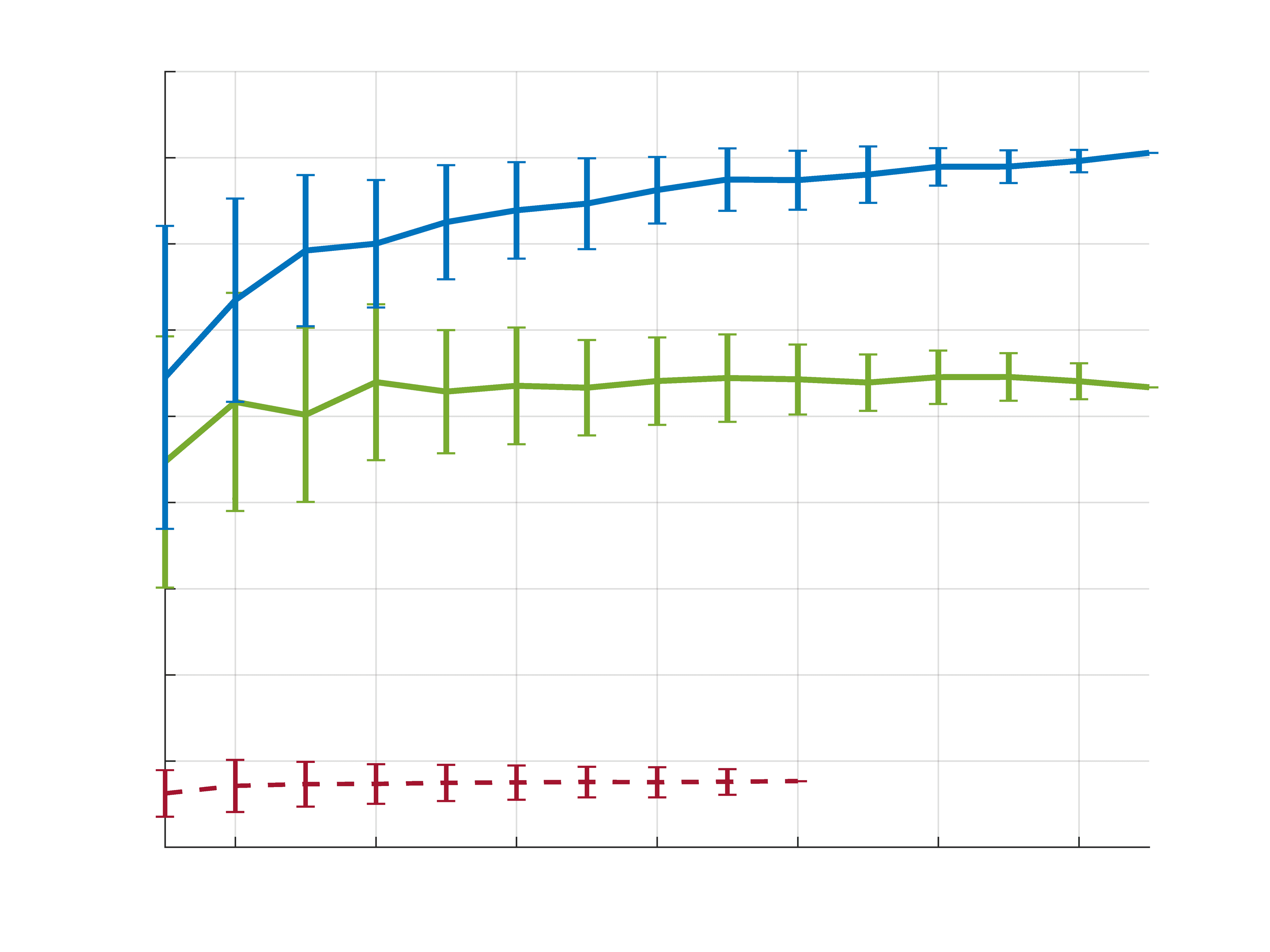
Figure 5(b)-(d) show the relationship between DTFM-based SQI scores and those from visual manual annotation. Positive linear relationships are apparent at all activity levels, though this correlation is somewhat lower during walking. The results of this figure suggest that the heuristics by which human annotators scored the signal — including relative quality of features related to AO and AC — were reflected by the DTFM- based SQI. This follows intuition: since AO and AC generally yield high-energy features in the signal, distance minimization algorithms would incur a large penalty if these features were not identified and matched between the signal and template. The ability of the different quality indexing methods to distinguish signals from different activity levels is shown in Figure 6(a). As shown in the figure, DTFM more effectively stratifies SCG segments taken during different activity levels based on their SQI compared to DTW. This is especially apparent between the rest and recovery periods, which DTW ranks as higher quality, in opposition to the visual scoring gold-standard. For this reason, the DTFM-based SQI produces a stratification that is more congruent with visual scoring. These results are reflected in Figure 6(b). Notably, all scoring methods produce test statistics which are relatively high compared to the chi-square critical value of 7.82 for 3 degrees of freedom. Since the relative value of the test statistic is due to differences in variance and not necessarily the validity of the scores assigned by each method, Figure 6(b) does not suggest that one method is better than the other. Rather, the result of interest is that, for DTFM-based SQI, increasing the number of reference templates or annotators increases score stratification. This suggests that, though there is no reference standard SCG, there are patterns on the population level which may be synthesized to effectively assess a signal. Furthermore, the relative separation when using DTFM increases compared to DTW as more templates are used, indicating that the addition of templates has a greater marginal benefit for DTFM.

Figure 5(b)-(d) show the relationship between DTFM-based SQI scores and those from visual manual annotation. Positive linear relationships are apparent at all activity levels, though this correlation is somewhat lower during walking. The results of this figure suggest that the heuristics by which human annotators scored the signal — including relative quality of features related to AO and AC — were reflected by the DTFM- based SQI. This follows intuition: since AO and AC generally yield high-energy features in the signal, distance minimization algorithms would incur a large penalty if these features were not identified and matched between the signal and template. The ability of the different quality indexing methods to distinguish signals from different activity levels is shown in Figure 6(a). As shown in the figure, DTFM more effectively stratifies SCG segments taken during different activity levels based on their SQI compared to DTW. This is especially apparent between the rest and recovery periods, which DTW ranks as higher quality, in opposition to the visual scoring gold-standard. For this reason, the DTFM-based SQI produces a stratification that is more congruent with visual scoring. These results are reflected in Figure 6(b). Notably, all scoring methods produce test statistics which are relatively high compared to the chi-square critical value of 7.82 for 3 degrees of freedom. Since the relative value of the test statistic is due to differences in variance and not necessarily the validity of the scores assigned by each method, Figure 6(b) does not suggest that one method is better than the other. Rather, the result of interest is that, for DTFM-based SQI, increasing the number of reference templates or annotators increases score stratification. This suggests that, though there is no reference standard SCG, there are patterns on the population level which may be synthesized to effectively assess a signal. Furthermore, the relative separation when using DTFM increases compared to DTW as more templates are used, indicating that the addition of templates has a greater marginal benefit for DTFM.

Study Snapshot

Metadata Summary

Target Population

20 healthy subjects

N

Sample Size

20 Subjects

Validated Metric

91.8%

Critical Appraisal
supporting

ā€œValidated a unified framework for SCG signal quality assessment, critical for reliable monitoring.ā€