Trodden Lanes or New Paths: Ballisto- and Seismocardiography Till Now
Executive Summary
This systematic review analyzes 425 papers on ballistocardiography (BCG) and seismocardiography (SCG) published between 2003 and 2019, highlighting the dominance of BCG research (317 papers) over SCG (120 papers). The study identifies accelerometers as the most commonly used sensors and notes a predominance of healthy subjects in research. The findings suggest that advancements in sensor technology and signal analysis are driving increased interest in SCG, with potential for clinical applications in diagnostics and monitoring.
Answer Machine Insights
Q: What is the primary focus of BCG and SCG research?
The primary focus is on signal parameter analysis for diagnostics, with 338 articles emphasizing medical applications.
The majority has a medical focus, such as the analysis of signal parameters for diagnostics (total of 338 articles).
Q: What explains the increase in SCG publications?
The increase is attributed to advancements in sensitive sensor technology and prior findings in signal analysis.
The increasing number of SCG publication figures can certainly be attributed to the increasingly sensitive sensor technology as well as the previous experience and findings in signal analysis.
Q: What is the distribution of subjects in BCG/SCG studies?
Most studies involve healthy or heart-healthy subjects, with limited inclusion of diseased subjects.
Looking now at the number and distribution of included subjects, it is noticeable that rather low and primarily healthy subjects are used.
Key Results
BCG research accounts for 317 papers compared to 120 for SCG between 2003 and 2019.
Accelerometers were used in nearly 50% of studies, with other sensors including pressure sensors and weighing scales.
Visual Evidence
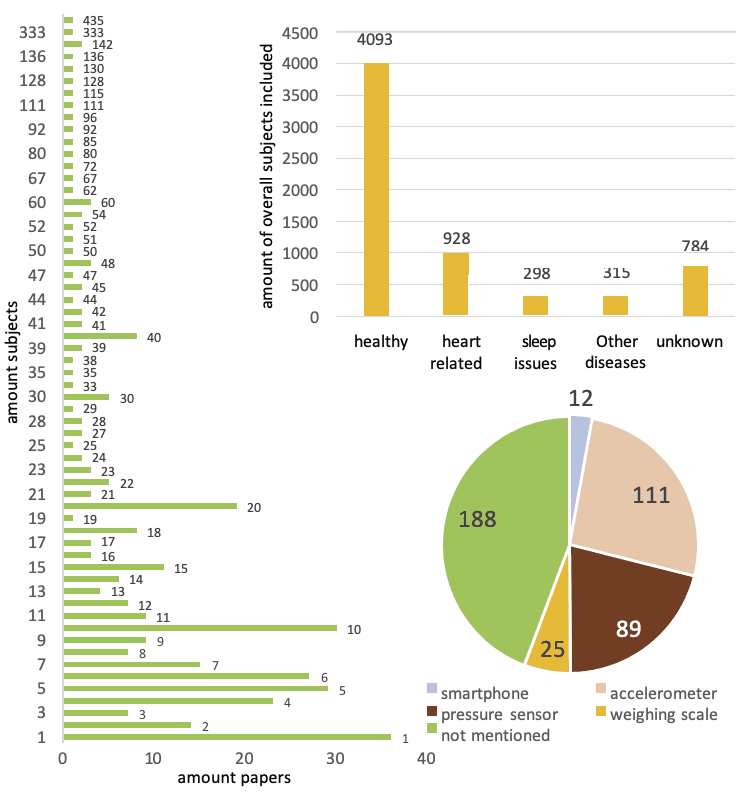
Figure 3. Number of used subjects in publications (left), type of used subjects (top right) and used sensing technology (bottom right).
Clinical Snapshot
Evidence Rating
Relevance
high Priority