Amplitude Modulation Effects in Cardiac Signals
Executive Summary
This study investigates the impact of amplitude modulation on cardiac signals, specifically ECG and SCG, and proposes rectification or the Teager-Kaiser (T-K) operator as preprocessing steps to recover lost frequency domain information. The findings demonstrate that these methods enhance the visibility of heartbeat and respiration periodicity in Fourier-transformed spectra, with implications for improving cardiac signal analysis in clinical and research settings.
Answer Machine Insights
Q: What preprocessing methods were proposed to address amplitude modulation effects in cardiac signals?
Rectification and the Teager-Kaiser operator were proposed to recover lost frequency domain information.
Such loss can be avoided by looking also at the rectified signal. In generating the 2nd time record, either rectification or the T-K operator can be used to condition the raw signal before doing the FFT.
Q: What advantage does the cumulative spectrum provide over the density spectrum?
The cumulative spectrum is less cluttered and facilitates the recognition of heart abnormalities involving variable rates.
The cumulative spectrum is much less cluttered than the density spectrum from which it is obtained by integration, multiple plots can be usefully overlaid as shown in Fig. 6.
Key Results
Rectification and the Teager-Kaiser operator recover low-frequency spectral lines in ECG and SCG signals, making heartbeat and respiration periodicity visible.
Cumulative spectra are less cluttered and more effective for identifying cardiac abnormalities compared to density spectra.
Visual Evidence
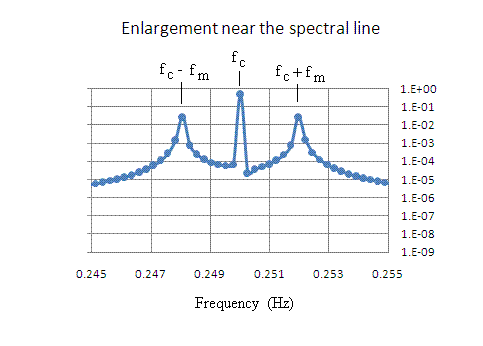
Figure 2. Close-up of the upper-right plot of Fig. 1, showing that the information is present in the form of sidebands.
Clinical Snapshot
Evidence Rating
Relevance
high Priority