Back to Evidence Hub
Case Study a-novel-adaptive-recursive-least-squares-filter-to-remove-the-motion-artifact-in-seismocardiography
2020 Release

A Novel Adaptive Recursive Least Squares Filter to Remove the Motion Artifact in Seismocardiography

Executive Summary

This study introduces a novel adaptive recursive least squares filter (ARLSF) for motion artifact removal in seismocardiography (SCG) signals, utilizing a single consumer-grade accelerometer. Tested on 16 subjects during standing and walking conditions, the ARLSF achieved a heartbeat detection accuracy of 98% and demonstrated strong agreement between SCG-derived and ECG-derived heart rates. The method shows promise for improving SCG signal clarity without additional processing, paving the way for wearable applications in dynamic environments.

This study developed a new method to clean heart vibration signals from motion noise, achieving 98% accuracy in detecting heartbeats during walking and standing, using a single wearable sensor.

Answer Machine Insights

Q: What is the accuracy of heartbeat detection using ARLSF?

The heartbeat detection accuracy using ARLSF was up to 98%.

The heartbeat detection accuracy was up to 98% and heart rates estimated from the SCG and ECG matched well under both the standing and walking conditions.

Q: How does the heart rate estimated from SCG compare to ECG?

The heart rates estimated from SCG and ECG matched very well, with a mean difference of 0.08 bpm and a standard deviation of 2.08 bpm.

The detailed difference between the heart rates from ECG and SCG with a mean value of 0.08 bpm and a standard deviation value of 2.08 bpm is plotted in Figure 12.

Key Results

  • Heartbeat detection accuracy of 98% achieved using ARLSF.

  • Heart rate differences between SCG and ECG had a mean of 0.08 bpm and a standard deviation of 2.08 bpm.

Visual Evidence
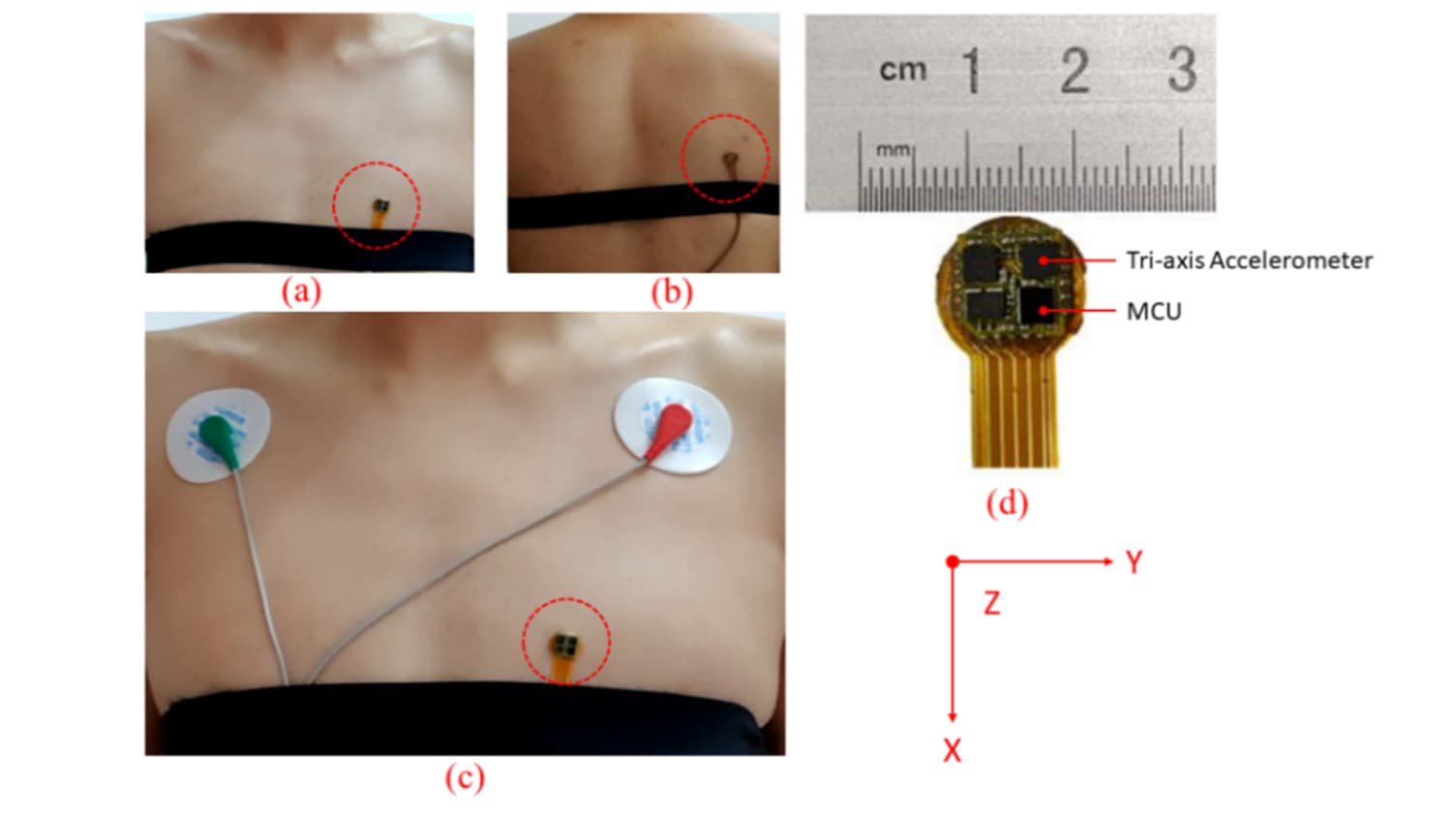
Figure 3. (a,b) Seismocardiography (SCG) recorder system placement for measuring heartbeat signal and motion signals, respectively. (c) A pair of electrocardiogram (ECG) lead I electrodes placement and SCG recorder system placement. (d) An image of the SCG recorder system which shows the dimensions. X-axis, y-axis and z-axis describe the head to foot, shoulder to shoulder and dorsoventral direction, respectively.

Figure 3. (a,b) Seismocardiography (SCG) recorder system placement for measuring heartbeat signal and motion signals, respectively. (c) A pair of electrocardiogram (ECG) lead I electrodes placement and SCG recorder system placement. (d) An image of the SCG recorder system which shows the dimensions. X-axis, y-axis and z-axis describe the head to foot, shoulder to shoulder and dorsoventral direction, respectively.

Clinical Snapshot

Evidence Rating

Relevance

high Priority

Confidence

Supporting

Relativity Score

4/5
Rigor
4/5
Novelty
5/5
Impact

Semantic Graph Connections

Similar Methodology

Heart Beat Detection from Smartphone SCG Signals: Comparison with Previous Study on HR Estimation

Similar Methodology

Heart Rate Variability Analysis on Reference Heart Beats and Detected Heart Beats of Smartphone Seismocardiograms

Similar Methodology

Autonomic function testing aboard the ISS using “PNEUMOCARD”

Similar Methodology

A seismocardiography system and a possibility of its use for diagnosis of internal organs diseases using seismocardiogram information analysis

Similar Methodology

Validity and reliability of a clinical non-exercise method for assessment of cardiorespiratory fitness using seismocardiography

Similar Methodology

Heart Rate and Respiratory Rate Monitoring Using Seismocardiography

Similar Methodology

Beat-to-beat estimation of LVET and QS2 indices of cardiac mechanics from wearable seismocardiography in ambulant subjects

Similar Methodology

A Wavelet-Based Approach for Motion Artifact Reduction in Ambulatory Seismocardiography

Similar Methodology

A Hidden Markov Model for Seismocardiography

Similar Methodology

High-Accuracy, Unsupervised Annotation of Seismocardiogram Traces for Heart Rate Monitoring

Similar Methodology

A new algorithm for segmentation of cardiac quiescent phases and cardiac time intervals using seismocardiography

Similar Methodology

BCG Artifact Removal Using Improved Independent Component Analysis Approach

Similar Methodology

Enhancing visual seismocardiography in noisy environments with adaptive bidirectional filtering for Cardiac Health Monitoring

Similar Methodology

Multi-site cardiac rhythm monitoring via multi-channel SCG system and exercise-induced physiological analysis

Similar Methodology

A Comparison of Heart Pulsations Provided by Forcecardiography and Double Integration of Seismocardiogram

Similar Methodology

ECG-Free Heartbeat Detection in Seismocardiography Signals via Template Matching

Similar Methodology

Comparison of Seismocardiography Based Heart Rate Measurement Method

Similar Methodology

Amplitude Modulation Effects in Cardiac Signals

Similar Methodology

ECG-Free Assessment of Cardiac Valve Events Using Seismocardiography