Deep Learning Predicts Cardiac Output from Seismocardiographic Signals in Heart Failure
Executive Summary
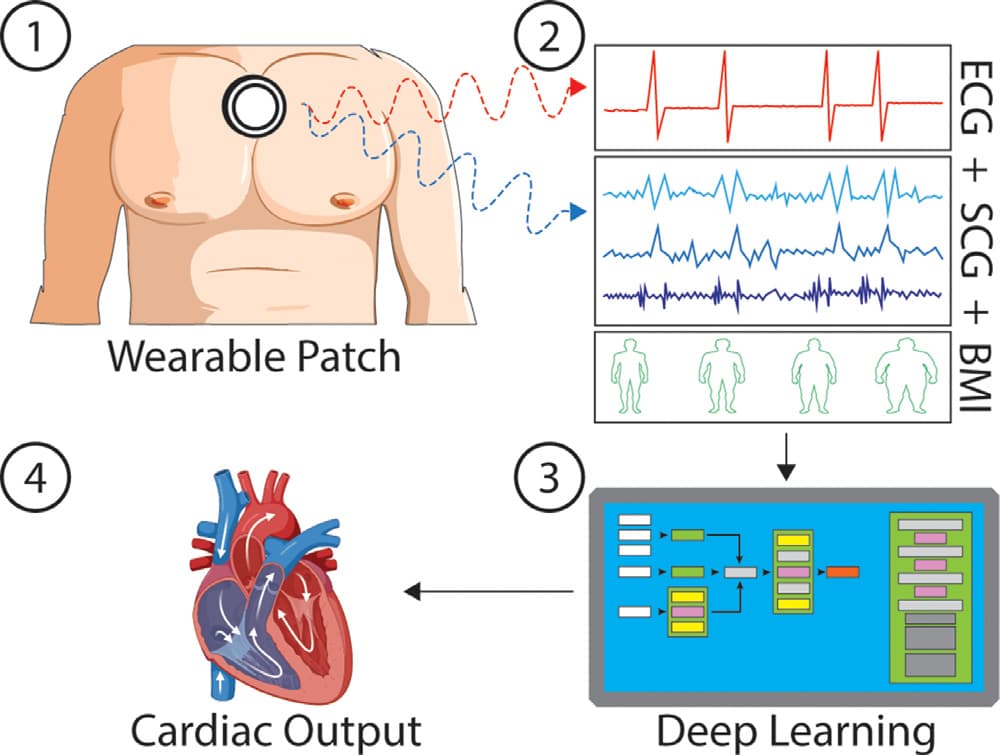
This study developed a deep learning model to estimate cardiac output (CO) using seismocardiography (SCG), electrocardiogram (ECG), and body mass index (BMI) in heart failure patients undergoing right heart catheterization (RHC). The model demonstrated strong performance, particularly in low-output states, achieving a mean bias of -0.01 L/min with limits of agreement (LoA) from -0.88 to 0.87 L/min for CO < 6 L/min. These findings suggest SCG-based monitoring could provide a scalable, non-invasive alternative to invasive hemodynamic evaluation, with potential applications in resource-limited settings.
Answer Machine Insights
Q: How accurate is the model in predicting cardiac output for low-output states?
The model achieved a mean bias of -0.01 L/min with limits of agreement from -0.88 to 0.87 L/min for CO < 6 L/min.
When estimating CO in patients with a reference output < 6 L/min, the deep learning model achieved a mean bias of -0.01 L/min with LoA from -0.88 to 0.87 L/min.
Q: What is the clinical significance of SCG-based CO estimation?
SCG-based monitoring offers a non-invasive, scalable alternative for hemodynamic assessment, particularly in settings where invasive monitoring is impractical.
These findings highlight the potential of SCG-based monitoring to augment clinical decision-making in settings where invasive measurements are impractical or unavailable.
Key Results
Mean bias of -0.01 L/min with LoA from -0.88 to 0.87 L/min for CO < 6 L/min.
Pearson correlation coefficient (PCC) of 0.80 for CO < 6 L/min, indicating strong agreement with RHC-derived values.
Visual Evidence
Clinical Snapshot
Evidence Rating
Relevance
high Priority