Driver Cardiovascular Disease Detection Using Seismocardiogram
Executive Summary
This study explores the use of seismocardiogram (SCG) signals for non-invasive cardiovascular monitoring in drivers, utilizing accelerometers integrated into safety belts. The methodology involves adaptive digital filtering to process SCG signals in noisy environments, achieving heart rate estimation despite significant noise (SNR = -11.32 dB). The findings demonstrate the feasibility of detecting aortic valve opening peaks and calculating heart rate, with implications for integrating SCG-based health monitoring into automotive safety systems.
Answer Machine Insights
Q: What is the main innovation of the proposed system?
The integration of SCG sensors into a driver's safety belt for non-invasive cardiovascular monitoring.
The novelty of this article reflects a not yet examined location of the SCG sensor when the MEMS is integrated into the driver’s safety belt for measuring the cardio mechanical vibrations.
Q: How effective was the adaptive filtering in processing SCG signals?
The fourth adaptive filter achieved heart rate estimation despite significant noise, with an SNR of -11.32 dB and RMSE of 0.1942 m/s².
As a result, the fourth adaptive filter obtained an estimated HR = 65 beats per min (bpm) in a still-noisy signal (SNR = −11.32 dB).
Key Results
Heart rate estimated at 65 bpm in a noisy signal environment (SNR = -11.32 dB).
Root mean square error (RMSE) of 0.1942 m/s² achieved with adaptive filtering.
Visual Evidence
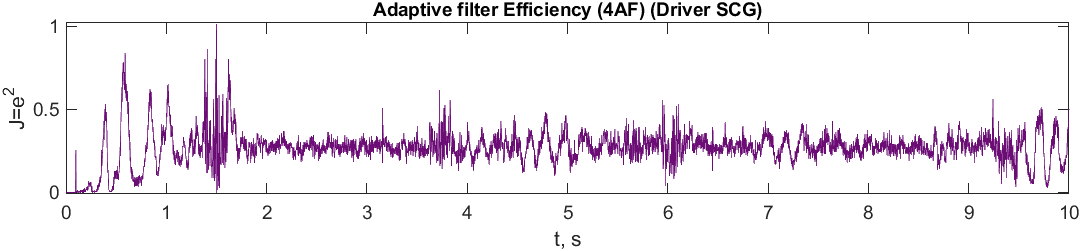
Figure 6. The fourth adaptive filter. (a) Adaptation error of the fourth adaptive filter. (b) The fourth adaptively filtrated signal. (c) Adaptation efficiency.
Clinical Snapshot
Evidence Rating
Relevance
high Priority