Back to Evidence Hub
Case Study a-wavelet-based-approach-for-motion-artifact-reduction-in-ambulatory-seismocardiography
2024 Release

A Wavelet-Based Approach for Motion Artifact Reduction in Ambulatory Seismocardiography

Executive Summary

This study introduces a novel algorithm combining Maximum Overlap Discrete Wavelet Transform (MODWT), time-frequency masking, and nonnegative matrix factorization (NMF) to mitigate motion artifacts in seismocardiography (SCG) signals during ambulatory scenarios. The algorithm demonstrated significant improvements in heart rate estimation accuracy, achieving an R-squared of 0.8 at -15 dB signal-to-noise ratio (SNR), and extended SCG's usability without reliance on electrocardiography (ECG). These advancements enhance SCG's potential for wearable cardiac monitoring in real-world and clinical settings.

This study developed a method to clean heart vibration signals for wearable devices, making them more accurate even during walking, without needing extra sensors like ECG. This could improve heart monitoring in daily life and hospitals.

Answer Machine Insights

Q: What is the primary advantage of the proposed algorithm?

The algorithm significantly reduces motion artifacts in SCG signals, enabling accurate heart rate estimation without relying on ECG.

Our method reduces motion artifacts in SCG signals up to a SNR of −19 dB without requiring any external assistance from electrocardiography (ECG).

Q: How does the algorithm perform under high noise conditions?

The algorithm improves heart rate estimation accuracy up to -19 dB SNR but struggles at full-strength noise levels (-27 dB SNR).

At −15 dB, we observed a noteworthy improvement in HR r2, elevating it from less than 0.1 to above 0.8. However, at −27 dB, the method only marginally increased the r2 from 0 to about 0.1.

Key Results

  • MODWT achieved the highest signal reconstruction accuracy with an R-squared of 0.42 at -20.9 dB SNR.

  • Heart rate estimation improved from an R-squared of 0.1 to 0.8 at -15 dB SNR using the proposed algorithm.

Visual Evidence
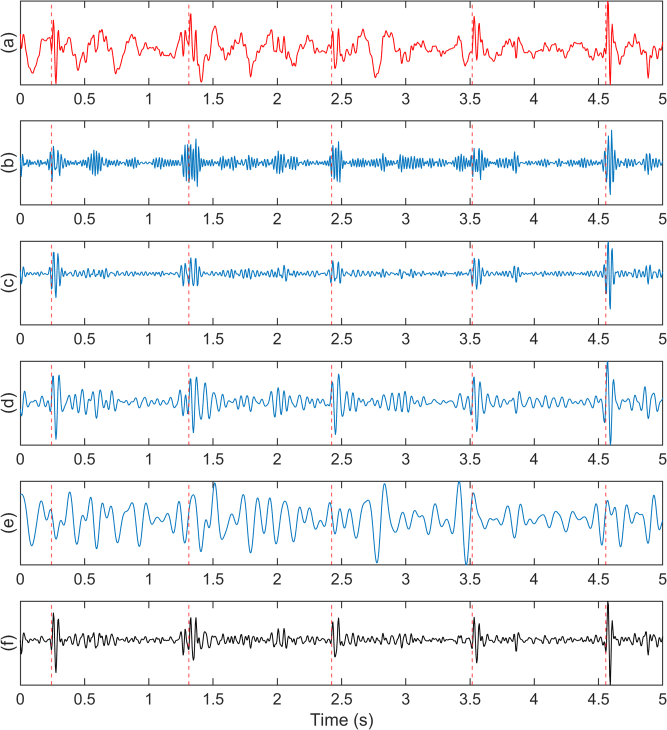
Fig. 2. MODWT decomposition showing (a) input signal, (b) first sub- band, (c) second sub-band, (d) third sub-band, (e) fourth sub-band, and (f)  reconstructed signal from first three sub-bands. ECG R-Peaks shown in red  dashed lines.

Fig. 2. MODWT decomposition showing (a) input signal, (b) first sub- band, (c) second sub-band, (d) third sub-band, (e) fourth sub-band, and (f) reconstructed signal from first three sub-bands. ECG R-Peaks shown in red dashed lines.

Clinical Snapshot

Evidence Rating

Relevance

high Priority

Confidence

Supporting

Relativity Score

4/5
Rigor
4/5
Novelty
5/5
Impact

Semantic Graph Connections

Similar Methodology

Heart Beat Detection from Smartphone SCG Signals: Comparison with Previous Study on HR Estimation

Similar Methodology

Monitoring of respiration and cardiorespiratory interactions from multichannel seismocardiography signals

Similar Methodology

Accurate and consistent automatic seismocardiogram annotation without concurrent ECG

Similar Methodology

Motion artifact cancellation from a single channel SCG using adaptive forgetting factor recursive least square filter

Similar Methodology

Heart Rate and Respiratory Rate Monitoring Using Seismocardiography

Similar Methodology

Beat-to-beat estimation of LVET and QS2 indices of cardiac mechanics from wearable seismocardiography in ambulant subjects

Similar Methodology

Universal Pre-Ejection Period Estimation Using Seismocardiography: Quantifying the Effects of Sensor Placement and Regression Algorithms

Similar Methodology

A Hidden Markov Model for Seismocardiography

Similar Methodology

High-Accuracy, Unsupervised Annotation of Seismocardiogram Traces for Heart Rate Monitoring

Similar Methodology

Enhancing visual seismocardiography in noisy environments with adaptive bidirectional filtering for Cardiac Health Monitoring

Similar Methodology

Visualization of the Multichannel Seismocardiogram

Similar Methodology

Revolutionizing smartphone gyrocardiography for heart rate monitoring: overcoming clinical validation hurdles

Similar Methodology

Driver Cardiovascular Disease Detection Using Seismocardiogram

Similar Methodology

A Cardiac Early Warning System with Multi Channel SCG and ECG Monitoring for Mobile Health

Similar Methodology

A Novel Adaptive Recursive Least Squares Filter to Remove the Motion Artifact in Seismocardiography

Similar Methodology

Comparison of Seismocardiography Based Heart Rate Measurement Method

Similar Methodology

LubDubDecoder: Bringing Micro-Mechanical Cardiac Monitoring to Hearables

Similar Methodology

SCG With Your Phone: Diagnosis of Rhythmic Spectrum Disorders in Field Conditions