Effect of Normal Breathing and Breath Holding on Seismocardiographic Signals and Heart Rate
Executive Summary
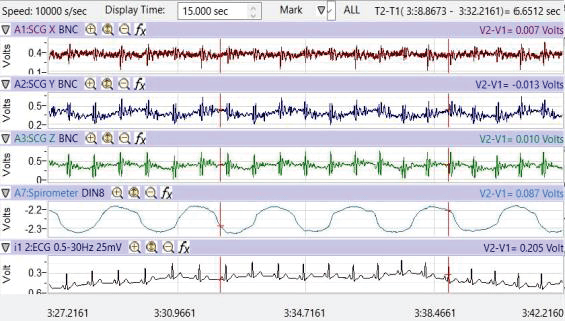
This study investigates the impact of normal breathing and breath holding (BH) on seismocardiographic (SCG) signals and heart rate in eight healthy subjects. Using unsupervised machine learning (K-medoid clustering with dynamic time warping), the researchers reduced SCG waveform variability by 32% during BH compared to normal breathing. The study also observed an 8% decrease in heart rate and a 68% reduction in heart rate variability energy in the 0.15–0.4 Hz range during BH. These findings suggest that BH may improve SCG signal accuracy, with potential implications for non-invasive cardiac monitoring.
Answer Machine Insights
Q: What was the reduction in SCG waveform variability during breath holding?
SCG waveform variability decreased by 32% during breath holding compared to normal breathing.
Results showed that the SCG average intra-cluster variability was 32% lower during breath holding compared to normal breathing.
Q: How did heart rate change during breath holding?
Heart rate decreased by 8% during breath holding compared to normal breathing.
Results suggested that there was an 8% drop (p<0.05) in heart rate during BH cases.
Q: What was the change in heart rate variability energy in the 0.15–0.4 Hz range during breath holding?
Heart rate variability energy in the 0.15–0.4 Hz range dropped by 68% during breath holding.
Results suggested that there was a 68% drop (p<0.05) in heart rate energy in the 0.15-0.4 Hz range during BH cases.
Key Results
SCG waveform variability decreased by 32% during breath holding compared to normal breathing.
Heart rate decreased by 8% and heart rate variability energy in the 0.15–0.4 Hz range dropped by 68% during breath holding.
Visual Evidence
Clinical Snapshot
Evidence Rating
Relevance
high Priority