Back to Evidence Hub
Case Study robustness-of-persistence-diagrams-to-time-delay-for-seismocardiogram-signal-quality-assessment
2025 Release

Robustness of Persistence Diagrams to Time-Delay for Seismocardiogram Signal Quality Assessment*

Executive Summary

This study evaluates the robustness of topological data analysis (TDA) using persistence diagrams for SCG signal quality assessment under time-delay conditions. It compares TDA with dynamic time feature matching (DTFM) and demonstrates that TDA significantly outperforms DTFM in ranking SCG beats by signal-to-noise ratio (SNR) when beats are segmented earlier than ECG R-peak locations. These findings highlight the potential of TDA for ECG-free SCG signal quality analysis, enabling longitudinal cardiac monitoring in ambulatory and critical care settings.

This study shows that a new method using persistence diagrams can assess heart vibration signal quality without needing ECG, making it more reliable for wearable heart monitors in noisy environments.

Answer Machine Insights

Q: How does TDA perform compared to DTFM under time-delay conditions?

TDA significantly outperforms DTFM in ranking SCG beats by SNR under time-delay conditions.

For all shifted cases (100, 200, and 300 ms), p<0.001 and post-hoc analyses showed significant differences between all pairs of models.

Q: What is the practical advantage of TDA for SCG signal quality assessment?

TDA does not require fine-tuning of hyperparameters, making it more user-friendly and robust for ECG-free SCG signal quality analysis.

TDA does not require fine-tuning thus decreasing the burden on the user.

Key Results

  • TDA maintained a mean Kendall's Tau value above 0.94 across all time-delay conditions, demonstrating robust ranking performance.

  • DTFM performance dropped significantly under time-delay conditions, with Kendall's Tau values becoming negative for DTFMD and diminishing to 0-0.4 for DTFMS.

Visual Evidence
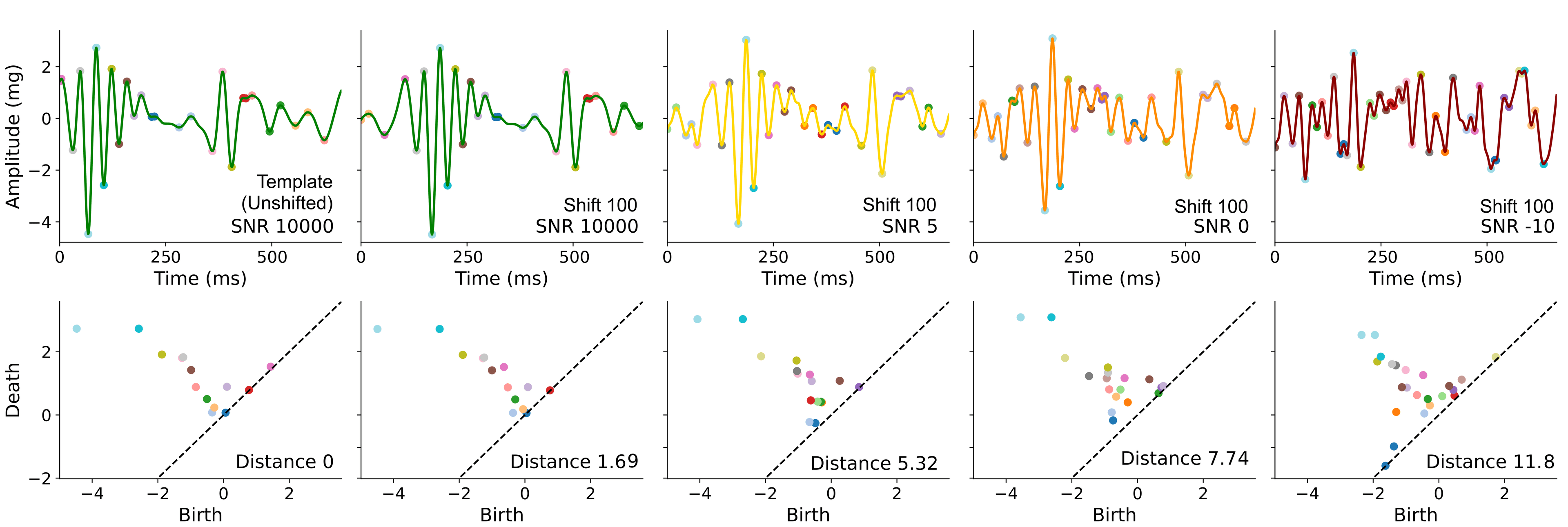
Fig. 2. Example seismocardiogram beat traces and corresponding persistence diagrams (PDs): We extracted PDs for the unshifted template beat and beats containing varying levels of added synthetic noise at multiple shift amounts. Beats of four SNR levels (10000, 5, 0, and -10) which were segmented 100 ms earlier than the ECG R-peak are shown above with decreasing SNR. Peaks and valleys are colored in accordance with their matching points on the PDs.

Fig. 2. Example seismocardiogram beat traces and corresponding persistence diagrams (PDs): We extracted PDs for the unshifted template beat and beats containing varying levels of added synthetic noise at multiple shift amounts. Beats of four SNR levels (10000, 5, 0, and -10) which were segmented 100 ms earlier than the ECG R-peak are shown above with decreasing SNR. Peaks and valleys are colored in accordance with their matching points on the PDs.

Clinical Snapshot

Evidence Rating

Relevance

high Priority

Confidence

Supporting

Relativity Score

4/5
Rigor
4/5
Novelty
5/5
Impact

Semantic Graph Connections

Similar Methodology

Heart Beat Detection from Smartphone SCG Signals: Comparison with Previous Study on HR Estimation

Similar Methodology

Heart Rate Variability Analysis on Reference Heart Beats and Detected Heart Beats of Smartphone Seismocardiograms

Similar Methodology

Influence of Gravitational Offset Removal on Heart Beat Detection Performance from Android Smartphone Seismocardiograms

Similar Methodology

Estimation of cardiorespiratory fitness in healthy using seismocardiography

Similar Methodology

Accurate and consistent automatic seismocardiogram annotation without concurrent ECG

Similar Methodology

End-to-end sensor fusion and classification of atrial fibrillation using deep neural networks and smartphone mechanocardiography

Similar Methodology

Postural and longitudinal variability in seismocardiographic signals

Similar Methodology

A seismocardiography system and a possibility of its use for diagnosis of internal organs diseases using seismocardiogram information analysis

Similar Methodology

Heartbeat Detection in Seismocardiograms with Semantic Segmentation

Similar Methodology

A Unified Framework for Quality Indexing and Classification of Seismocardiogram Signals

Similar Methodology

Non-Invasive Wearable Patch Utilizing Seismocardiography for Peri-Operative Use in Surgical Patients

Similar Methodology

Toward Wearable Estimation of Tidal Volume via Electrocardiogram and Seismocardiogram Signals

Similar Methodology

Effect of Normal Breathing and Breath Holding on Seismocardiographic Signals and Heart Rate

Similar Methodology

Quantifying and Reducing Motion Artifacts in Wearable Seismocardiogram Measurements During Walking to Assess Left Ventricular Health

Similar Methodology

A Hidden Markov Model for Seismocardiography

Similar Methodology

BIOWISH: Biometric Recognition using Wearable Inertial Sensors detecting Heart Activity

Similar Methodology

High-Accuracy, Unsupervised Annotation of Seismocardiogram Traces for Heart Rate Monitoring

Similar Methodology

A new algorithm for segmentation of cardiac quiescent phases and cardiac time intervals using seismocardiography

Similar Methodology

Severe aortic stenosis detection using seismocardiography

Similar Methodology

The acceptability of a novel seismocardiography device for measuring VO2 max in a workplace setting: a mixed methods approach

Similar Methodology

Heart Rate Variability Estimation with Joint Accelerometer and Gyroscope Sensing

Similar Methodology

Machine Learning Based Classification of Myocardial Infarction Conditions Using Smartphone-Derived Seismo- and Gyrocardiography

Similar Methodology

Determining the Respiratory State From a Seismocardiographic Signal--A Machine Learning Approach

Similar Methodology

Visualization of the Multichannel Seismocardiogram

Similar Methodology

Cross-Domain Detection of Pulmonary Hypertension in Human and Porcine Heart Sounds

Similar Methodology

Detecting Aortic Stenosis Using Seismocardiography and Gryocardiography Combined with Convolutional Neural Networks

Similar Methodology

Determination of Maximal Oxygen Uptake Using Seismocardiography at Rest

Similar Methodology

Application of Acceleration Sensors in Physiological Experiments

Similar Methodology

Revolutionizing smartphone gyrocardiography for heart rate monitoring: overcoming clinical validation hurdles

Similar Methodology

Evaluating Seismocardiography as a Non-Exercise Method for Estimating Maximal Oxygen Uptake

Similar Methodology

Seismocardiography for Emotion Recognition: A Study on EmoWear with Insights from DEAP