Smart Seismocardiography: A Machine Learning Approach for Automatic Data Processing
Executive Summary
This study introduces a smart seismocardiography (SCG) system utilizing an ultra-low-cost brass piezoelectric diaphragm sensor and a lightweight K-Means clustering algorithm for automatic labeling of SCG waveform events. The methodology includes spectral filtering, peak detection, and unsupervised machine learning to segment and cluster cardiovascular events with high sensitivity and accuracy. The findings demonstrate the feasibility of cost-effective wearable devices for assessing cardiac mechanical processes and time intervals, with implications for remote cardiovascular monitoring.
Answer Machine Insights
Q: What type of sensor was used in the study?
An ultra-low-cost brass piezoelectric diaphragm sensor with a 27 mm diameter was used.
For SCG measurements, we used the CEB-27D44 device, an ultra-low-cost brass piezoelectric diaphragm sensor with a 27 mm diameter.
Q: How were SCG signals processed for clustering?
Signals were pre-processed using spectral filtering, segmented using peak detection, and clustered using the K-Means algorithm.
Once the signals are recorded, they are cleaned-up by spectral filtering. Thus, the filtered signal is sequentially segmented, and each frame is processed by a lightweight K-Means algorithm for clustering and automatic annotation of SCG events.
Key Results
The K-Means algorithm successfully clustered SCG events with high sensitivity and accuracy.
Cardiac time intervals were reliably estimated with low variability across test subjects.
Visual Evidence
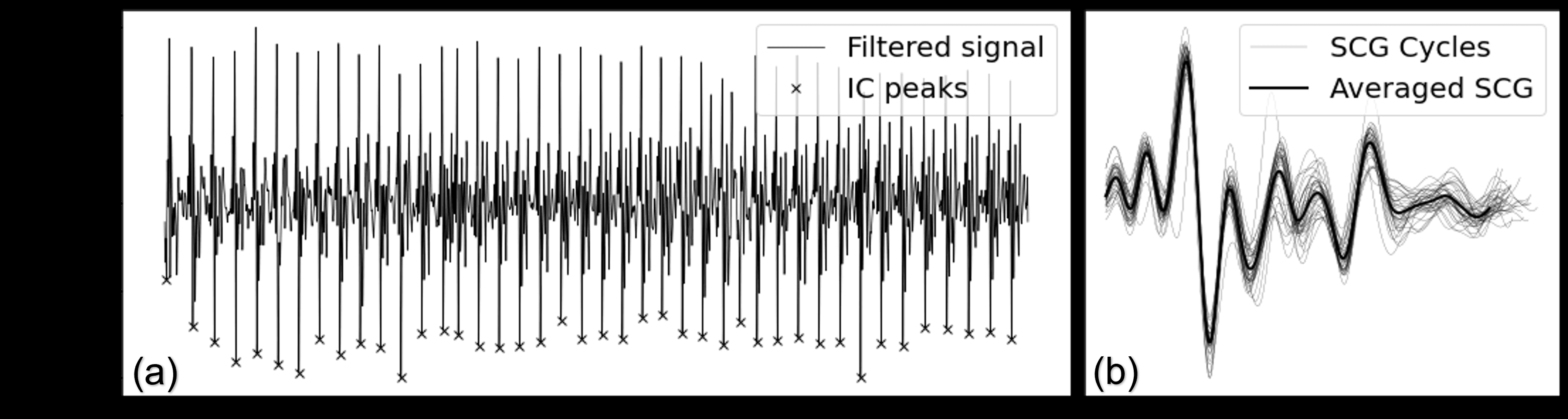
Figure 2. SCG signal measurement and segmentation. (a) Filtered signal (continuous line) and the peaks (marks) found by the pre-processing algorithm. (b) SCG cycles and their average.
Clinical Snapshot
Evidence Rating
Relevance
high Priority