Back to Evidence Hub
Case Study postural-and-longitudinal-variability-in-seismocardiographic-signals
2023 Release

Postural and longitudinal variability in seismocardiographic signals

Executive Summary

This study investigates postural and longitudinal variability in seismocardiographic (SCG) signals using data from 19 healthy subjects over five months. SCG signals were acquired in three postures (supine, 45° tilt, and sitting) and analyzed using unsupervised machine learning (k-medoid clustering with dynamic time warping) to reduce respiratory-induced variability. Key findings include significant postural effects on SCG morphological variability and cardiac timing intervals, while spectral energy distribution remained stable across postures. Longitudinally, SCG features showed minimal variability, suggesting their potential for monitoring true cardiac changes over time.

This study shows that SCG signals, which measure heart vibrations, change with posture but remain stable over time, making them promising for long-term heart monitoring.

Answer Machine Insights

Q: How does posture affect SCG signal variability?

Posture significantly impacts SCG morphological variability and cardiac timing intervals, with sitting posture showing higher variability compared to supine and 45° tilt.

Figure 10 suggests that both intra and inter-cluster variability tend to be higher in sitting position compared to supine and 45°.

Q: Are SCG features stable over time for longitudinal monitoring?

Yes, SCG features such as morphological variability, spectral energy distribution, and cardiac timing intervals remained stable over five months.

Table 5 suggests that the morphological variability (intra and inter-cluster variability) values between recording sessions were not significantly different for the study subjects.

Key Results

  • Postural changes significantly affect SCG morphological variability, with intra-cluster variability ranging from 1 to 2 milli g and inter-cluster variability from 2 to 5 milli g.

  • Longitudinal SCG features, including cardiac timing intervals and spectral energy distribution, showed no significant variability over five months.

Visual Evidence
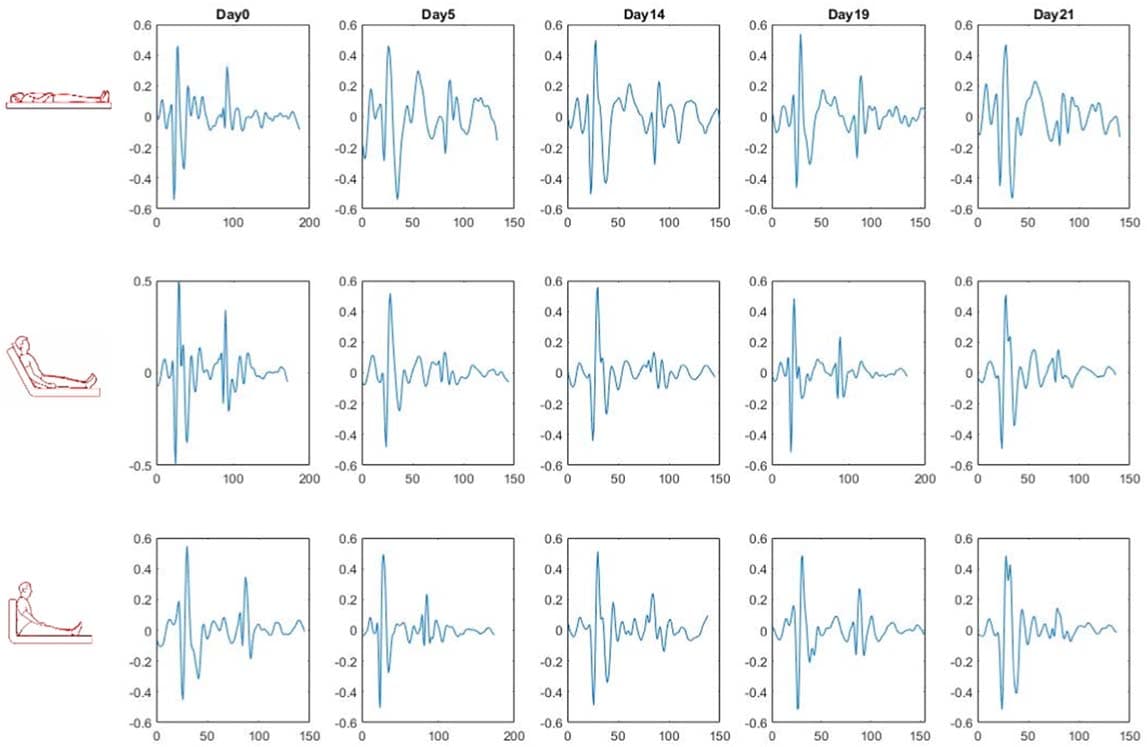
Figure 15. Longitudinal SCG beat variation in a representative subject at different postures.

Figure 15. Longitudinal SCG beat variation in a representative subject at different postures.

Clinical Snapshot

Evidence Rating

Relevance

high Priority

Confidence

Supporting

Relativity Score

4/5
Rigor
3/5
Novelty
5/5
Impact

Semantic Graph Connections

Similar Methodology

Non-contact heart vibration measurement using computer vision-based seismocardiography

Similar Methodology

Accurate and consistent automatic seismocardiogram annotation without concurrent ECG

Similar Methodology

A seismocardiography system and a possibility of its use for diagnosis of internal organs diseases using seismocardiogram information analysis

Similar Methodology

Robustness of Persistence Diagrams to Time-Delay for Seismocardiogram Signal Quality Assessment*

Similar Methodology

Performance Analysis of Gyroscope and Accelerometer Sensors for Seismocardiography-Based Wearable Pre-Ejection Period Estimation

Similar Methodology

A Unified Framework for Quality Indexing and Classification of Seismocardiogram Signals

Similar Methodology

Automatic Detection of Seismocardiogram Sensor Misplacement for Robust Pre-Ejection Period Estimation in Unsupervised Settings

Similar Methodology

Toward Wearable Estimation of Tidal Volume via Electrocardiogram and Seismocardiogram Signals

Similar Methodology

A Hidden Markov Model for Seismocardiography

Similar Methodology

Waveform Similarity Analysis Using Graph Mining for the Optimization of Sensor Positioning in Wearable Seismocardiography

Similar Methodology

High-Accuracy, Unsupervised Annotation of Seismocardiogram Traces for Heart Rate Monitoring

Similar Methodology

A new algorithm for segmentation of cardiac quiescent phases and cardiac time intervals using seismocardiography

Similar Methodology

Visualization of the Multichannel Seismocardiogram

Similar Methodology

Cardiac Time Intervals Derived from Electrocardiography and Seismocardiography in Different Patient Groups

Similar Methodology

Discrete Wavelet Transforms-Based Analysis of Accelerometer Signals for Continuous Human Cardiac Monitoring

Similar Methodology

Smart Seismocardiography: A Machine Learning Approach for Automatic Data Processing

Similar Methodology

Deep Learning for identifying systolic complexes in SCG traces: a cross-dataset analysis