Accuracy of the Instantaneous Breathing and Heart Rates Estimated by Smartphone Inertial Units
Executive Summary
This study evaluates the accuracy of smartphone inertial sensors in measuring instantaneous heart and breathing rates using seismocardiography (SCG) and gyrocardiography (GCG). Data from 10 healthy subjects were analyzed, showing high sensitivity and positive predictive values for heartbeat and respiratory act detection, with strong correlations (R2 > 0.999 for IBIs and R2 > 0.968 for IBrIs) against reference ECG and respiration belt signals. The findings suggest that smartphones can serve as cost-effective, non-invasive tools for cardiorespiratory monitoring.
Answer Machine Insights
Q: How accurate are smartphone inertial sensors in detecting heartbeats?
Smartphone inertial sensors achieved 89.3% sensitivity and 93.3% PPV for SCG, and 97.3% sensitivity and 97.9% PPV for GCG.
Heartbeats were detected with a sensitivity and positive predictive value (PPV) of 89.3% and 93.3% in SCG signals and of 97.3% and 97.9% in GCG signals.
Q: What is the correlation between smartphone-derived IBIs and ECG-derived IBIs?
The correlation coefficient (R2) was greater than 0.999 for both SCG and GCG.
IBIs measurements reported strong linear relationships (R2 > 0.999), non-significant biases, and Bland–Altman limits of agreement (LoA) of ±7.33 ms for SCG and ±5.22 ms for GCG.
Key Results
Heartbeats detected with 89.3% sensitivity and 93.3% PPV for SCG, and 97.3% sensitivity and 97.9% PPV for GCG.
IBIs showed R2 > 0.999 and Bland–Altman LoA of ±7.33 ms (SCG) and ±5.22 ms (GCG).
Visual Evidence
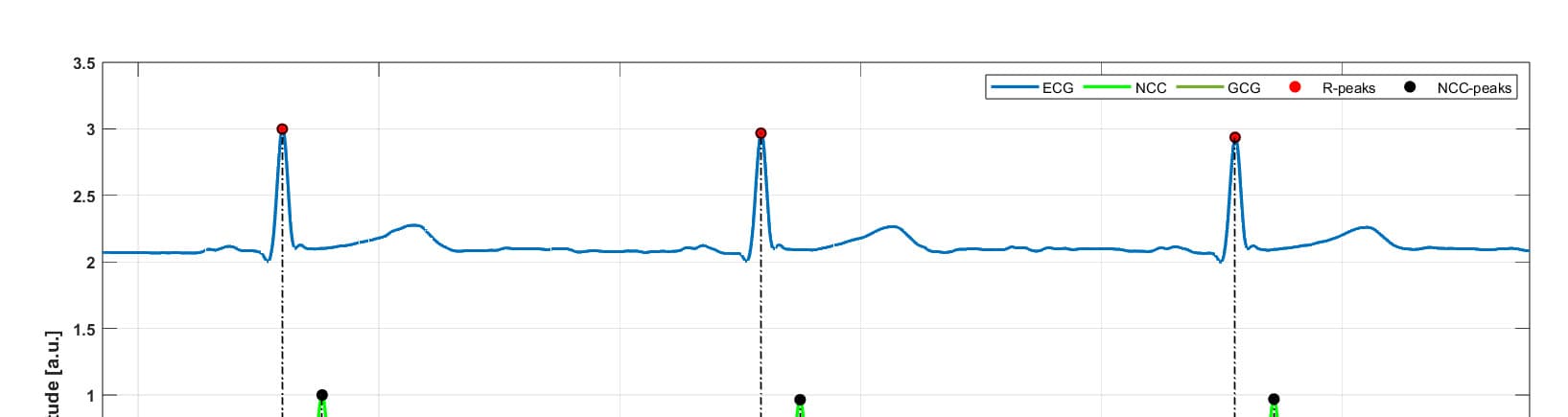
Clinical Snapshot
Evidence Rating
Relevance
high Priority