Ballistocardiography and Seismocardiography: A Review of Recent Advances
Executive Summary
This review paper explores recent advancements in ballistocardiography (BCG) and seismocardiography (SCG), focusing on instrumentation, signal processing, and clinical applications. It highlights novel wearable and bed-based systems, signal modeling techniques, and human subject studies that validate the clinical relevance of BCG and SCG for monitoring cardiac mechanics. The paper also discusses challenges such as motion artifacts and the need for standardization, emphasizing the potential of these technologies for non-invasive, ubiquitous health monitoring.
Answer Machine Insights
Q: What are the primary advantages of wearable BCG and SCG systems?
Wearable systems enable continuous monitoring during daily activities and provide insights into cardiovascular performance under various environmental stressors.
The primary advantage of wearable BCG or SCG measurement systems is the possibility of obtaining data continuously throughout normal daily living.
Q: How does microgravity affect BCG measurements?
Microgravity allows for undistorted 3-D BCG recordings, revealing significant recoil forces in all three dimensions.
The ideal environment for assessing the BCG would be in microgravity settings, such as during space missions.
Key Results
BCG and SCG signals correlate strongly with cardiac output and stroke volume changes during exercise recovery (R2 = 0.86 for R-J interval and PEP).
Wearable SCG systems demonstrated accurate beat-to-beat cardiac time interval estimation during daily activities.
Visual Evidence
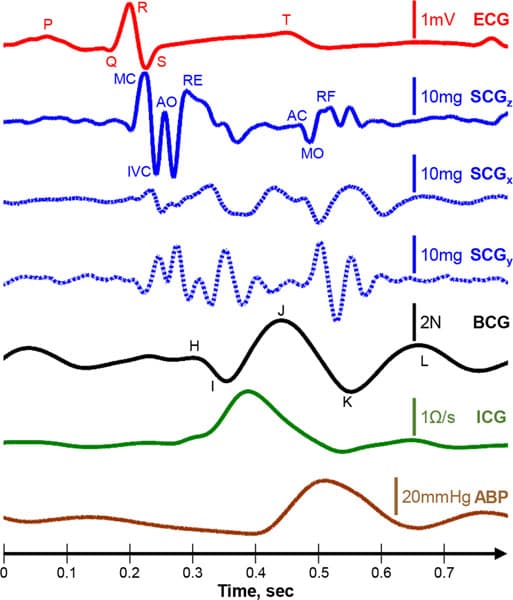
Fig. 1. Simultaneously acquired Lead II electrocardiogram (ECG); three-axis seismocardiogram (SCG) with z indicating the dorso-ventral axis, x indicating the right-to-left lateral axis, and y indicating the head-to-foot axis; ballisto- cardiogram (BCG); impedance cardiogram (ICG); and arterial blood pressure (ABP) measured at the finger, signals from one subject, illustrating the relative timing and amplitude features of the signals.
Clinical Snapshot
Evidence Rating
Relevance
high Priority