BCG Artifact Removal Using Improved Independent Component Analysis Approach
Executive Summary
This study introduces an improved Independent Component Analysis (ICA) approach combined with k-means clustering for artifact removal in Ballistocardiography (BCG) signals. The methodology involves preprocessing raw BCG data using FIR filters, ICA decomposition, and clustering based on power spectrum efficiency to identify and remove artifacts. Experimental results demonstrate superior artifact removal performance compared to existing methods, validated using a dataset of 17 subjects from Georgia Institute of Technology.
Answer Machine Insights
Q: What is the main innovation of the proposed artifact removal method?
The integration of Independent Component Analysis (ICA) with k-means clustering based on power spectrum efficiency for artifact detection and removal.
In this work, k-means clustering is applied for independent component extraction and artifacts are classified based on the power frequency of the clustered dataset.
Q: How does the proposed method compare to existing approaches?
The proposed method shows better performance in terms of artifact removal, as demonstrated by comparative statistical analysis.
Artifact removal approach is compared with existing method which shows the better performance.
Key Results
Mean and standard deviation of preprocessed BCG signals were significantly reduced, indicating improved signal stability.
Proposed method achieved better artifact removal performance compared to existing systems, as evidenced by statistical metrics.
Visual Evidence
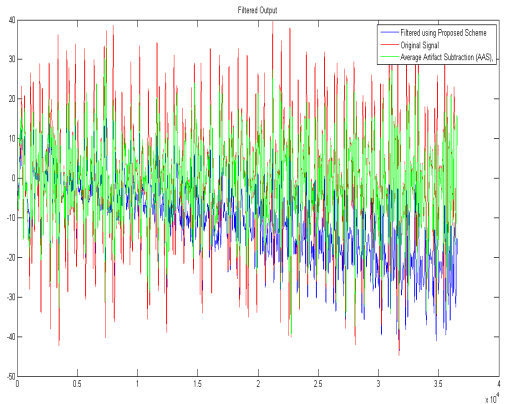
Figure 3. Pre-processed BCG Data
Clinical Snapshot
Evidence Rating
Relevance
high Priority