A deep learning approach to using wearable seismocardiography (SCG) for diagnosing aortic valve stenosis and predicting aortic hemodynamics obtained by 4D flow MRI
Executive Summary
This study investigates the use of deep learning applied to wearable seismocardiography (SCG) signals for predicting aortic hemodynamics and diagnosing aortic valve stenosis. Using convolutional neural networks (CNN) and continuous wavelet transform (CWT) scalograms, the model achieved high correlation (r = 0.76) with peak systolic velocity (Vmax) values obtained via 4D flow MRI and classified valve conditions with ROC-AUC values ranging from 81% to 95%. The findings suggest SCG-based methods could serve as cost-effective alternatives or supplements to 4D flow MRI for screening and diagnosis of aortic valve diseases.
Answer Machine Insights
Q: How accurate is the SCG-based prediction of peak systolic velocity compared to 4D flow MRI?
The SCG-based prediction achieved a correlation coefficient of r = 0.76 with 4D flow MRI-derived values.
The figure shows a strong linear correlation between the estimated and measured Vmax values (y = 0.89x, r = 0.76, p ≪ 0.01).
Q: What is the classification performance for different valve conditions?
The model achieved ROC-AUC values of 92% for non-AS TAV, 95% for non-AS BAV, 81% for non-AS MAV, and 83% for AS.
The ROC-AUC values indicate the model’s performance on each of the four classes, with values of 91.8 ± 5.3%, 94.8 ± 5.1%, 81.2 ± 10.8%, and 83.1 ± 11.1% for non-AS TAV, non-AS BAV, non-AS MAV, and AS subjects, respectively.
Key Results
Correlation coefficient of r = 0.76 between SCG-predicted Vmax and 4D flow MRI-derived Vmax.
ROC-AUC values for classification: non-AS TAV (92%), non-AS BAV (95%), non-AS MAV (81%), AS (83%).
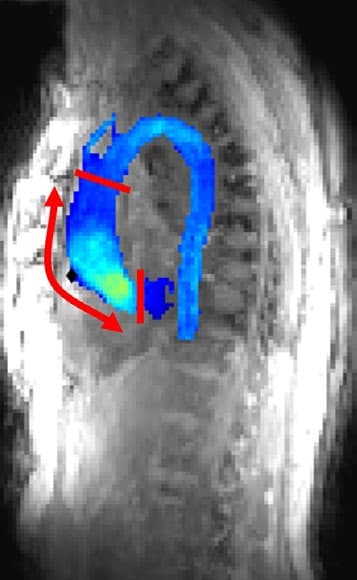
Visual Evidence
Clinical Snapshot
Evidence Rating
Relevance
high Priority