Synthetic Seismocardiography Signal Generation by a Generative Adversarial Network
Executive Summary
This study explores the use of a conditional Generative Adversarial Network (cGAN) to synthetically generate seismocardiography (SCG) signals, addressing the challenge of limited SCG datasets for machine learning applications. The cGAN was trained on real SCG data from 62 subjects and demonstrated the ability to produce realistic and subject-specific synthetic heartbeats with an average RMSE of 0.1831 compared to real ensemble averages. The findings suggest that synthetic SCG data can augment existing datasets, potentially accelerating research and clinical applications in cardiac monitoring.
Answer Machine Insights
Q: What was the average RMSE of generated SCG heartbeats compared to real ensemble averages?
The average RMSE was 0.1831.
Generated heartbeats had an average root-mean-squared-error of 0.1831 when compared to the ensemble average of their real counterparts.
Q: Did the generated SCG heartbeats capture subject-specific features?
Yes, the generated heartbeats showed subject-specific features, as evidenced by higher RMSE when compared to ensemble averages of other subjects.
Additionally, it shows that on average, each beat is more similar to their own ensemble average, than to the ensemble averaged from other subjects.
Key Results
Generated SCG heartbeats had an average RMSE of 0.1831 compared to real ensemble averages.
Generated heartbeats showed subject-specific features, with higher RMSE when compared to ensemble averages of other subjects (0.2357).
Visual Evidence
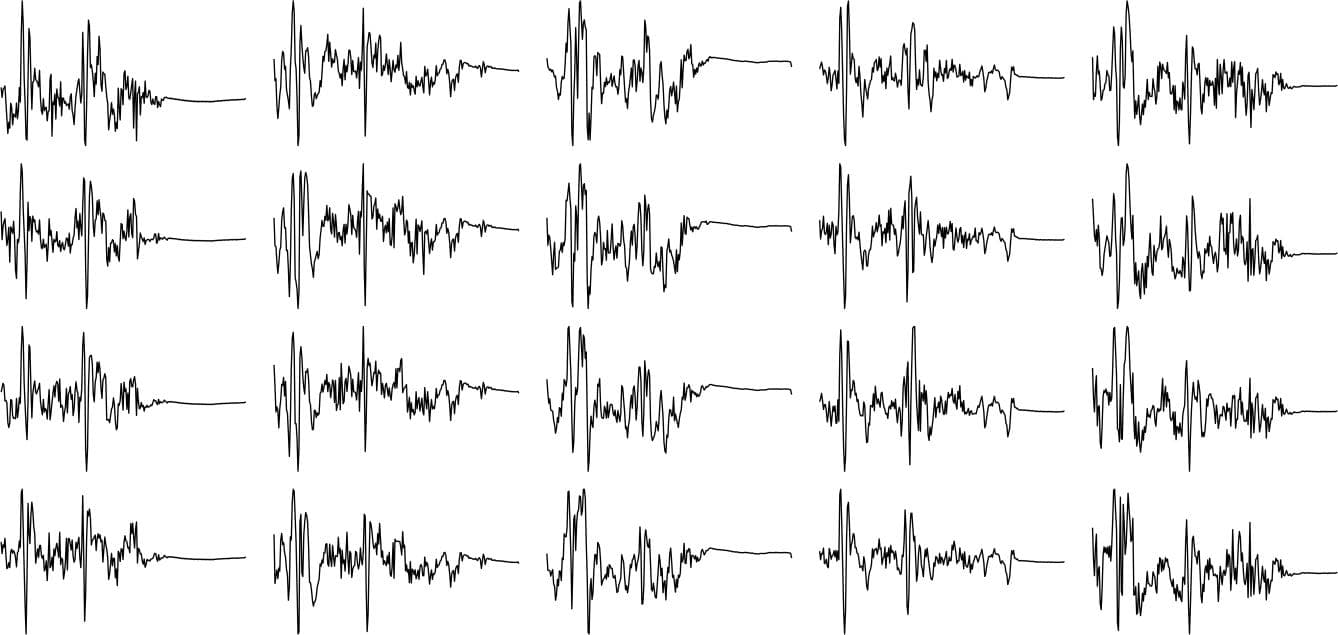
Figure 2. Randomly generated heartbeats from five subjects across four random samples. Each column shows heartbeats from the same subject.
Clinical Snapshot
Evidence Rating
Relevance
high Priority