SCG With Your Phone: Diagnosis of Rhythmic Spectrum Disorders in Field Conditions
Executive Summary
This study introduces a robust deep-learning framework based on a modified U-Net v3 architecture for seismocardiography (SCG) signal segmentation and rhythm analysis using consumer smartphones. The framework incorporates multi-scale convolutions, residual connections, and attention gates to handle noisy, real-world data, achieving state-of-the-art performance with sensitivity of 99.80% and PPV of 99.09%. The findings demonstrate the feasibility of low-cost, automated cardiac monitoring in field conditions, paving the way for scalable cardiovascular assessment and multimodal diagnostic systems.
Answer Machine Insights
Q: What is the primary innovation in the proposed SCG analysis method?
The primary innovation is the modified U-Net v3 architecture, which integrates multi-scale convolutions, residual connections, and attention gates for robust SCG segmentation in noisy, real-world conditions.
To address the shortcomings of the baseline U-Net, we introduced three key modifications that resulted in the U-Net v3 architecture (Figure 3), tailored specifically for SCG segmentation.
Q: How does the model handle variability in smartphone orientation?
The model uses an adaptive 3D-to-1D projection pipeline to estimate the optimal viewing direction for SCG signals, ensuring orientation-agnostic performance.
To achieve orientation-agnostic performance, we developed an adaptive 3D-to-1D projection pipeline that estimates the optimal viewing direction n ∈R3 – the unit vector aligned with cardiac-induced chest displacement – using only the raw triaxial signal.
Key Results
The U-Net v3 architecture achieved a segmentation Dice score of 96.47% and sensitivity of 99.80%.
The proposed method demonstrated 94% satisfactory ratings in real-world, unlabeled data evaluations by cardiologists.
Visual Evidence
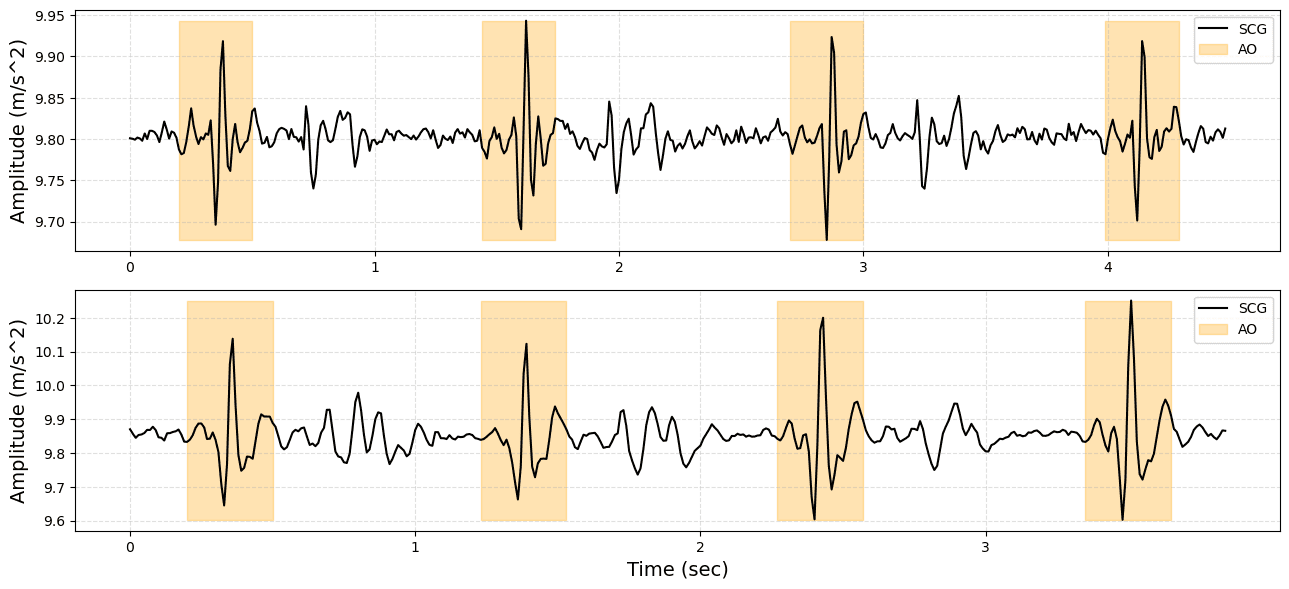
Figure 2: Labeled SCG.
Clinical Snapshot
Evidence Rating
Relevance
high Priority