A System for Seismocardiography-Based Identification of Quiescent Heart Phases: Implications for Cardiac Imaging
Executive Summary
This study developed a hardware system to synchronously acquire seismocardiography (SCG), electrocardiography (EKG), and echocardiography data to investigate the variability between mechanical and electrical heart signals. Key findings include the demonstration that SCG-derived quiescent phases vary predictably with heart rate and differ between individuals, suggesting SCG may be a superior gating signal for cardiac CT imaging compared to EKG. Clinical implications include potential reductions in radiation dose and improved diagnostic quality for coronary CT angiography.
Answer Machine Insights
Q: How does SCG compare to EKG for identifying quiescent heart phases?
SCG demonstrates variability in quiescent phases that are more predictive and individualized compared to EKG.
The implication of the results from Table II is that EKG demonstrates variability with respect to the SCG, and since the latter has been shown to be an accurate indicator of cardiac state based on US [15], EKG may be a less optimal trigger for gating CTCA.
Q: What is the clinical significance of SCG-derived gating for cardiac CT imaging?
SCG-derived gating could reduce radiation dose and improve diagnostic quality by enabling more precise identification of quiescent heart phases.
The result shown in Fig. 8 implies that if SCG analysis is performed prior to prospectively gated CTCA based on EKG gating, tighter padding intervals could be used, which would further decrease the amount CT tube current ON time, thus decreasing radiation dose.
Key Results
SCG-derived quiescent phases vary predictably with heart rate and differ between individuals.
SCG gating could reduce radiation dose in cardiac CT imaging by enabling tighter padding intervals.
Visual Evidence
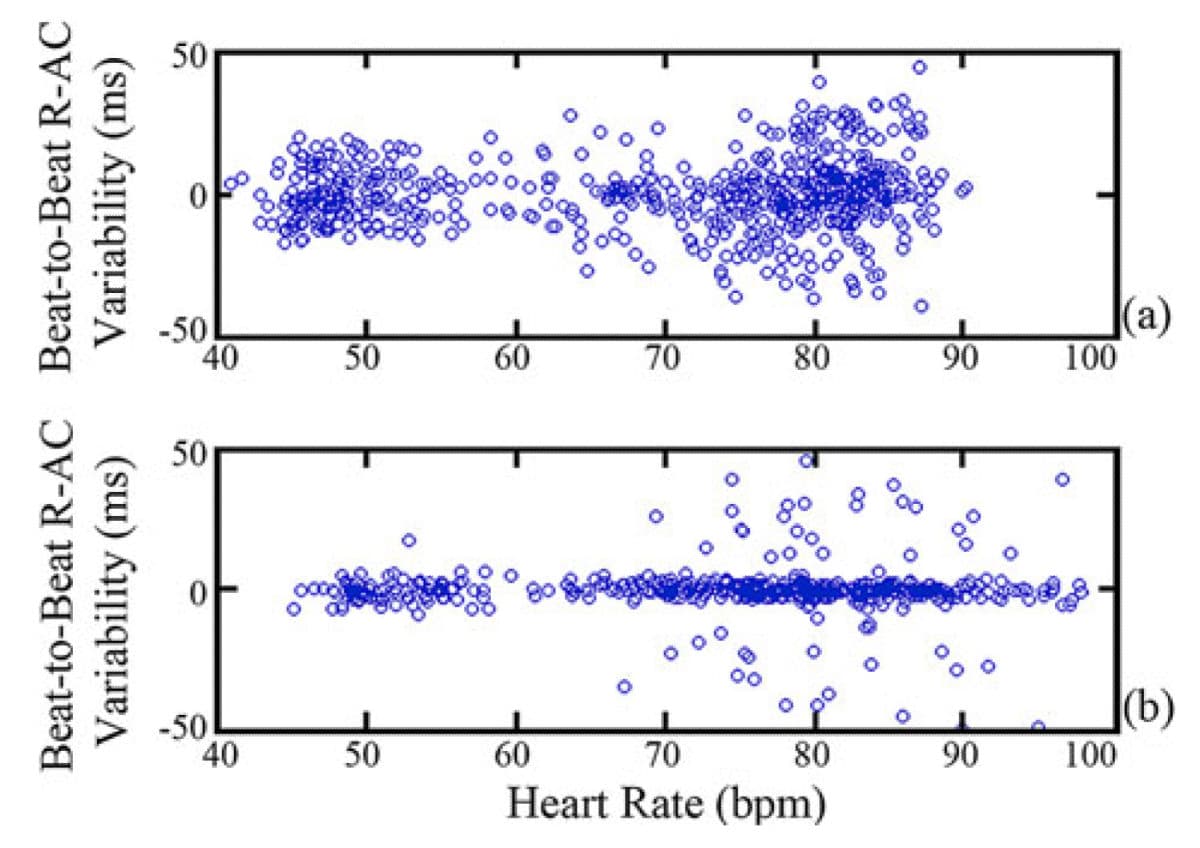
Fig. 9. Variability in beat-to-beat R-AC delay for (a) Subject 1 and (b) Subject 2. Each data point corresponds to the difference in the R-AC delay for two consecutive cycles plotted against the heart rate defined by the first cycle.
Clinical Snapshot
Evidence Rating
Relevance
high Priority