Back to Evidence Hub
Case Study multichannel-seismocardiography-an-imaging-modality-for-investigating-heart-vibrations
2020 Release

Multichannel seismocardiography: an imaging modality for investigating heart vibrations

Executive Summary

This study introduces a multichannel seismocardiography (mchSCG) system with 16 three-axis accelerometers to investigate chest wall vibrations caused by cardiac activity. The system demonstrated high synchronization accuracy, linear frequency response, and signal quality, enabling the identification of fiducial points associated with aortic valve events. Analysis of vibration propagation patterns across 13 subjects revealed spatial and temporal trends linked to cardiac mechanics, suggesting potential applications in cardiac resynchronization therapy and physiological parameter estimation.

Researchers developed a new system to map heart vibrations across the chest, revealing patterns tied to heart valve movements. This technology could improve heart failure treatments and diagnostics.

Answer Machine Insights

Q: What fiducial points were identified in the SCG signals?

Four fiducial points were identified: AOvalley, AOhill, ACvalley, and AChill, corresponding to aortic valve opening and closing events.

Fiducial point was defined as the negative and positive peaks that align with aorta valve opening, for the systolic points, and with aorta valve closing for the diastolic points.

Q: How does the system handle spatial propagation of chest vibrations?

The system uses a 4x4 grid of sensors to map vibration propagation, calculating centers of mass for fiducial points to analyze spatial trends.

To qualify spatial movement of acceleration waves on the chest surface, the center of mass of each colormap was calculated and illustrated as a magenta point on the colormaps.

Key Results

  • The system achieved a synchronization latency of 0 ms between sensors and 4 samples between ECG and SCG channels.

  • Average signal-to-noise ratio (SNR) of 25.8 dB across 208 signals from 13 subjects.

Visual Evidence
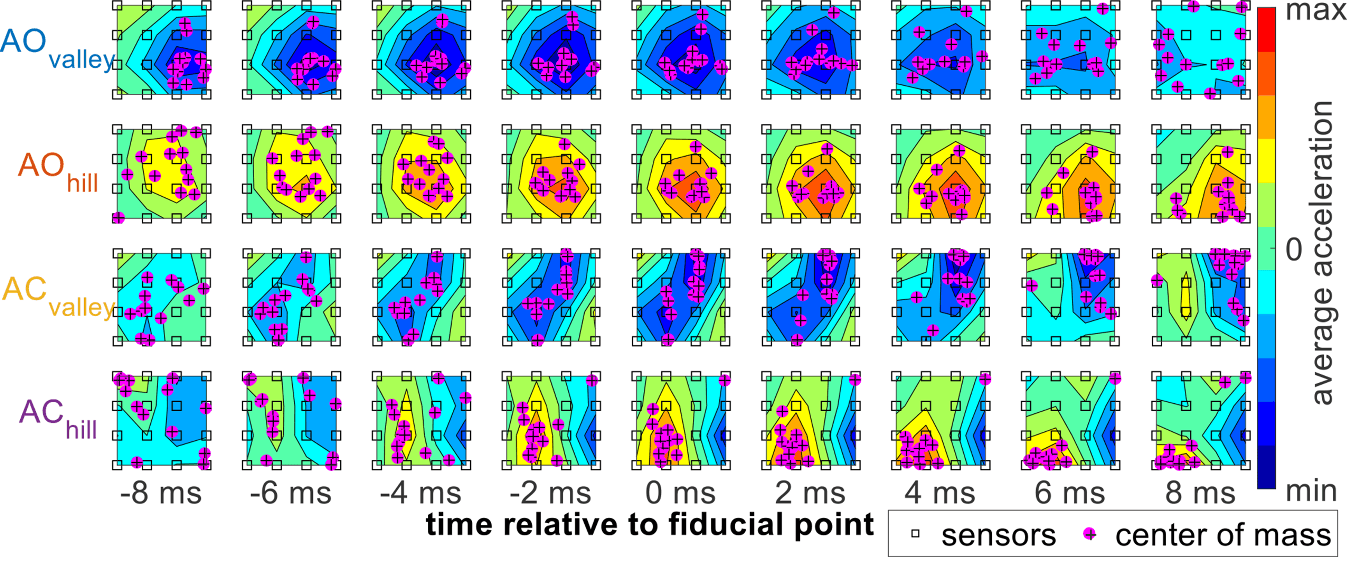
Figure 9. Mean colormaps from the 13 subjects from the SCG markers, illustrates how the center of mass propagates across the chest over time. The colormaps are normalized to the absolute maximum acceleration for each subject.

Figure 9. Mean colormaps from the 13 subjects from the SCG markers, illustrates how the center of mass propagates across the chest over time. The colormaps are normalized to the absolute maximum acceleration for each subject.

Clinical Snapshot

Evidence Rating

Relevance

high Priority

Confidence

Cornerstone

Relativity Score

4/5
Rigor
4/5
Novelty
5/5
Impact

Semantic Graph Connections

Similar Methodology

Monitoring of respiration and cardiorespiratory interactions from multichannel seismocardiography signals

Similar Methodology

Autonomic function testing aboard the ISS using “PNEUMOCARD”

Similar Methodology

Definition of Fiducial Points in the Normal Seismocardiogram

Similar Methodology

From video to vital signs: a new method for contactless multichannel seismocardiography

Similar Methodology

Automatic Identification of Systolic Time Intervals in Seismocardiogram

Similar Methodology

Accurate and consistent automatic seismocardiogram annotation without concurrent ECG

Similar Methodology

A seismocardiography system and a possibility of its use for diagnosis of internal organs diseases using seismocardiogram information analysis

Similar Methodology

Seismocardiography and echocardiography: the correlation in the systolic complex

Similar Methodology

A trimodal system for the acquisition of synchronous echocardiography, electrocardiography, and seismocardiography data

Similar Methodology

Universal Pre-Ejection Period Estimation Using Seismocardiography: Quantifying the Effects of Sensor Placement and Regression Algorithms

Similar Methodology

Near Real-Time Implementation of An Adaptive Seismocardiography – ECG Multimodal Framework for Cardiac Gating

Similar Methodology

Quantifying and Reducing Motion Artifacts in Wearable Seismocardiogram Measurements During Walking to Assess Left Ventricular Health

Similar Methodology

A System for Seismocardiography-Based Identification of Quiescent Heart Phases: Implications for Cardiac Imaging

Similar Methodology

Noncontact Multipoint Vital Sign Monitoring With mmWave MIMO Radar

Similar Methodology

Digital Twin-Based Investigation of Seismocardiogram Sensitivity to Tissue Mechanics and Myocardial Motion

Similar Methodology

Novel Wearable Seismocardiography and Machine Learning Algorithms Can Assess Clinical Status of Heart Failure Patients

Similar Methodology

Wearable Seismocardiography‐Based Assessment of Stroke Volume in Congenital Heart Disease

Similar Methodology

Visualization of the Multichannel Seismocardiogram

Similar Methodology

Seismocardiography on Infants and Kids

Similar Methodology

Porcine Model for Validation of Noninvasive Estimation of Pulmonary Hypertension

Similar Methodology

Application of Acceleration Sensors in Physiological Experiments

Similar Methodology

Quantification of cardiac kinetic energy and its changes during transmural myocardial ischemia assessed by multi-dimensional seismocardiography

Similar Methodology

Multi-site cardiac rhythm monitoring via multi-channel SCG system and exercise-induced physiological analysis

Similar Methodology

A Comparison of Heart Pulsations Provided by Forcecardiography and Double Integration of Seismocardiogram

Similar Methodology

Non-Invasive Wearable Technology to Predict Heart Failure Decompensation

Similar Methodology

ECG-Free Assessment of Cardiac Valve Events Using Seismocardiography

Similar Methodology

Seismocardiography: Interpretation and Clinical Application

Similar Methodology

Three-dimensional apex-seismocardiography