Back to Evidence Hub
Case Study visualization-of-the-multichannel-seismocardiogram
2019 Release

Visualization of the Multichannel Seismocardiogram

Executive Summary

This study investigates four visualization methods for multichannel seismocardiography (mchSCG) data collected from 16 three-axis accelerometers placed on the chest of 11 healthy males. The methods—SCG charts, color plots, tracking maps, and seismic mesh—are evaluated for their ability to represent temporal, spatial, and directional information. Key findings include the SCG chart's sensitivity to temporal and amplitude variations, color plots' enhanced spatial resolution, tracking maps' effective representation of directionality, and seismic mesh's ability to show collective spatial and directional vibration patterns. These visualizations provide tools for interpreting cardio-mechanical events and vibration wave behavior.

This study explores ways to visualize chest vibrations caused by heart activity using data from 16 sensors. The methods help researchers better understand how these vibrations relate to heart function.

Answer Machine Insights

Q: Which visualization method is best for temporal analysis?

The SCG chart is best for temporal analysis due to its alignment with accelerometer grid locations and ability to show temporal similarities and signal magnitude differences.

The SCG chart is useful when investigating temporal similarities and signal magnitude differences, due to the grid and signals alignment. (Page 2)

Q: What is the advantage of the seismic mesh method?

The seismic mesh method excels in showing spatial and directional information by interpolating vibration data across a higher resolution grid.

The seismic mesh shows the three cardinal axes collective vibration and gives detailed information about the wavelengths of the vibrations by interpolation. (Page 3)

Key Results

  • SCG charts are optimal for temporal and amplitude sensitivity analysis.

  • Seismic mesh provides detailed spatial and directional vibration patterns through interpolation.

Visual Evidence
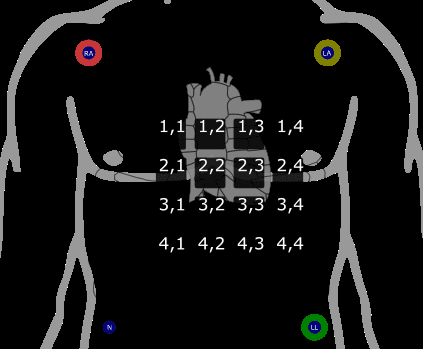
Figure 1. Accelerometer locations and ECG electrode positions.  Accelerometer 3,2 is placed above the Xiphoid Process.  Vibrations are defined in the positive directions of the three  cardinal axes: frontal (left), vertical (superior), and sagittal  (anterior).

Figure 1. Accelerometer locations and ECG electrode positions. Accelerometer 3,2 is placed above the Xiphoid Process. Vibrations are defined in the positive directions of the three cardinal axes: frontal (left), vertical (superior), and sagittal (anterior).

Clinical Snapshot

Evidence Rating

Relevance

high Priority

Confidence

Supporting

Relativity Score

4/5
Rigor
4/5
Novelty
5/5
Impact

Semantic Graph Connections

Similar Methodology

Influence of Gravitational Offset Removal on Heart Beat Detection Performance from Android Smartphone Seismocardiograms

Similar Methodology

Monitoring of respiration and cardiorespiratory interactions from multichannel seismocardiography signals

Similar Methodology

Estimation of cardiorespiratory fitness in healthy using seismocardiography

Similar Methodology

Automatic Identification of Systolic Time Intervals in Seismocardiogram

Similar Methodology

Accurate and consistent automatic seismocardiogram annotation without concurrent ECG

Similar Methodology

Multichannel seismocardiography: an imaging modality for investigating heart vibrations

Similar Methodology

Postural and longitudinal variability in seismocardiographic signals

Similar Methodology

A seismocardiography system and a possibility of its use for diagnosis of internal organs diseases using seismocardiogram information analysis

Similar Methodology

Robustness of Persistence Diagrams to Time-Delay for Seismocardiogram Signal Quality Assessment*

Similar Methodology

Performance Analysis of Gyroscope and Accelerometer Sensors for Seismocardiography-Based Wearable Pre-Ejection Period Estimation

Similar Methodology

A Unified Framework for Quality Indexing and Classification of Seismocardiogram Signals

Similar Methodology

Automatic Detection of Seismocardiogram Sensor Misplacement for Robust Pre-Ejection Period Estimation in Unsupervised Settings

Similar Methodology

Universal Pre-Ejection Period Estimation Using Seismocardiography: Quantifying the Effects of Sensor Placement and Regression Algorithms

Similar Methodology

Respiratory Modulation of Sternal Motion in the Context of Seismocardiography

Similar Methodology

Toward Wearable Estimation of Tidal Volume via Electrocardiogram and Seismocardiogram Signals

Similar Methodology

A Wavelet-Based Approach for Motion Artifact Reduction in Ambulatory Seismocardiography

Similar Methodology

Effect of the Airway Pressure on the Frequency Domain of Seismocardiographic Signal

Similar Methodology

Quantifying and Reducing Motion Artifacts in Wearable Seismocardiogram Measurements During Walking to Assess Left Ventricular Health

Similar Methodology

A Hidden Markov Model for Seismocardiography

Similar Methodology

Waveform Similarity Analysis Using Graph Mining for the Optimization of Sensor Positioning in Wearable Seismocardiography

Similar Methodology

High-Accuracy, Unsupervised Annotation of Seismocardiogram Traces for Heart Rate Monitoring

Similar Methodology

A System for Seismocardiography-Based Identification of Quiescent Heart Phases: Implications for Cardiac Imaging

Similar Methodology

Noncontact Multipoint Vital Sign Monitoring With mmWave MIMO Radar

Similar Methodology

A new algorithm for segmentation of cardiac quiescent phases and cardiac time intervals using seismocardiography

Similar Methodology

Determining the Respiratory State From a Seismocardiographic Signal--A Machine Learning Approach

Similar Methodology

Porcine Model for Validation of Noninvasive Estimation of Pulmonary Hypertension

Similar Methodology

Determination of Maximal Oxygen Uptake Using Seismocardiography at Rest

Similar Methodology

Application of Acceleration Sensors in Physiological Experiments

Similar Methodology

Analysis of Non-Contact Multichannel Recording of Cardiac Vibration: Visual Seismocardiogram

Similar Methodology

Deep learning-based beat-to-beat delineation of heart sounds and fiducial points in seismocardiography

Similar Methodology

Can Seismocardiogram Fiducial Points Be Used for the Routine Estimation of Cardiac Time Intervals in Cardiac Patients?

Similar Methodology

Multi-site cardiac rhythm monitoring via multi-channel SCG system and exercise-induced physiological analysis

Similar Methodology

Discrete Wavelet Transforms-Based Analysis of Accelerometer Signals for Continuous Human Cardiac Monitoring

Similar Methodology

Evaluating Seismocardiography as a Non-Exercise Method for Estimating Maximal Oxygen Uptake

Similar Methodology

A Cardiac Early Warning System with Multi Channel SCG and ECG Monitoring for Mobile Health

Similar Methodology

Deep Learning for identifying systolic complexes in SCG traces: a cross-dataset analysis

Similar Methodology

ECG-Free Assessment of Cardiac Valve Events Using Seismocardiography

Similar Methodology

Seismocardiography for Emotion Recognition: A Study on EmoWear with Insights from DEAP

Similar Methodology

LubDubDecoder: Bringing Micro-Mechanical Cardiac Monitoring to Hearables

Similar Methodology

Seismocardiography: Interpretation and Clinical Application

Similar Methodology

Three-dimensional apex-seismocardiography