Back to Evidence Hub
Case Study a-new-algorithm-for-segmentation-of-cardiac-quiescent-phases-and-cardiac-time-intervals-using-seismocardiography
2015 Release

A new algorithm for segmentation of cardiac quiescent phases and cardiac time intervals using seismocardiography

Executive Summary

This study developed an algorithm for automatic detection of cardiac events and segmentation of cardiac quiescent phases using seismocardiography (SCG) synchronized with electrocardiography (ECG). The algorithm accurately measured systolic time intervals (STIs) such as QS2, PEP, and LVET, and identified quiescent phases critical for applications like nuclear imaging and diastolic timed vibrators. Results showed poor correlation between QS2 and heart rate but highlighted strong inverse relationships between heart rate and diastolic quiescent phases, suggesting SCG's potential for non-invasive cardiac mechanics monitoring.

This study shows how chest vibrations can measure heart mechanics and identify resting phases of the heart, which could improve imaging and early disease detection without expensive equipment.

Answer Machine Insights

Q: What correlation was observed between heart rate and diastolic quiescent phase duration?

A high inverse correlation (r = -0.97) was observed.

High inverse correlation (r= -0.97) was obtained between the heart rate and the diastolic quiescent phase (see Fig.5 (a)).

Q: What are the clinical applications of cardiac quiescent phase segmentation?

Applications include nuclear medicine imaging (e.g., CT or PET) and diastolic timed vibrators (DTV).

Two quiescent phases were detected which are clinically significant in order to use for diagnostic or treatment tools such as nuclear medicine imaging (e.g. for computed tomography (CT) or positron emission tomography (PET)) and diastolic timed vibrators (DTV).

Key Results

  • Mean corrected QS2i, PEPi, and LVETi values were 513.4±9.3ms, 111.8±6.5ms, and 401.6±8.3ms respectively.

  • High inverse correlation (r = -0.97) was observed between heart rate and diastolic quiescent phase duration.

Visual Evidence
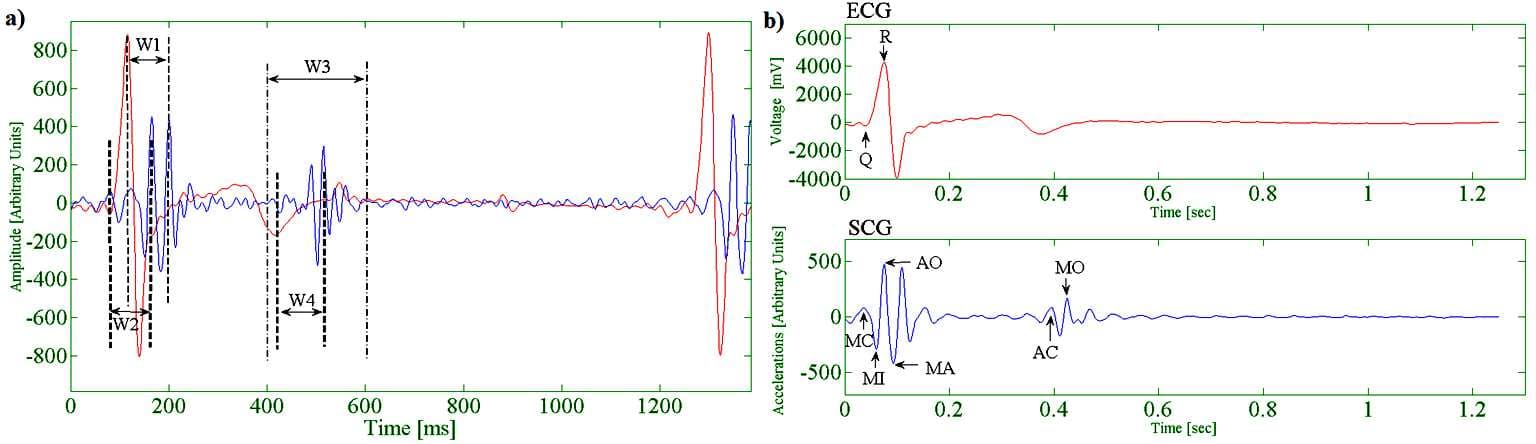
Figure 2. (a) Windowing for Event Detection. (b) Detected Cardiac Events within SCG and ECG.

Figure 2. (a) Windowing for Event Detection. (b) Detected Cardiac Events within SCG and ECG.

Clinical Snapshot

Evidence Rating

Relevance

high Priority

Confidence

Supporting

Relativity Score

4/5
Rigor
4/5
Novelty
5/5
Impact

Semantic Graph Connections

Similar Methodology

Heart Beat Detection from Smartphone SCG Signals: Comparison with Previous Study on HR Estimation

Similar Methodology

Heart Rate Variability Analysis on Reference Heart Beats and Detected Heart Beats of Smartphone Seismocardiograms

Similar Methodology

Influence of Gravitational Offset Removal on Heart Beat Detection Performance from Android Smartphone Seismocardiograms

Similar Methodology

Definition of Fiducial Points in the Normal Seismocardiogram

Similar Methodology

Estimation of cardiorespiratory fitness in healthy using seismocardiography

Similar Methodology

Automatic Identification of Systolic Time Intervals in Seismocardiogram

Similar Methodology

Accurate and consistent automatic seismocardiogram annotation without concurrent ECG

Similar Methodology

End-to-end sensor fusion and classification of atrial fibrillation using deep neural networks and smartphone mechanocardiography

Similar Methodology

Postural and longitudinal variability in seismocardiographic signals

Similar Methodology

A seismocardiography system and a possibility of its use for diagnosis of internal organs diseases using seismocardiogram information analysis

Similar Methodology

Motion artifact cancellation from a single channel SCG using adaptive forgetting factor recursive least square filter

Similar Methodology

Robustness of Persistence Diagrams to Time-Delay for Seismocardiogram Signal Quality Assessment*

Similar Methodology

A Unified Framework for Quality Indexing and Classification of Seismocardiogram Signals

Similar Methodology

Toward Wearable Estimation of Tidal Volume via Electrocardiogram and Seismocardiogram Signals

Similar Methodology

Quantifying and Reducing Motion Artifacts in Wearable Seismocardiogram Measurements During Walking to Assess Left Ventricular Health

Similar Methodology

A Hidden Markov Model for Seismocardiography

Similar Methodology

High-Accuracy, Unsupervised Annotation of Seismocardiogram Traces for Heart Rate Monitoring

Similar Methodology

A System for Seismocardiography-Based Identification of Quiescent Heart Phases: Implications for Cardiac Imaging

Similar Methodology

Novel Wearable Seismocardiography and Machine Learning Algorithms Can Assess Clinical Status of Heart Failure Patients

Similar Methodology

Enhancing visual seismocardiography in noisy environments with adaptive bidirectional filtering for Cardiac Health Monitoring

Similar Methodology

Combined measurement of ECG, Breathing and Seismocardiograms DataBase (CEBSDB)

Similar Methodology

Visualization of the Multichannel Seismocardiogram

Similar Methodology

Seismocardiography on Infants and Kids

Similar Methodology

Cardiac Time Intervals Derived from Electrocardiography and Seismocardiography in Different Patient Groups

Similar Methodology

Porcine Model for Validation of Noninvasive Estimation of Pulmonary Hypertension

Similar Methodology

Application of Acceleration Sensors in Physiological Experiments

Similar Methodology

Analysis of Non-Contact Multichannel Recording of Cardiac Vibration: Visual Seismocardiogram

Similar Methodology

Multi-site cardiac rhythm monitoring via multi-channel SCG system and exercise-induced physiological analysis

Similar Methodology

A Comparison of Heart Pulsations Provided by Forcecardiography and Double Integration of Seismocardiogram

Similar Methodology

A Novel Adaptive Recursive Least Squares Filter to Remove the Motion Artifact in Seismocardiography

Similar Methodology

ECG-Free Assessment of Cardiac Valve Events Using Seismocardiography

Similar Methodology

Three-dimensional apex-seismocardiography