Analysis of Non-Contact Multichannel Recording of Cardiac Vibration: Visual Seismocardiogram
Executive Summary
This study introduces a novel airborne ultrasound device, the Surface Motion Camera (SMC), for non-contact multichannel seismocardiography (SCG) recording. It proposes visualization techniques (vSCG) to analyze both spatial and temporal variations in cardiac vibrations, enabling more accurate detection of cardiac events such as mitral valve closing and aortic valve opening. The findings highlight the advantages of multichannel SCG over single-channel methods, particularly in eliminating propagation delays and improving diagnostic reproducibility.
Answer Machine Insights
Q: What is the main advantage of using the Surface Motion Camera (SMC) for SCG recordings?
The SMC enables non-contact multichannel SCG recordings, eliminating propagation delays and improving spatial and temporal analysis of cardiac vibrations.
The mitral closing (MC) and the Aortic opening (AO) events are detected earlier than the Xiphoidal SCG due to the elimination of the propagation delays, thus allowing more accurate event detections.
Q: How does vSCG improve diagnostic reproducibility?
vSCG provides color-coded time variation maps and spatial distribution contours, enabling detailed analysis of cardiac mechanics and location-specific vibration features.
These maps enable the analysis of the origin and distribution of vibration patterns on the chest, which can be important identifiers for disease diagnosis.
Key Results
Non-contact multichannel SCG using SMC eliminates propagation delays, enabling earlier detection of cardiac events such as mitral valve closing and aortic valve opening.
Visualization techniques (vSCG) provide spatial distribution maps of chest vibrations, enhancing diagnostic reproducibility and identifying location-specific features.
Visual Evidence
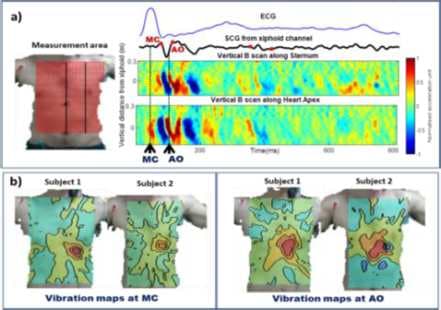
Figure 1.Visual Seismocardiogram (vSCG). a) Time variation along vertical scans b) Spatial distribution of chest surface vibrations at fiducial events- Mitral valve closing (MC) and Aortic valve opening (AO).
Clinical Snapshot
Evidence Rating
Relevance
high Priority