Back to Evidence Hub
Case Study definition-of-fiducial-points-in-the-normal-seismocardiogram
2018 Release

Definition of Fiducial Points in the Normal Seismocardiogram

Executive Summary

This study defines fiducial points in the seismocardiogram (SCG) and correlates them with physiological events identified in ultrasound images for 42 healthy subjects. Using synchronized SCG, ECG, and echocardiography data, the authors manually annotated fiducial points and established correlations with eight cardiac events, including valve openings and closures. The findings demonstrate strong correlations (e.g., r = 0.94 for aortic valve closure) and suggest SCG's potential for non-invasive cardiac diagnostics, particularly in identifying cardiac cycle events with high temporal precision.

This research shows how chest vibrations (SCG) can accurately track heart valve movements, offering a simple, non-invasive way to monitor heart health using accelerometers.

Answer Machine Insights

Q: What is the correlation between SCG fiducial points and aortic valve closure?

The fiducial point Bd in SCG correlates strongly with aortic valve closure (r = 0.94, p < 0.001).

The shortest time difference between the fiducial point of the SCG and the time point for aortic valve closure is −5 ms (±12 ms) and is located at point Bd. The correlation between the fiducial point and time point is 0.94 (p < 0.001).

Q: How accurately does SCG detect mitral valve opening?

SCG fiducial point Fd shows a mean difference of −7 ms (±19 ms) with mitral valve opening, with a correlation of r = 0.87 (p < 0.001).

For the MO time point a combination of the tissue Doppler image and the onset of the E-wave in the pulsed wave Doppler was used. The shortest mean time difference of −7 ms (±19 ms) is to the fiducial point Sd. The correlation is 0.87 (p < 0.001).

Key Results

  • Correlation coefficient for aortic valve closure and SCG fiducial point Bd: r = 0.94 (p < 0.001).

  • Mean difference between mitral valve opening and SCG fiducial point Fd: −7 ms (±19 ms), r = 0.87 (p < 0.001).

Visual Evidence
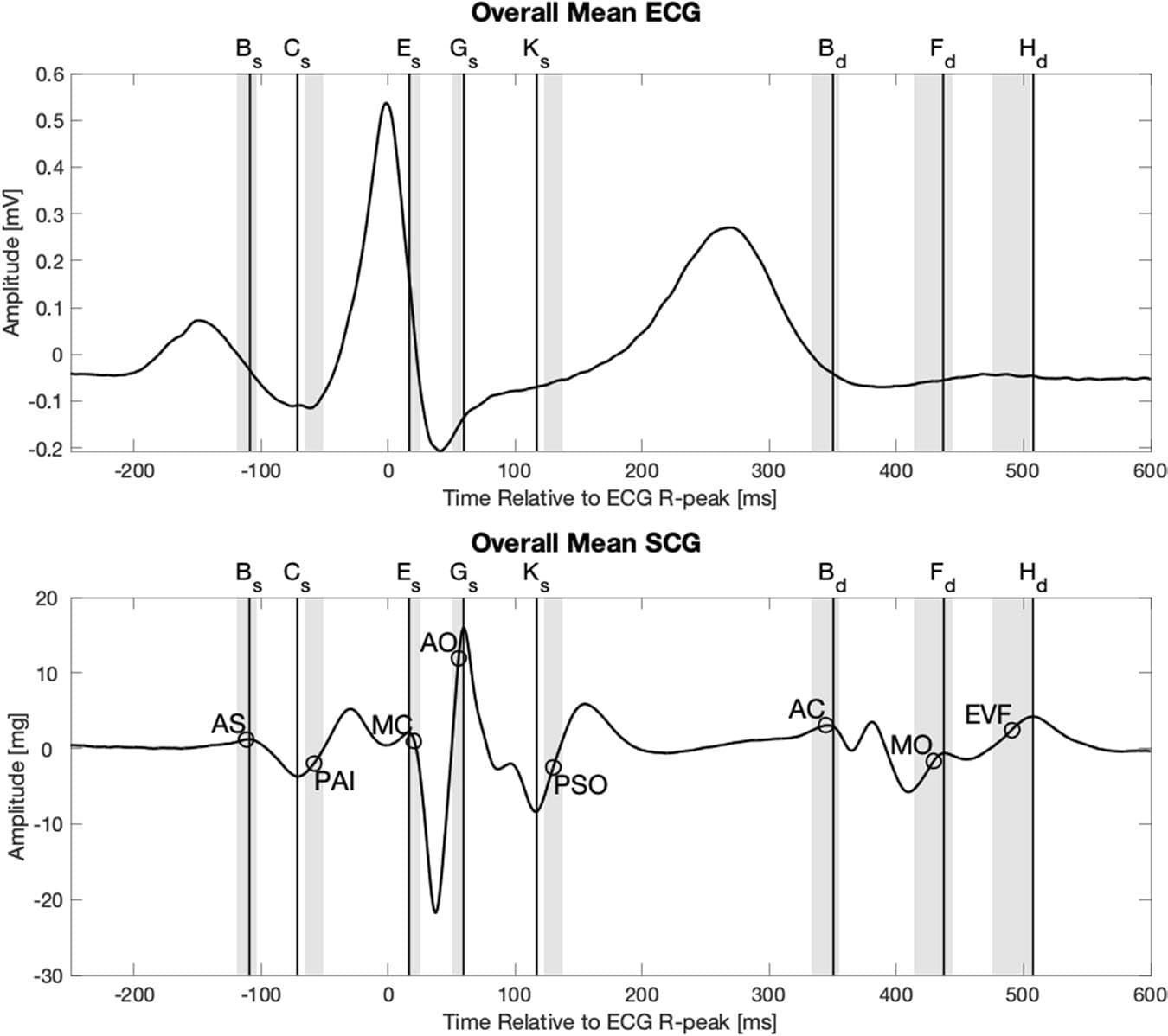
Figure 4.  Overall mean electrocardiogram and seismocardiogram signal from 34 subjects. The circles indicate  the mean location of the following physiologic events found in ultrasound images, from left: Atrial systole (AS),  peak atrial inflow (PAI), mitral valve closure (MC), aortic valve opening (AO), peak systolic outflow (PSO),  aortic valve closing (AC), mitral valve opening (MO), early ventricular filling (EVF). The grey areas indicate the  95% confidence intervals of the means for the physiologic events found in the ultrasound images.

Figure 4.  Overall mean electrocardiogram and seismocardiogram signal from 34 subjects. The circles indicate the mean location of the following physiologic events found in ultrasound images, from left: Atrial systole (AS), peak atrial inflow (PAI), mitral valve closure (MC), aortic valve opening (AO), peak systolic outflow (PSO), aortic valve closing (AC), mitral valve opening (MO), early ventricular filling (EVF). The grey areas indicate the 95% confidence intervals of the means for the physiologic events found in the ultrasound images.

Clinical Snapshot

Evidence Rating

Relevance

high Priority

Confidence

Cornerstone

Relativity Score

4/5
Rigor
4/5
Novelty
5/5
Impact

Semantic Graph Connections

Similar Methodology

Autonomic function testing aboard the ISS using “PNEUMOCARD”

Similar Methodology

Mechanical deconditioning of the heart due to long-term bed rest as observed on seismocardiogram morphology

Similar Methodology

Automatic Identification of Systolic Time Intervals in Seismocardiogram

Similar Methodology

Multichannel seismocardiography: an imaging modality for investigating heart vibrations

Similar Methodology

A seismocardiography system and a possibility of its use for diagnosis of internal organs diseases using seismocardiogram information analysis

Similar Methodology

Evaluation of seismocardiography in detecting pre-load changes and cardiovascular disease: a comparative study with transthoracic echocardiography

Similar Methodology

A new algorithm for segmentation of cardiac quiescent phases and cardiac time intervals using seismocardiography

Similar Methodology

Challenges in Using Seismocardiography for Blood Pressure Monitoring

Similar Methodology

Cardiac Time Intervals Derived from Electrocardiography and Seismocardiography in Different Patient Groups

Similar Methodology

Porcine Model for Validation of Noninvasive Estimation of Pulmonary Hypertension

Similar Methodology

Analysis of Non-Contact Multichannel Recording of Cardiac Vibration: Visual Seismocardiogram

Similar Methodology

Multi-site cardiac rhythm monitoring via multi-channel SCG system and exercise-induced physiological analysis

Similar Methodology

A Comparison of Heart Pulsations Provided by Forcecardiography and Double Integration of Seismocardiogram

Similar Methodology

ECG-Free Assessment of Cardiac Valve Events Using Seismocardiography

Similar Methodology

Three-dimensional apex-seismocardiography