LubDubDecoder: Bringing Micro-Mechanical Cardiac Monitoring to Hearables
Executive Summary
This study introduces LubDubDecoder, a novel system that transforms hearables into tools for monitoring micro-mechanical cardiac vibrations, specifically SCG and GCG signals, using built-in speakers and microphones. The system achieves high correlations (0.88–0.95) with chest-mounted reference measurements in a feasibility study with 25 participants and demonstrates robustness across different hearable designs, remounting sessions, and music playback. Clinical implications include enabling hands-free, everyday cardiovascular monitoring, potentially improving early detection and management of heart conditions.
Answer Machine Insights
Q: What is the primary innovation of LubDubDecoder?
The system repurposes built-in speakers in hearables to capture and reconstruct SCG and GCG signals, enabling cardiac monitoring across a wide range of devices.
Our key insight is that the familiar 'lub-dub' sounds of the heart beating can be measured from the ear and leveraged to reconstruct the fine-grained SCG and GCG waveforms.
Q: How does the system handle variability across different hearables?
It uses a zero-effort normalization strategy that aligns signals from new devices with a reference device, enabling generalization without explicit user calibration.
To generalize to new hearable devices not seen during training, we apply a zero-effort normalization strategy that does not require any explicit calibration effort by the user.
Key Results
Achieved Pearson correlations of 0.88–0.95 with chest-mounted reference measurements.
Zero-effort adaptation scheme generalized across hearables with a correlation of 0.91.
Visual Evidence
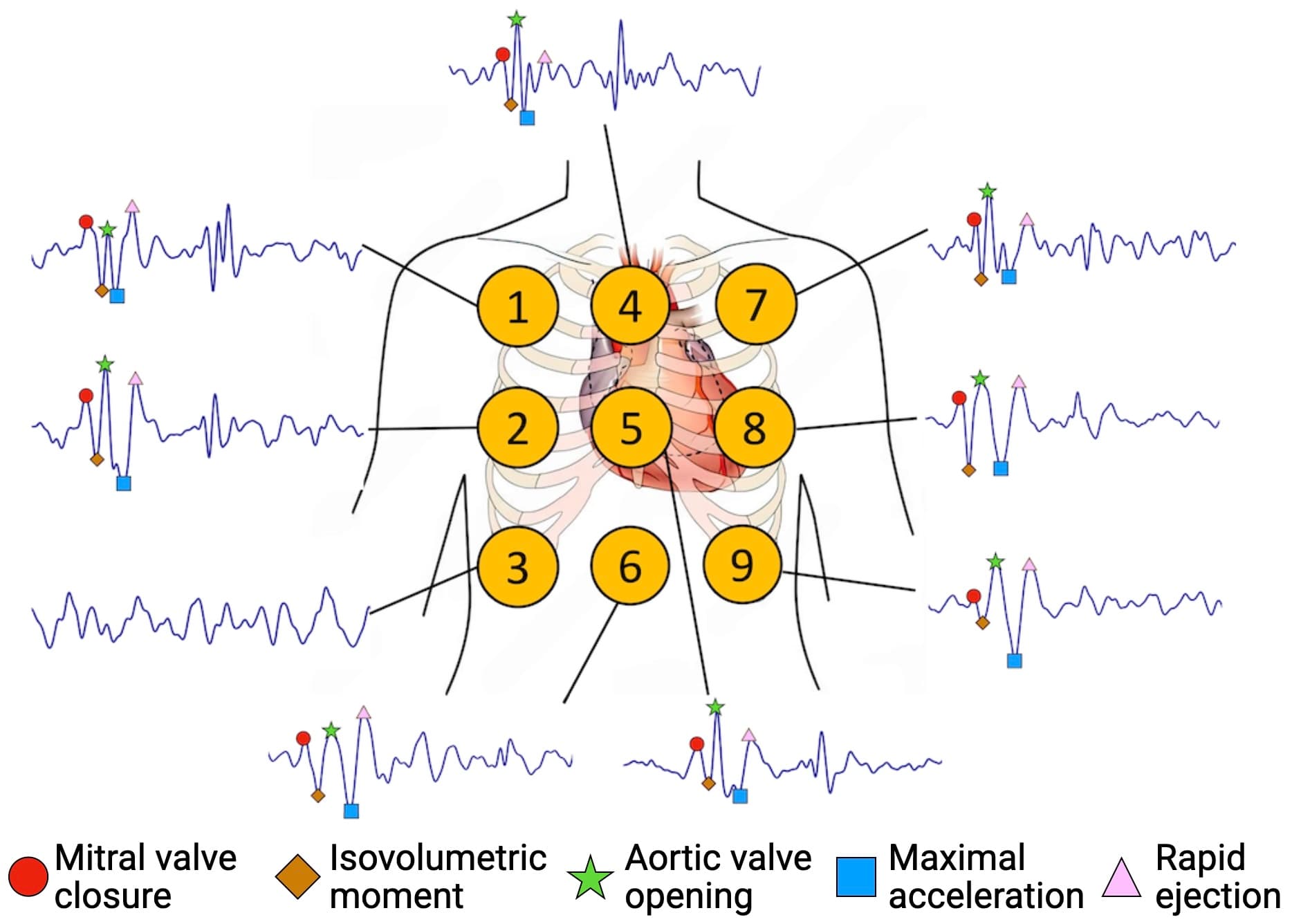
Figure 3: Challenge of conventional IMU-based micro-cardiac measurements. Differences in sensor placement lead to vari- ations in waveforms, making comparisons across repeated measurements challenging. Precise and consistent placement is difficult to ensure when measurements are performed by lay users outside clinical settings. Each waveform cor- responds to a cycle of 800 ms, and amplitudes are normalized to their own maximum.
Clinical Snapshot
Evidence Rating
Relevance
high Priority