Back to Evidence Hub
Case Study monitoring-of-respiration-and-cardiorespiratory-interactions-from-multichannel-seismocardiography-signals
2025 Release

Monitoring of respiration and cardiorespiratory interactions from multichannel seismocardiography signals

Executive Summary

This study investigates the impact of accelerometer placement on the extraction of respiratory information and cardiorespiratory interactions from seismocardiography (SCG) signals. Using a 4-by-4 matrix of triaxial accelerometers, respiratory signals were derived from chest inclination, amplitude modulation, and morphological changes in SCG signals. A novel continuous morphological similarity index (MSi) was introduced, achieving high accuracy in respiratory act detection (sensitivity >90%) and inter-breath interval estimation (bias ±0.8s). The findings suggest SCG can reliably monitor respiration and cardiorespiratory interactions across multiple chest locations, with implications for wearable health monitoring systems.

This study shows that chest vibrations measured by accelerometers can accurately track breathing and heart-lung interactions, regardless of sensor placement. It introduces a new method to analyze these signals for better health monitoring.

Answer Machine Insights

Q: What is the impact of sensor placement on SCG-based respiratory monitoring?

Sensor placement had minimal impact on respiratory signals derived from chest inclination and morphological changes, but amplitude modulation showed higher variability.

Very accurate localization of respiratory acts and measurement of inter-breath intervals were possible in all 16 positions over the chest, thus confirming that sensor placement has no practical impact on respiratory signals based on thoracic movements.

Q: What is the novelty of the morphological similarity index (MSi)?

MSi provides a continuous description of respiratory-induced morphological changes in SCG signals, unlike previous studies that only described discrete changes.

For the first time, a continuous description of morphological changes in SCG signals is presented, as opposed to previous studies that proposed discrete descriptions based only on two SCG morphologies.

Key Results

  • Sensitivity for respiratory act detection exceeded 90% for chest inclination and MSi signals.

  • Inter-breath interval estimation showed biases within ±0.8s for chest inclination and MSi signals.

Visual Evidence
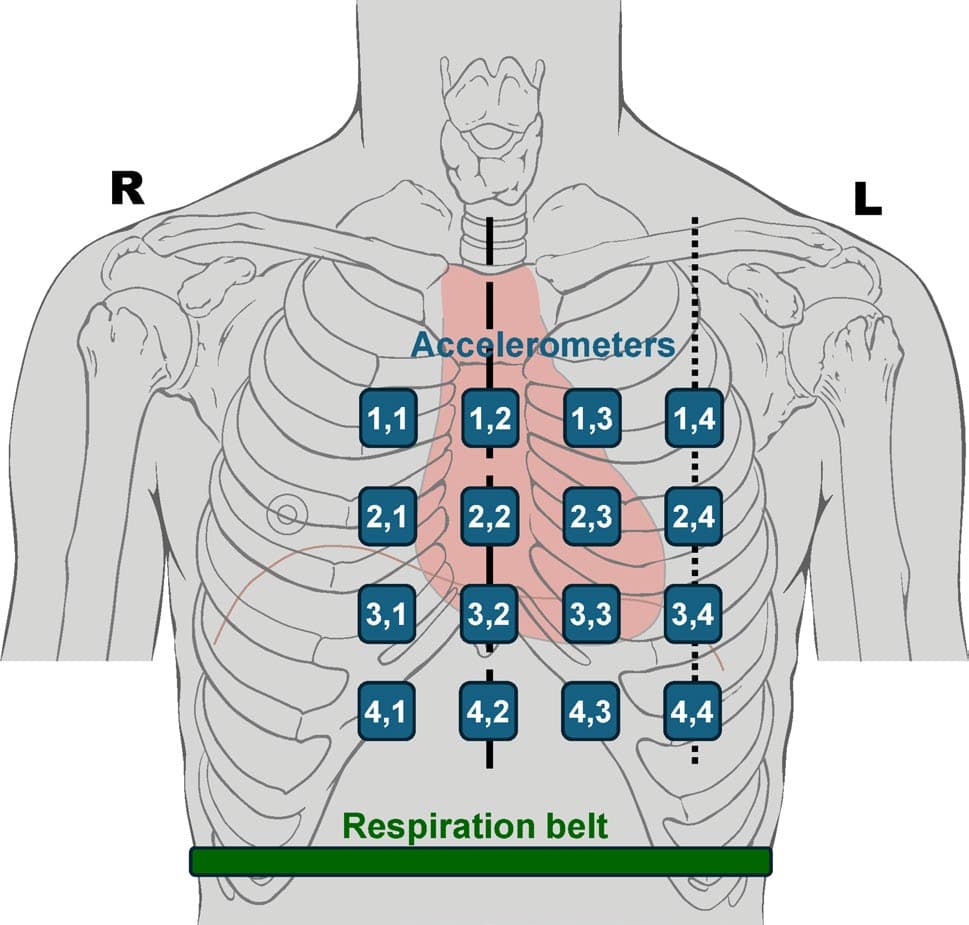
Fig. 1  Positioning of the 4-by-4 accelerometer matrix and the respira­ tion belt on a subject’s chest

Fig. 1  Positioning of the 4-by-4 accelerometer matrix and the respira­ tion belt on a subject’s chest

Clinical Snapshot

Evidence Rating

Relevance

high Priority

Confidence

Supporting

Relativity Score

4/5
Rigor
4/5
Novelty
5/5
Impact

Semantic Graph Connections

Similar Methodology

From video to vital signs: a new method for contactless multichannel seismocardiography

Similar Methodology

Estimation of cardiorespiratory fitness in healthy using seismocardiography

Similar Methodology

Accurate and consistent automatic seismocardiogram annotation without concurrent ECG

Similar Methodology

Multichannel seismocardiography: an imaging modality for investigating heart vibrations

Similar Methodology

Non-exercise estimation of peak oxygen uptake in patients with ischaemic heart disease and heart failure using seismocardiography

Similar Methodology

Validity and reliability of a clinical non-exercise method for assessment of cardiorespiratory fitness using seismocardiography

Similar Methodology

Heart Rate and Respiratory Rate Monitoring Using Seismocardiography

Similar Methodology

Universal Pre-Ejection Period Estimation Using Seismocardiography: Quantifying the Effects of Sensor Placement and Regression Algorithms

Similar Methodology

Toward Wearable Estimation of Tidal Volume via Electrocardiogram and Seismocardiogram Signals

Similar Methodology

A Wavelet-Based Approach for Motion Artifact Reduction in Ambulatory Seismocardiography

Similar Methodology

Extracting Cardiovascular-Induced Chest Vibrations from Ordinary Chest Videos: A Comparative Study

Similar Methodology

A Hidden Markov Model for Seismocardiography

Similar Methodology

High-Accuracy, Unsupervised Annotation of Seismocardiogram Traces for Heart Rate Monitoring

Similar Methodology

The acceptability of a novel seismocardiography device for measuring VO2 max in a workplace setting: a mixed methods approach

Similar Methodology

Determining the Respiratory State From a Seismocardiographic Signal--A Machine Learning Approach

Similar Methodology

Visualization of the Multichannel Seismocardiogram

Similar Methodology

Determination of Maximal Oxygen Uptake Using Seismocardiography at Rest

Similar Methodology

Multi-site cardiac rhythm monitoring via multi-channel SCG system and exercise-induced physiological analysis

Similar Methodology

Evaluating Seismocardiography as a Non-Exercise Method for Estimating Maximal Oxygen Uptake

Similar Methodology

A Cardiac Early Warning System with Multi Channel SCG and ECG Monitoring for Mobile Health

Similar Methodology

ECG-Free Assessment of Cardiac Valve Events Using Seismocardiography

Similar Methodology

Seismocardiography for Emotion Recognition: A Study on EmoWear with Insights from DEAP

Similar Methodology

LubDubDecoder: Bringing Micro-Mechanical Cardiac Monitoring to Hearables