Universal Pre-Ejection Period Estimation Using Seismocardiography: Quantifying the Effects of Sensor Placement and Regression Algorithms
Executive Summary
This study explores universal pre-ejection period (PEP) estimation using seismocardiography (SCG) signals, focusing on sensor placement and regression algorithms. Using ensemble regression models, particularly XGBoost, the authors demonstrate that SCG signals collected below the left clavicle combined with sternum signals yield the lowest RMSE (11.6 ± 0.4 ms). The findings suggest that sensor placement below the clavicle improves PEP estimation accuracy compared to conventional sternum placement, and flexible interfacing materials maintain measurement reliability, supporting wearable device applications.
Answer Machine Insights
Q: What sensor placement yielded the best PEP estimation accuracy?
The combination of sensors placed below the left clavicle and on the sternum yielded the best accuracy with RMSE = 11.6 ± 0.4 ms.
Our results show that ensemble regression using XGBoost with a combination of sensors placed on the sternum and below the left clavicle provide the best RMSE = 11.6 ± 0.4 ms across all subjects.
Q: Can SCG sensors be used over clothing without losing accuracy?
Yes, placing the sensor on a flexible silicone rubber sheet slightly improved PEP estimation accuracy compared to direct skin contact.
Finding that SCG obtained from placing the sensor on a silicone rubber sheet performs as well, and even slightly better, in PEP estimation than SCG obtained from placing the sensor in direct contact with the skin could be an indication that the sensor can be worn over a thin layer of clothing.
Key Results
RMSE for PEP estimation using SCG signals from below the left clavicle combined with sternum signals was 11.6 ± 0.4 ms.
Flexible silicone rubber sheets for sensor placement maintained or slightly improved PEP estimation accuracy compared to direct skin contact.
Visual Evidence
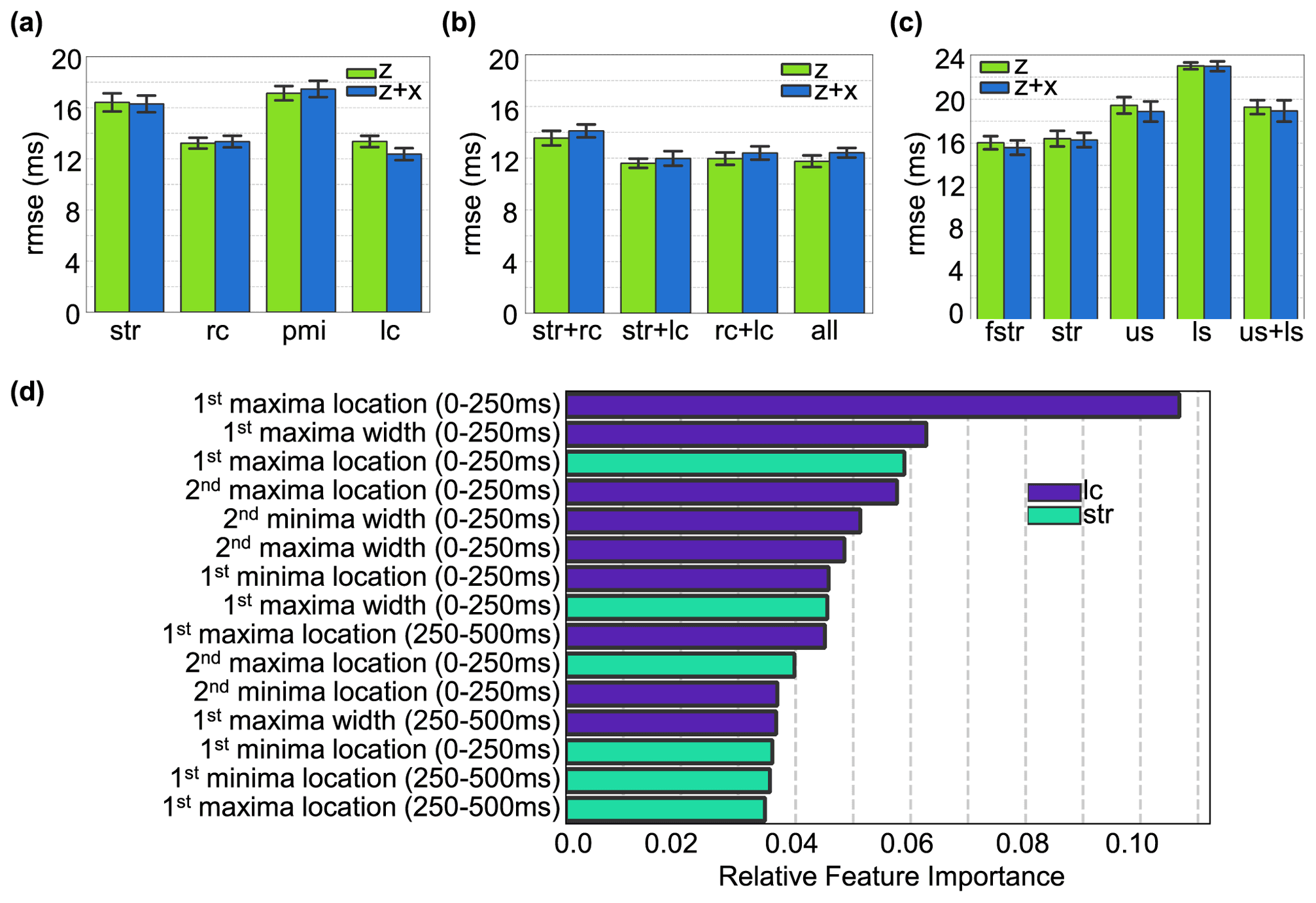
Fig. 4. (a). RMSE from PEP estimated from features obtained from accelerometers placed on the sternum (Str), below the right clavicle (RC), point of maximal impulse (PMI), and below the left clavicle (LC)for both the dorsoventral axis (z-axis) and head-to-foot and dorsoventral axes combined (z+x axes). (b) RMSE from PEP estimated from features obtained from the best performing combination of accelerometer locations. It can be observed that adding more sensors does not substantially reduce the error obtained using one sensor below the left or right clavicle. (c) RMSE from PEP estimated from accelerometers placed on the sternum with different interfacing techniques: in the middle of a silicone rubber sheet placed along on the sternum (fstr), directly on the sternum (Str), and two accelerometers coupled by a rigid plastic mold and placed on the upper sternum (US) and lower sternum (LS). (d) Ranking of best 15 features obtained from the combination of sensors and axis that rendered the lowest RMSE (Str+LC axis z).
Clinical Snapshot
Evidence Rating
Relevance
high Priority