Motion artifact cancellation from a single channel SCG using adaptive forgetting factor recursive least square filter
Executive Summary
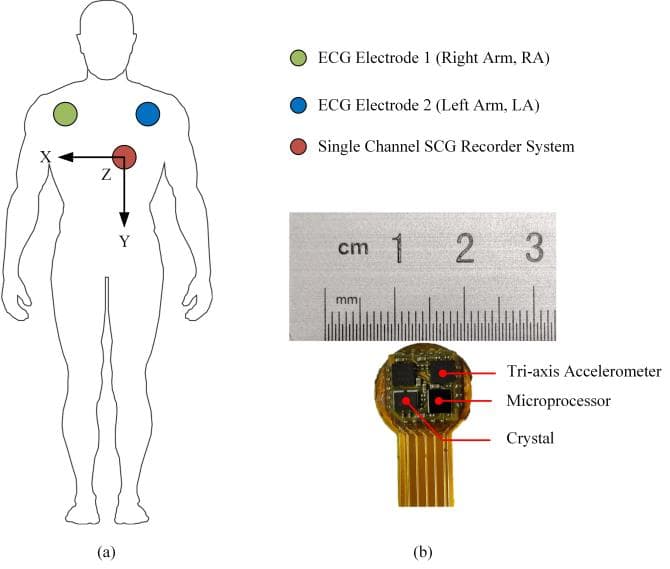
This study introduces a novel adaptive forgetting factor recursive least square filter (AFFRLSF) for motion artifact cancellation in single-channel seismocardiography (SCG) signals recorded using a tri-axis accelerometer. The filter was embedded in a custom hardware system and tested on 24 subjects performing various dynamic motions. Results demonstrated an average correlation coefficient of 0.9878 between heart rates estimated from SCG and ECG, highlighting the filter's effectiveness in extracting clear heartbeat signals under motion artifacts. The findings suggest significant potential for wearable SCG-based heart monitoring applications.
Answer Machine Insights
Q: How effective is the AFFRLSF in removing motion artifacts from SCG signals?
The AFFRLSF achieved an average correlation coefficient of 0.9878 between heart rates estimated from SCG and ECG, demonstrating high effectiveness.
The results indicate an average correlation coefficient of up to 0.9878 between heart rates estimated from SCG and ECG of all the 24 subjects.
Q: What motions were tested in the study?
Standing, walking, jogging, jumping, and recovery motions were tested.
Dynamic motions including standing, walking, jogging, and jumping are considered in our experiment.
Key Results
Average correlation coefficient of 0.9878 between heart rates estimated from SCG and ECG.
Heart rate estimation accuracy decreases with increasing motion intensity, but remains robust under walking and jogging conditions.
Visual Evidence
Clinical Snapshot
Evidence Rating
Relevance
high Priority