High-Accuracy, Unsupervised Annotation of Seismocardiogram Traces for Heart Rate Monitoring
Executive Summary
This study introduces an unsupervised, automated methodology for analyzing Seismocardiogram (SCG) signals to detect heartbeats and annotate beat-to-beat intervals without requiring ECG-based calibration. The algorithm was validated on two datasets, achieving sensitivity and precision scores above 98%, and demonstrated strong agreement with ECG-derived intervals (R2 > 98%). The findings highlight the robustness of SCG-based heart rate monitoring for applications in active assisted living (AAL) environments.
Answer Machine Insights
Q: How does the proposed method compare to ECG-based calibration?
The method eliminates the need for ECG-based calibration while maintaining high accuracy in detecting heartbeats and annotating intervals.
In previous work, initial calibration required the acquisition of a reference ECG trace. In the current approach, such ECG-assisted calibration phase is no longer needed.
Q: What are the implications of the achieved sensitivity and precision scores?
The high sensitivity and precision scores indicate the method's reliability in detecting heartbeats without false positives or negatives.
Overall, an average of 98.5% and 99.1% sensitivity scores is achieved for the CEBS and Custom databases, respectively, whereas precision were found to be 98.6% and 97.9%.
Key Results
Sensitivity and precision scores of 98.5% and 98.6% for the CEBS dataset, and 99.1% and 97.9% for the Custom dataset.
R2 correlation scores of 99.3% and 98.4% with ECG-derived intervals for the CEBS and Custom datasets, respectively.
Visual Evidence
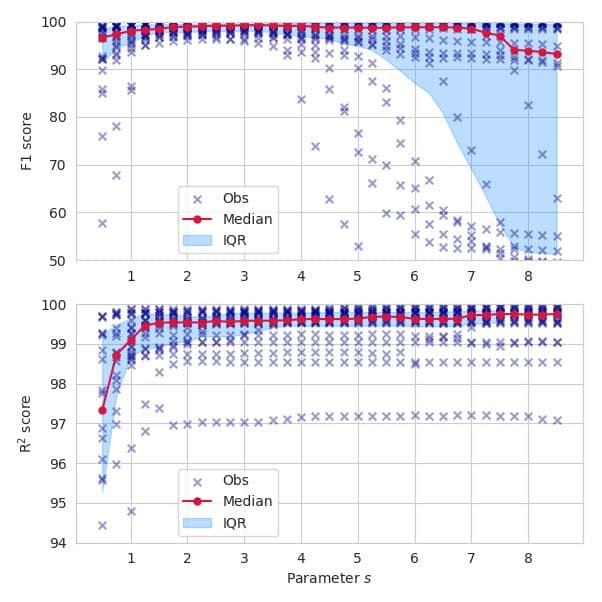
Fig. 4. Variation of F1 (top) and R2 (bottom) scores with respect to the s parameter. Shaded area represents the interquartile range, solid lines the median, whereas crosses represent individual performance.
Clinical Snapshot
Evidence Rating
Relevance
high Priority