Multiclass Classifier based Cardiovascular Condition Detection Using Smartphone Mechanocardiography
Executive Summary
This study explores the use of smartphone-based mechanocardiography (MCG) leveraging seismocardiography (SCG) and gyrocardiography (GCG) signals for multiclass classification of cardiovascular conditions, including atrial fibrillation (AFib), coronary artery disease (CAD), and ST-elevation myocardial infarction (STEMI). Using machine learning techniques such as Kernel Support Vector Machine (KSVM) and Random Forest (RF), the study achieved diagnostic accuracies of up to 98% for AFib detection and 75% for multiclass classification. The findings highlight the potential of smartphone inertial sensors for non-invasive cardiac monitoring, though further validation with larger datasets and clinical trials is necessary.
Answer Machine Insights
Q: What is the accuracy of AFib detection using smartphone inertial sensors?
The accuracy of AFib detection was 98% using Kernel Support Vector Machine (KSVM) with majority voting.
Strikingly, there is no need to get electro-physiological signals (e.g. ECG) from the heart, but only the precordial vibrations. Our presented MCG monitoring provides a novel way — based on solely measuring mechanical activity — for AFib detection independent of 12-lead ECG and with a comparable diagnostic accuracy of 98%.
Q: How effective is the multiclass classification for detecting multiple heart conditions?
The multiclass classification achieved an accuracy of 75% using Random Forest with majority voting.
The accuracy of the 4-class classifier is 71.17% without majority voting and 75.24% with majority voting.
Key Results
AFib detection achieved 98% accuracy using KSVM with majority voting.
Multiclass classification (Normal, AFib, CAD, STEMI) achieved 75% accuracy using RF with majority voting.
Visual Evidence
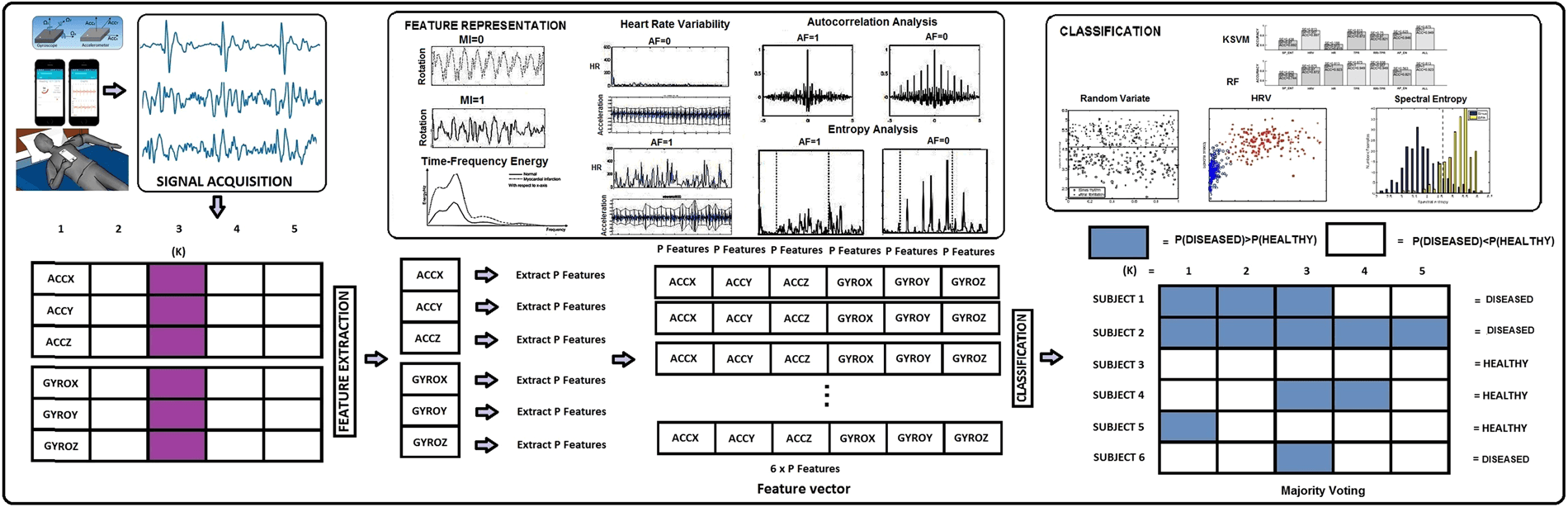
Figure 2. Overall diagram of the machine learning pipeline. Segmented SCG-GCG data are fed to the feature extraction function which forms a row-wise concatenation of features corresponding to each axis. In classification part, the final models are cross-validated by class prediction for each of the test cases is the dataset.
Clinical Snapshot
Evidence Rating
Relevance
high Priority