Comparison of Seismocardiography Based Heart Rate Measurement Method
Executive Summary
This study introduces two novel methods for heart rate estimation using seismocardiography (SCG) data obtained from a 6-degree-of-freedom MEMS inertial measurement unit (IMU). The methods include Empirical Mode Decomposition (EMD) and jerk signal analysis, with the latter showing improved accuracy in detecting the Aorta Open (AO) fiducial point. The findings suggest that jerk signal processing provides a more precise alternative for SCG-based heart rate estimation, with potential applications in non-invasive cardiac monitoring.
Answer Machine Insights
Q: What is the main advantage of the jerk signal method over traditional SCG methods?
The jerk signal method provides more accurate detection of the Aorta Open (AO) fiducial point, leading to improved heart rate estimation.
The success of SCG extraction method with jerk includes the features of AO points which are more clearly seen with the distance of AO-AO closer to the reference value between 400ms and 450ms.
Q: How does Empirical Mode Decomposition (EMD) contribute to SCG signal processing?
EMD decomposes SCG signals into intrinsic mode functions (IMFs), with the first IMF providing detailed information for AO event detection.
The experimental results showed that the EMD signal at the 2nd IMF contained signal artefacts representing the heart rate.
Key Results
Method 3 (jerk signal analysis) achieved AO-AO interval detection closer to the reference value (400-450ms).
Heart rate estimation using Method 3 showed improved accuracy compared to Method 1 and Method 2, with results aligning closely with reference values.
Visual Evidence
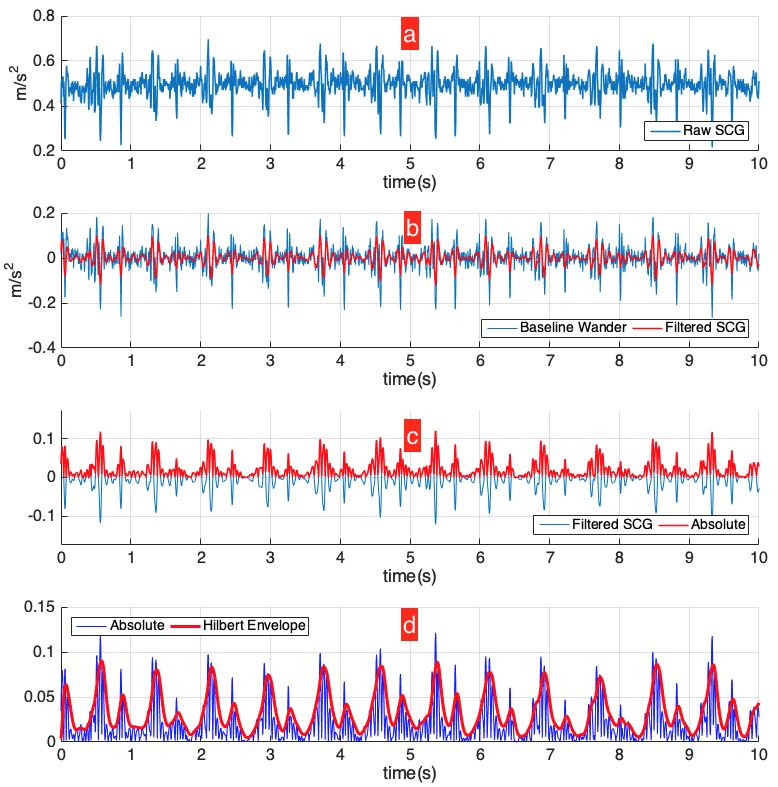
Figure 10. Signal processing in method 1 with the final result of peak on the signal envelope identical to the AO on the SCG signal. (a) original signal (b) filtered signal (c) and
Clinical Snapshot
Evidence Rating
Relevance
high Priority