Enhancing visual seismocardiography in noisy environments with adaptive bidirectional filtering for Cardiac Health Monitoring
Executive Summary
This study introduces Adaptive Bidirectional Filtering (ABF), a novel noise-cancellation technique for seismocardiography (SCG) signals, leveraging Redundant Multi-Scale Wavelet Decomposition (RMWD) and bidirectional filtering. The methodology integrates time-frequency masking and non-negative matrix factorization to isolate cardiac signals and suppress motion artefacts, achieving a noise reduction efficiency of 97% and an r-squared value of 0.95 at -20 dB SNR. The findings demonstrate ABF's potential for real-time, non-invasive cardiac monitoring in noisy environments without requiring ECG inputs.
Answer Machine Insights
Q: How effective is ABF in reducing motion artefacts in SCG signals?
ABF achieves a noise reduction efficiency of 97%, significantly outperforming other methods like EMD and NCC.
The ABF technique performs best with an NRE of 97%, which implies that it is highly efficient in isolating SCG signals from motion-related noise.
Q: What is the accuracy of heart rate estimation using ABF?
ABF achieves an r-squared value of 0.95 at -20 dB SNR, indicating high accuracy in heart rate estimation.
The accuracy in heart rate estimation reached an impressive r-squared value of 0.95 at −20 dB SNR, significantly outperforming the baseline value.
Key Results
Noise Reduction Efficiency (NRE) of 97% achieved using ABF.
R-squared value of 0.95 for heart rate estimation at -20 dB SNR.
Visual Evidence
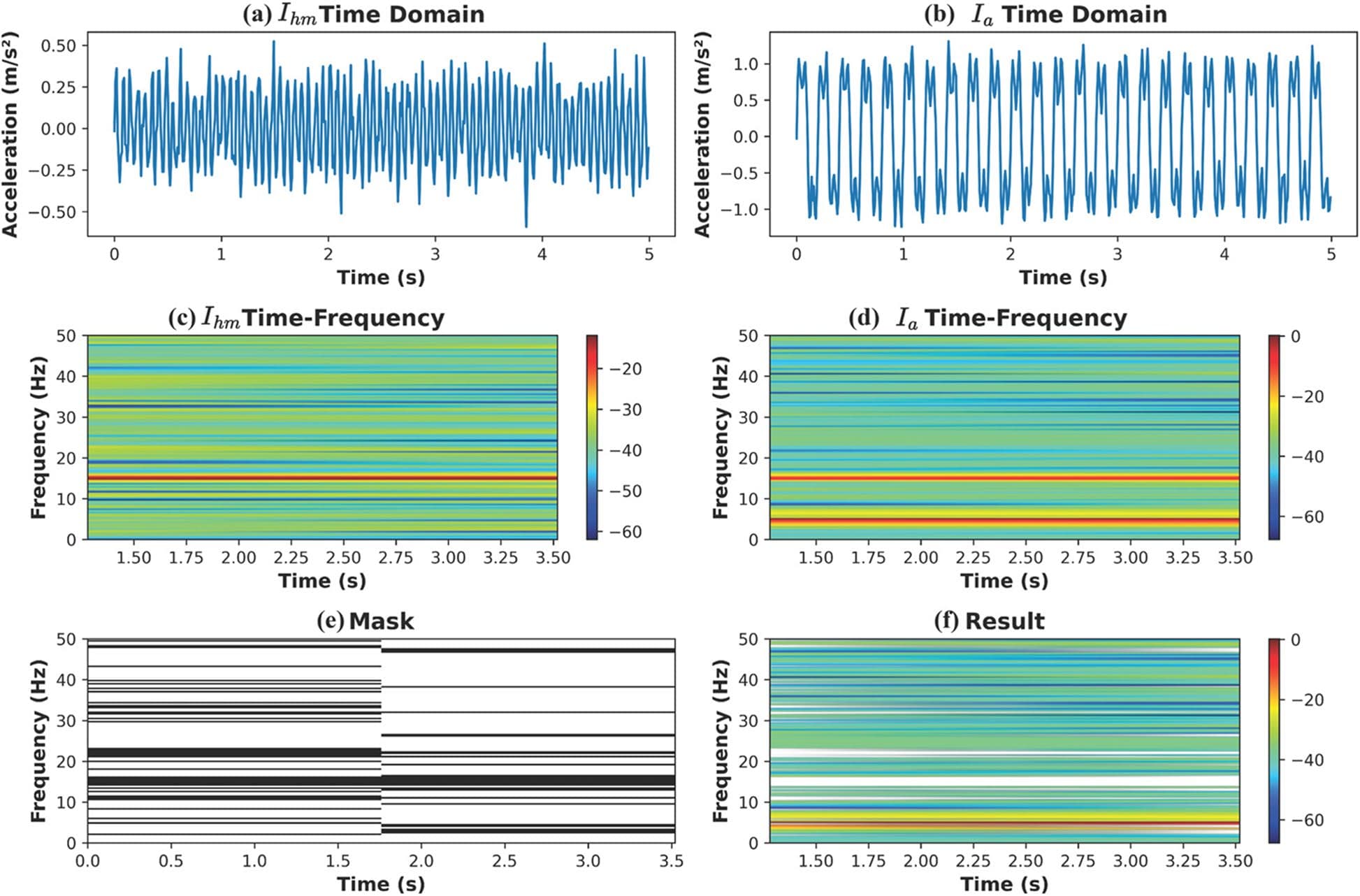
Fig. 2 Illustration of TFM that includes (a) Accelerometer Time Domain, (b) SCG Time Domain, (c) Accelerometer Time-Frequency, (d) SCG Time-Frequency, (e) Time-Frequency Mask, (f) Resulting SCG Signal
Clinical Snapshot
Evidence Rating
Relevance
high Priority