Back to Evidence Hub
Case Study non-exercise-estimation-of-peak-oxygen-uptake-in-patients-with-ischaemic-heart-disease-and-heart-failure-using-seismocardiography
2025 Release

Non-exercise estimation of peak oxygen uptake in patients with ischaemic heart disease and heart failure using seismocardiography

Executive Summary

This study evaluated the accuracy of a novel seismocardiography (SCG)-based equation (SCG 4.7_HD) for estimating peak oxygen uptake (VO2peak) in patients with ischemic heart disease (IHD) and heart failure with reduced ejection fraction (HFrEF). The SCG-based method was compared to the gold-standard cardiopulmonary exercise test (CPET) and showed poor-to-moderate agreement with significant overestimation and large estimation errors. Furthermore, the SCG method failed to detect changes in VO2peak following 12 weeks of cardiac rehabilitation, limiting its clinical applicability.

This study found that a new heart monitoring method using vibrations (SCG) was not accurate enough to estimate fitness levels or track improvements in heart patients after rehabilitation.

Answer Machine Insights

Q: How accurate was the SCG 4.7_HD in estimating VO2peak compared to CPET?

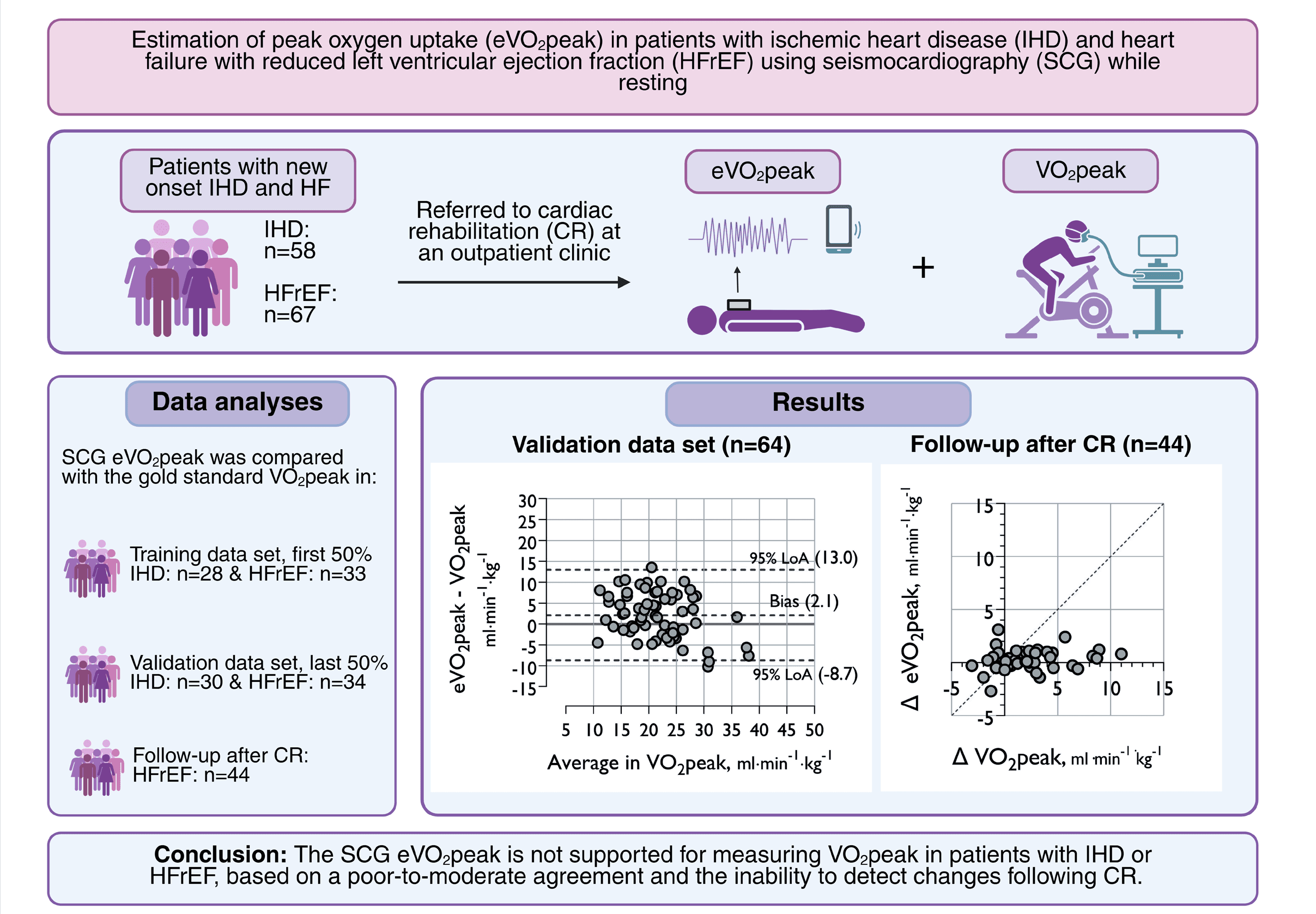
The SCG 4.7_HD showed poor-to-moderate agreement with CPET, overestimating VO2peak by 2.1 mL/min/kg and having a MAPE of 29.1%.

The SCG 4.7_HD overestimated VO2peak (2.1 mL min−1 kg−1, P = 0.003) with 95% limits of agreement ranging ±10.9 mL min−1 kg−1 when compared with CPET.

Q: Was the SCG method able to detect changes in VO2peak after cardiac rehabilitation?

No, the SCG method failed to detect changes in VO2peak following 12 weeks of cardiac rehabilitation.

No correlation was observed between delta SCG 4.7_HD and CPET after CR for patients with HFrEF.

Key Results

  • The SCG 4.7_HD overestimated VO2peak by 2.1 mL/min/kg with 95% limits of agreement ranging ±10.9 mL/min/kg compared to CPET.

  • The mean absolute percentage error (MAPE) of the SCG method was 29.1%, exceeding the predefined clinical relevance threshold of 10%.

Visual Evidence
Clinical Snapshot

Evidence Rating

Relevance

high Priority

Confidence

Supporting

Relativity Score

4/5
Rigor
3/5
Novelty
4/5
Impact

Semantic Graph Connections

Similar Methodology

Monitoring of respiration and cardiorespiratory interactions from multichannel seismocardiography signals

Similar Methodology

Estimation of cardiorespiratory fitness in healthy using seismocardiography

Similar Methodology

Accuracy of a Clinical Applicable Method for Prediction of VO2max Using Seismocardiography

Similar Methodology

Validity and reliability of a clinical non-exercise method for assessment of cardiorespiratory fitness using seismocardiography

Similar Methodology

Point-of-care aid-to-diagnosis for heart failure using artificial intelligence based on seismocardiography acquired with a smartphone in the emergency department

Similar Methodology

Seismocardiography as a valuable non-exercise method for estimating peak Vo2 in cardiac patients? first experiences in Germany

Similar Methodology

Automatic Detection of Seismocardiogram Sensor Misplacement for Robust Pre-Ejection Period Estimation in Unsupervised Settings

Similar Methodology

Universal Pre-Ejection Period Estimation Using Seismocardiography: Quantifying the Effects of Sensor Placement and Regression Algorithms

Similar Methodology

Estimation of Changes in Intracardiac Hemodynamics Using Wearable Seismocardiography and Machine Learning in Patients With Heart Failure: A Feasibility Study

Similar Methodology

Wearable Seismocardiography‐Based Assessment of Stroke Volume in Congenital Heart Disease

Similar Methodology

The acceptability of a novel seismocardiography device for measuring VO2 max in a workplace setting: a mixed methods approach

Similar Methodology

Determining the Respiratory State From a Seismocardiographic Signal--A Machine Learning Approach

Similar Methodology

Determination of Maximal Oxygen Uptake Using Seismocardiography at Rest

Similar Methodology

Evaluating Seismocardiography as a Non-Exercise Method for Estimating Maximal Oxygen Uptake