Automatic Detection of Seismocardiogram Sensor Misplacement for Robust Pre-Ejection Period Estimation in Unsupervised Settings
Executive Summary
This study investigates the impact of SCG sensor placement on pre-ejection period (PEP) estimation, demonstrating that regression parameters vary significantly with sensor position. A boosted J-48 decision tree classifier was developed to detect misplacement, achieving 0.83 precision and 0.82 recall. The findings highlight the importance of accurate sensor positioning for robust PEP estimation in unsupervised settings, with implications for home-based heart failure monitoring.
Answer Machine Insights
Q: What is the precision and recall of the classifier for detecting sensor misplacement?
The classifier achieved 0.83 precision and 0.82 recall.
With our classifier, we obtained a precision of 0.83 and a recall of 0.82.
Q: How does sensor misplacement affect PEP estimation?
Sensor misplacement leads to significant errors in PEP estimation, with average absolute errors reaching up to 2284.4 ms for cubic regression.
A summary of the obtained correlation coefficients, r, averaged across all subjects is shown in Figure 4(b). Additionally, Table I shows the average of absolute PEP estimation errors(ms) resulting from using the initially calibrated parameters obtained from the mid-sternal position when the accelerometer is placed in each of the 5 positions.
Key Results
The classifier achieved 0.83 precision and 0.82 recall in detecting sensor misplacement.
Average absolute PEP estimation errors varied significantly across sensor positions, with errors as high as 2284.4 ms for cubic regression.
Visual Evidence
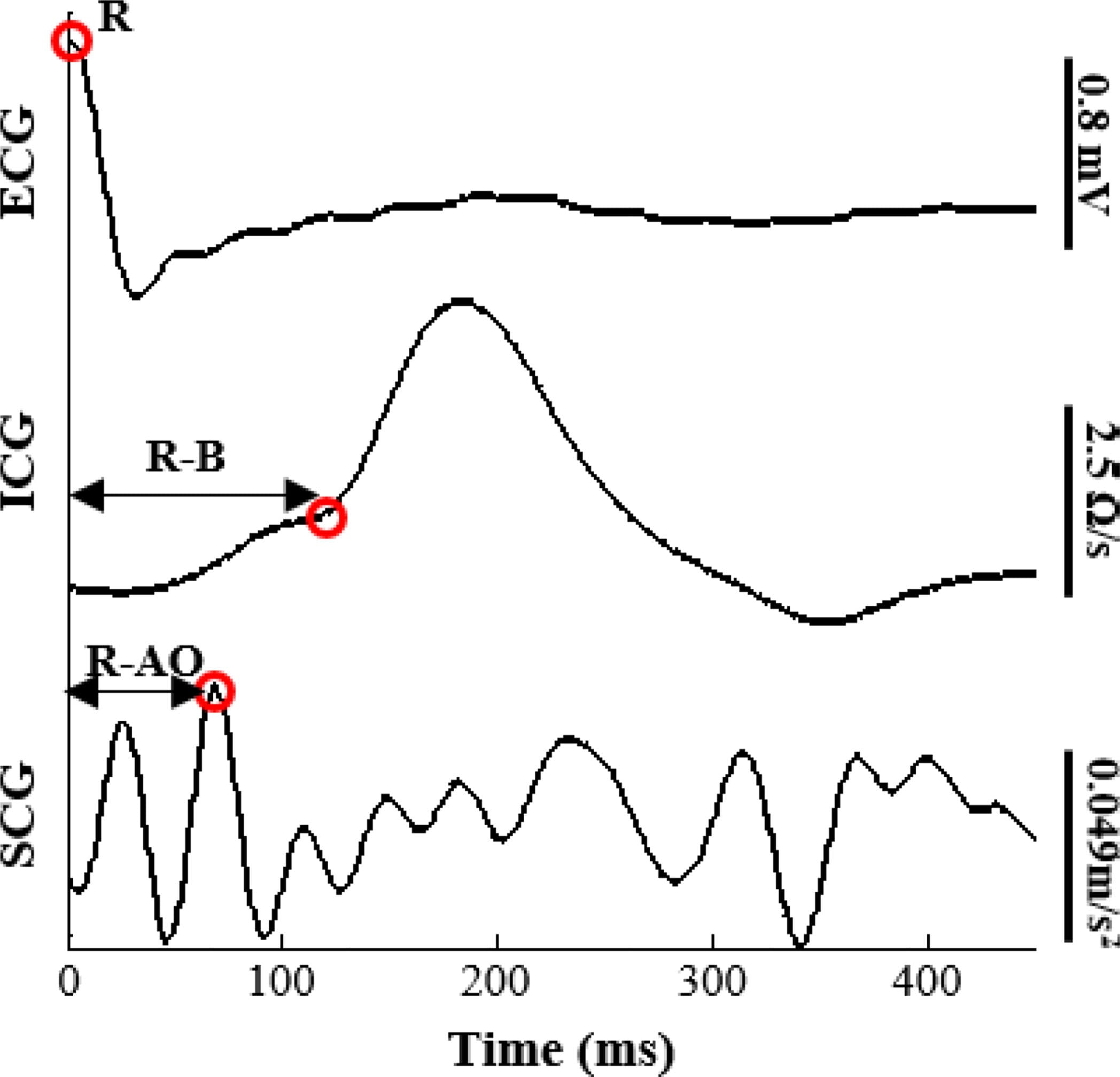
Fig. 2. Ensemble averaged beats of ECG, ICG, and mid-sternal SCG signals with the R-peak, B- point, and AO-point annotated.
Clinical Snapshot
Evidence Rating
Relevance
high Priority