SEISMIC-HF 1: key findings from AHA24 and implications for remote cardiac monitoring
Executive Summary
This mini-review highlights findings from the SEISMIC-HF 1 study, which demonstrated the ability of a wearable sensor patch (CardioTag) to estimate pulmonary capillary wedge pressure (PCWP) in patients with heart failure with reduced ejection fraction (HFrEF). Using seismocardiography, photoplethysmography, and electrocardiography signals combined with a machine learning algorithm, the study achieved a significant correlation (r = 0.74, R2 = 0.55) with gold-standard right heart catheterization measurements. These results suggest potential for non-invasive, remote hemodynamic monitoring in heart failure management.
Answer Machine Insights
Q: What was the correlation between the wearable sensor's PCWP estimates and the gold-standard RHC measurements?
The correlation was r = 0.74, with an R2 of 0.55.
The investigators found a correlation between their model predicted PCWP and gold standard measurement on RHC in the holdout set (r = 0.74). This yields an R2 of 0.55.
Q: What is the clinical significance of the wearable sensor's performance?
The wearable sensor's margin of error is comparable to implantable pulmonary artery sensors, suggesting it could be used for remote hemodynamic-guided management of heart failure.
It should be noted that the degree of correlation and margin of error in this study is in line with the performance of implantable pulmonary artery sensors in predicting pulmonary artery diastolic pressure.
Key Results
Correlation between model-predicted PCWP and RHC measurements: r = 0.74, R2 = 0.55.
Mean difference between predicted and measured PCWP: 1.04 ± 5.57 mmHg.
Visual Evidence
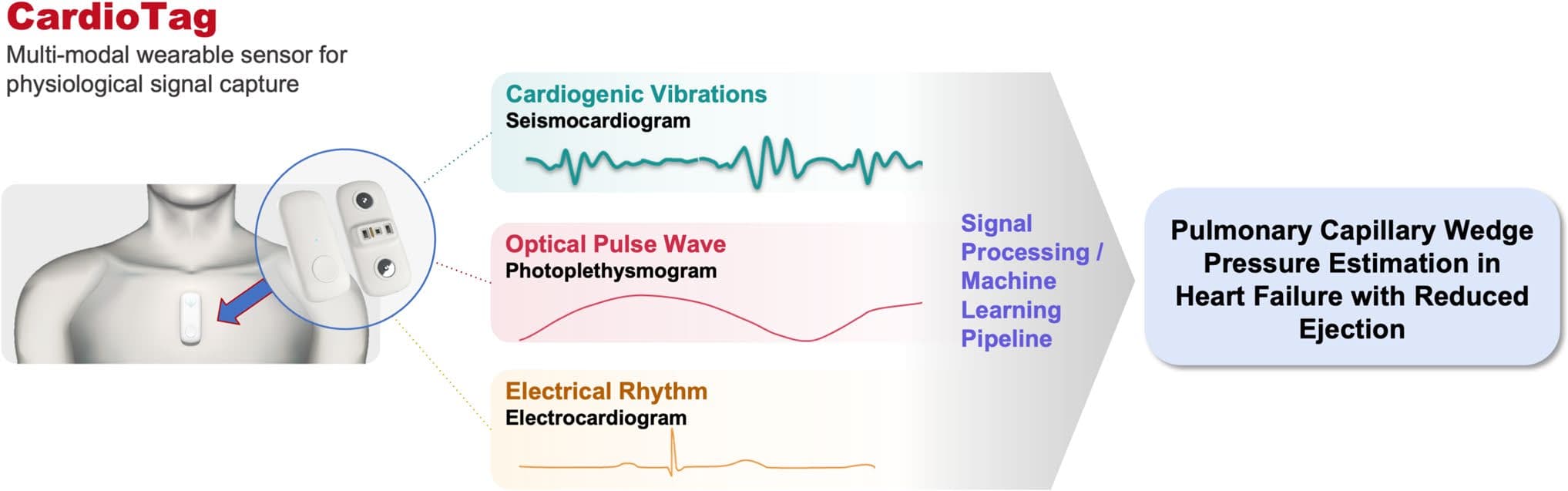
Fig. 1 Physiologic signals from non-invasive sensor for pulmonary capillary wedge pressure estimation. CardioTag (Cardiosense, Inc., Chicago, IL) is a wearable sensor patch capable of capturing seis- mocardiography, photoplethysmography, and electrocardiography
Clinical Snapshot
Evidence Rating
Relevance
high Priority