Back to Evidence Hub
Case Study non-invasive-wearable-patch-utilizing-seismocardiography-for-peri-operative-use-in-surgical-patients
2020 Release

Non-Invasive Wearable Patch Utilizing Seismocardiography for Peri-Operative Use in Surgical Patients

Executive Summary

This study introduces a wearable patch that combines seismocardiography (SCG) and electrocardiography (ECG) signals to estimate stroke volume (SV) in peri-operative surgical patients. Using a random forest regression model validated with leave-one-subject-out cross-validation, the wearable patch achieved a correlation coefficient of 0.81 and a median absolute error of 7.56 mL compared to the Transesophageal Doppler (TED) reference standard. The findings suggest that this non-invasive technology could replace TED for continuous SV monitoring during pre-, intra-, and post-operative periods, improving fluid management protocols and patient outcomes.

This study shows that a wearable patch can accurately monitor heart function during and after surgery, offering a non-invasive alternative to traditional methods.

Answer Machine Insights

Q: How accurate is the wearable patch compared to the TED for stroke volume estimation?

The wearable patch achieved a correlation coefficient of 0.81 and a median absolute error of 7.56 mL compared to the TED.

The regression model trained on the combination of the SCG and ECG features was correlated to the TED reference standard (r = 0.81) with a relatively low MedAE (7.56 mL) across all subjects.

Q: What are the advantages of using SCG and ECG signals together for stroke volume estimation?

Combining SCG and ECG signals improves prediction accuracy, achieving higher correlation and lower error compared to using either signal alone.

Using the cardio-mechanical information only (i.e., SCG signal features alone) resulted in a correlation value of 0.67 and a MedAE of 9.51 mL, whereas using only the electrical (ECG) information resulted in a correlation value of 0.31 and a MedAE of 14.75 mL.

Key Results

  • Correlation coefficient of 0.81 between wearable patch predictions and TED reference values.

  • Median absolute error of 7.56 mL for stroke volume estimation using SCG and ECG features.

Visual Evidence
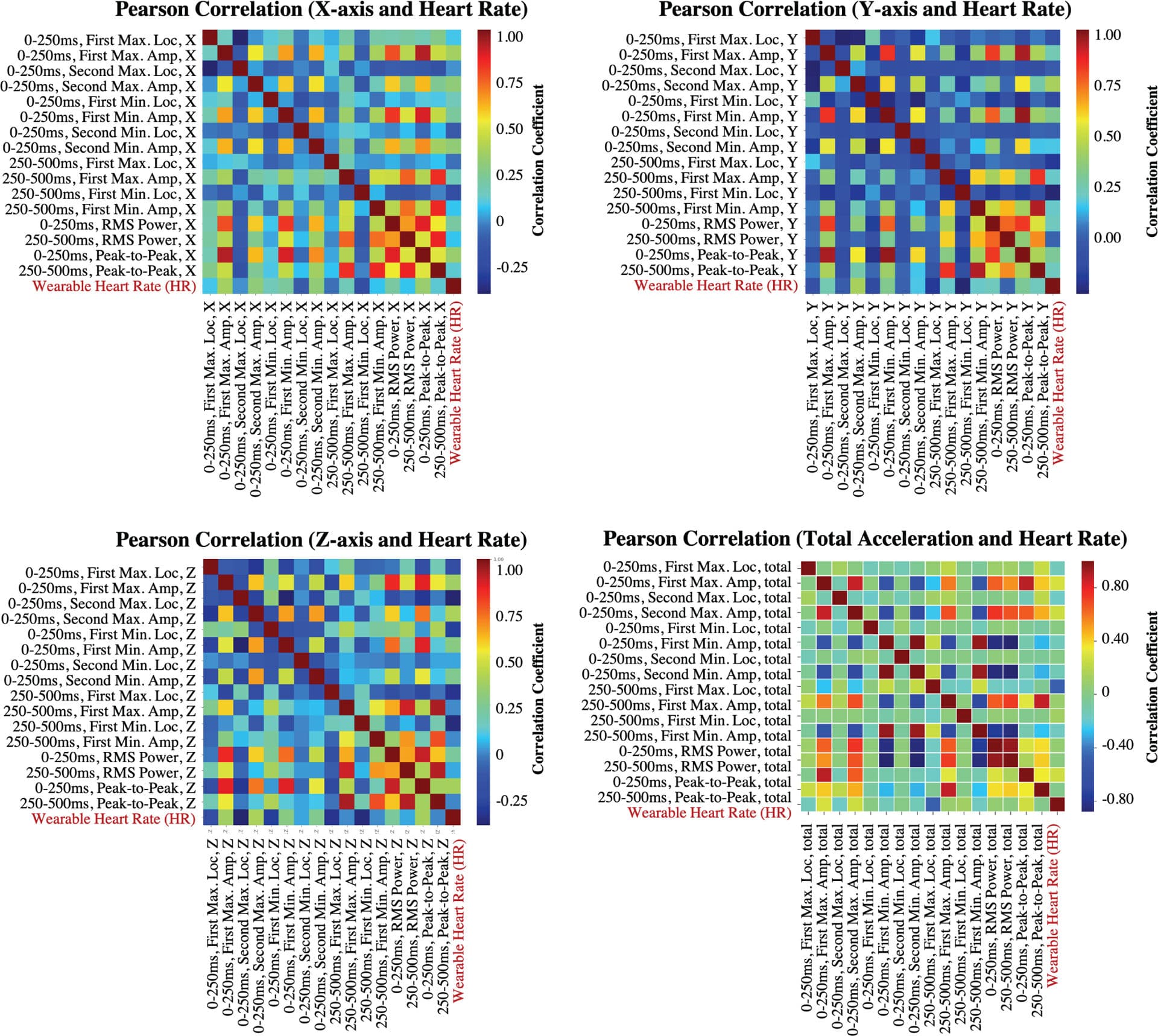
Fig. 6.  Pearson correlation coefficients between different feature pairs from SCGx,y,z,total signals.

Fig. 6. Pearson correlation coefficients between different feature pairs from SCGx,y,z,total signals.

Clinical Snapshot

Evidence Rating

Relevance

high Priority

Confidence

Supporting

Relativity Score

4/5
Rigor
4/5
Novelty
5/5
Impact

Semantic Graph Connections

Similar Methodology

SEISMIC-HF 1: key findings from AHA24 and implications for remote cardiac monitoring

Similar Methodology

Estimation of cardiorespiratory fitness in healthy using seismocardiography

Similar Methodology

Accuracy of a Clinical Applicable Method for Prediction of VO2max Using Seismocardiography

Similar Methodology

Seismocardiography-based estimation of hemodynamic parameters during submaximal ergometer test

Similar Methodology

Design of synchronous seismocardiography-ballistocardiography monitoring system

Similar Methodology

Robustness of Persistence Diagrams to Time-Delay for Seismocardiogram Signal Quality Assessment*

Similar Methodology

Toward Wearable Estimation of Tidal Volume via Electrocardiogram and Seismocardiogram Signals

Similar Methodology

Quantifying and Reducing Motion Artifacts in Wearable Seismocardiogram Measurements During Walking to Assess Left Ventricular Health

Similar Methodology

Estimation of Changes in Intracardiac Hemodynamics Using Wearable Seismocardiography and Machine Learning in Patients With Heart Failure: A Feasibility Study

Similar Methodology

Wearable Seismocardiography‐Based Assessment of Stroke Volume in Congenital Heart Disease

Similar Methodology

The acceptability of a novel seismocardiography device for measuring VO2 max in a workplace setting: a mixed methods approach

Similar Methodology

Determination of Maximal Oxygen Uptake Using Seismocardiography at Rest

Similar Methodology

Evaluating Seismocardiography as a Non-Exercise Method for Estimating Maximal Oxygen Uptake

Similar Methodology

A Cardiac Early Warning System with Multi Channel SCG and ECG Monitoring for Mobile Health