Heart Rate Variability Estimation with Joint Accelerometer and Gyroscope Sensing
Executive Summary
This study introduces a novel method for estimating heart rate variability (HRV) using combined seismocardiography (SCG) and gyrocardiography (GCG) signals obtained from tri-axial MEMS accelerometers and gyroscopes. The methodology employs single-axis and multi-axis autocorrelation (1-AC and 6-AC) techniques to enhance HRV parameter extraction, validated against ECG recordings from 29 healthy male volunteers. Results demonstrate improved accuracy in key HRV metrics, suggesting potential for long-term wearable monitoring applications.
Answer Machine Insights
Q: What is the main advantage of using 6-AC over 1-AC?
The 6-AC method improves the accuracy of HRV parameters by combining data from all accelerometer and gyroscope axes.
The most important HRV parameters Mean RR and STD RR (as well as HR and STD HR) and RMSSD are improved clearly through the use of 6-AC method.
Q: How does the study validate the SCG/GCG method?
The study compares HRV parameters derived from SCG/GCG signals against ECG recordings in a cohort of 29 healthy male volunteers.
We validate our results with a comparison study between simultaneous ECG and SCG/GCG recordings using a study group of 29 healthy male volunteers.
Key Results
Mean error in mean RR intervals reduced from 3.36 ms (1-AC) to 2.23 ms (6-AC).
Frequency domain HRV parameters showed consistent improvement with 6-AC, e.g., FFT LF peak error reduced from 0.0121 Hz to 0.0075 Hz.
Visual Evidence
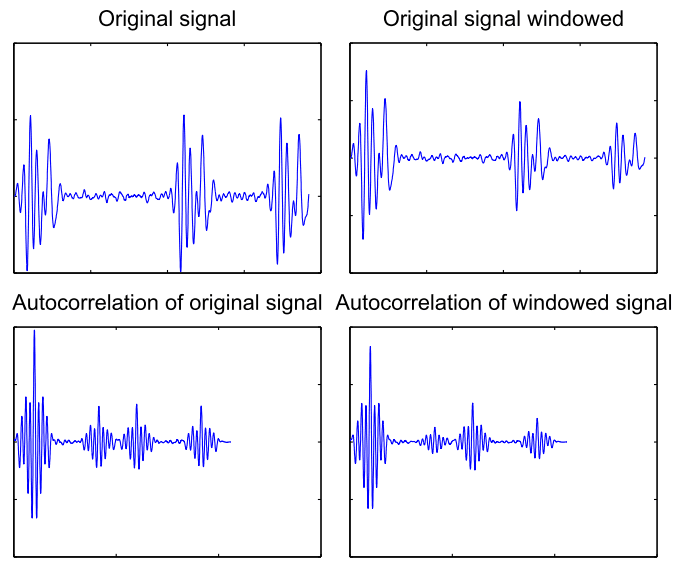
Figure 2. The figure shows first the original signal, and then the original signal windowed with a steadily decreas- ing windowing function (upper right corner). The autocor- relation of the original signal (lower left corner) shows that the first peak from the left (corresponding to signal itself) is the largest, but the other peaks are difficult to distin- guish. The last image (lower right corner) shows that the windowing function allows for separating the peaks after the leftmost part of the AC signal has been thresholded to zero.
Clinical Snapshot
Evidence Rating
Relevance
high Priority