Noncontact Multipoint Vital Sign Monitoring With mmWave MIMO Radar
Executive Summary
This study introduces MultiVital, a wireless system for non-contact multi-point vital sign monitoring using mmWave MIMO radar. The system integrates radar hardware with five-channel SCG sensors and one-channel ECG electrodes for synchronous monitoring and validation. A multi-modal signal processing framework was developed, including radar signal processing, SCG calibration, and spatial alignment. Experimental results demonstrate high precision in detecting cardiopulmonary movements across multiple chest regions, with radar estimates closely matching SCG and ECG references, highlighting its potential for comprehensive cardiopulmonary health monitoring.
Answer Machine Insights
Q: How does the radar system compare to SCG sensors in detecting chest displacements?
The radar system closely matches SCG sensor measurements, with cross-correlation values up to 0.88 and negligible frequency differences.
We can see that the radar results and x-axis, y-axis, and z-axis displacements have a very high degree of similarity, with the ρrx being 0.84 to 0.88 and (∆frx)max being 0.
Q: What are the advantages of using mmWave MIMO radar for vital sign monitoring?
The radar provides non-contact, multi-point monitoring with high spatial resolution, avoiding discomfort and skin allergies associated with contact-based methods.
These mmWave MIMO radars can be conveniently installed on walls and ceilings of both homes and hospitals, ensuring they integrate smoothly into people’s daily routines without causing any disturbances.
Key Results
Radar-based multi-point monitoring achieved high precision, closely matching SCG and ECG reference results.
Cross-correlation between radar and SCG signals reached up to 0.88, demonstrating strong agreement.
Visual Evidence
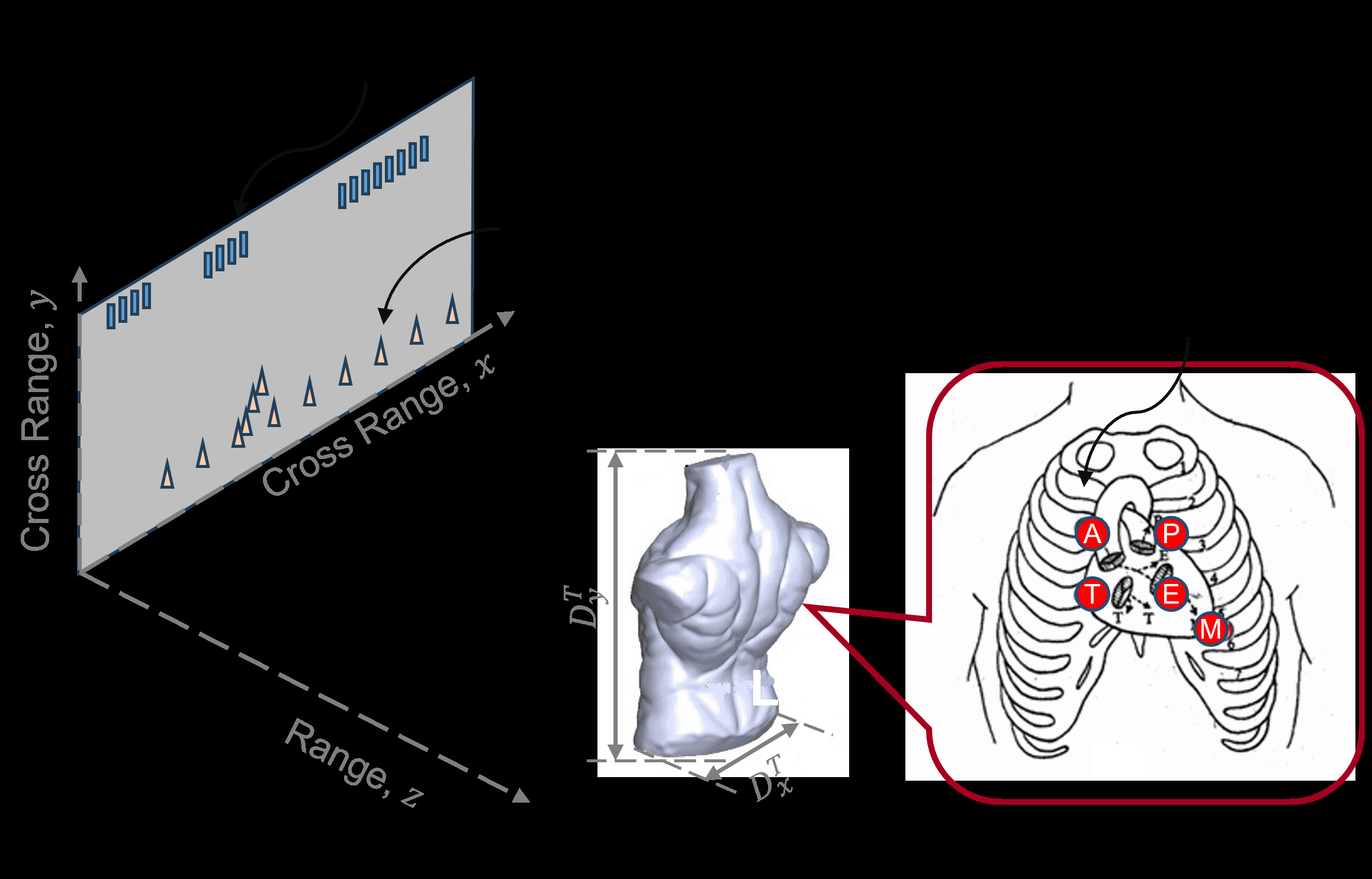
Fig. 1: Research scenario of multi-point vital sign monitoring with mmWave MIMO radar. The MIMO radar system is placed in front of the human chest wall and used to estimate the motion of the five scattering points of interest, i.e., point A, P, T, E, and M.
Clinical Snapshot
Evidence Rating
Relevance
high Priority