Deep Learning for identifying systolic complexes in SCG traces: a cross-dataset analysis
Executive Summary
This study evaluates the use of a U-Net deep learning model for identifying systolic complexes in seismocardiogram (SCG) signals across multiple datasets, including real-world scenarios. The analysis highlights the challenges of domain shift between controlled and uncontrolled environments and demonstrates the benefits of multi-channel data from accelerometers and gyroscopes. Personalization and fine-tuning strategies significantly improved model performance, with F1-scores reaching up to 0.95 in real-world datasets.
Answer Machine Insights
Q: What is the main challenge addressed in this study?
The study addresses the challenge of identifying systolic complexes in SCG signals under domain shift conditions, such as transitioning from controlled to real-world environments.
Our findings prove the effectiveness of a deep learning solution, while showing the importance of a personalization step to contrast the domain shift, namely a change in data distribution between training and testing data.
Q: How does multi-channel data improve performance?
Multi-channel data from accelerometers and gyroscopes significantly improved performance in real-world scenarios by providing additional information to cope with noise and variability.
This result confirms that real-world data are the most challenging ones, and that multiple channels are required to cope with that.
Q: What is the role of personalization in this study?
Personalization improved the model's F1-score by up to 5% in real-world datasets, demonstrating its importance in adapting to individual user data.
As expected, personalization improves all the cases analyzed in terms of F1-score.
Key Results
F1-score of 0.95 achieved in controlled datasets (CEBS and MEC).
F1-score improved by 5% in real-world data (BioPoli) through model personalization.
Visual Evidence
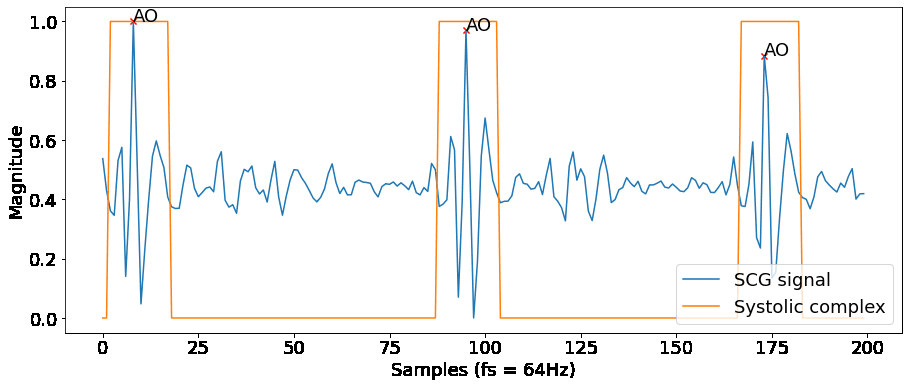
Fig. 1. AO fiducial points and systolic complexes in a clean portion of SCG signal. Note that the bounding boxes are centered in the AO points.
Clinical Snapshot
Evidence Rating
Relevance
high Priority