A Comparison of Heart Pulsations Provided by Forcecardiography and Double Integration of Seismocardiogram
Executive Summary
This study compares heart pulsations derived from Forcecardiography (FCG) and a novel displacement signal obtained via double integration of Seismocardiography (SCG). The methodology involves synchronized acquisition of signals from piezoelectric FCG sensors and MEMS accelerometers, processed to extract low-frequency components (LF-FCG and LF-DSCG). Results show high morphological similarity (normalized cross-correlation >0.9) between LF-FCG and LF-DSCG, but LF-DSCG exhibits lower consistency in inter-beat interval estimation. Future improvements in accelerometer performance and processing methods are suggested to enhance reliability.
Answer Machine Insights
Q: What is the main limitation of LF-DSCG in cardiac monitoring?
LF-DSCG exhibits moderate consistency within the cardiac cycle, leading to inaccuracies in inter-beat interval estimation.
The results show that LF-DSCG achieved fair sensitivity in heart beats detection (about 90%) but exhibited moderate consistency within the cardiac cycle, which led to limits of agreement with ECG higher than 130 milliseconds for inter-beat interval estimation.
Q: How similar are LF-FCG and LF-DSCG signals morphologically?
LF-FCG and LF-DSCG signals exhibit high morphological similarity, with normalized cross-correlation indices exceeding 0.9 during apnea.
The ECG-triggered ensemble averages scored NCCE of 0.93 ± 0.054 (mean ± SD), which turned out to be in excess of 0.94 for all but one subject (#5).
Key Results
Normalized cross-correlation between LF-FCG and LF-DSCG signals exceeds 0.9 during apnea.
LF-DSCG achieves a sensitivity of approximately 90% for heartbeat detection but exhibits inaccuracies in inter-beat interval estimation with limits of agreement exceeding 130 ms.
Visual Evidence
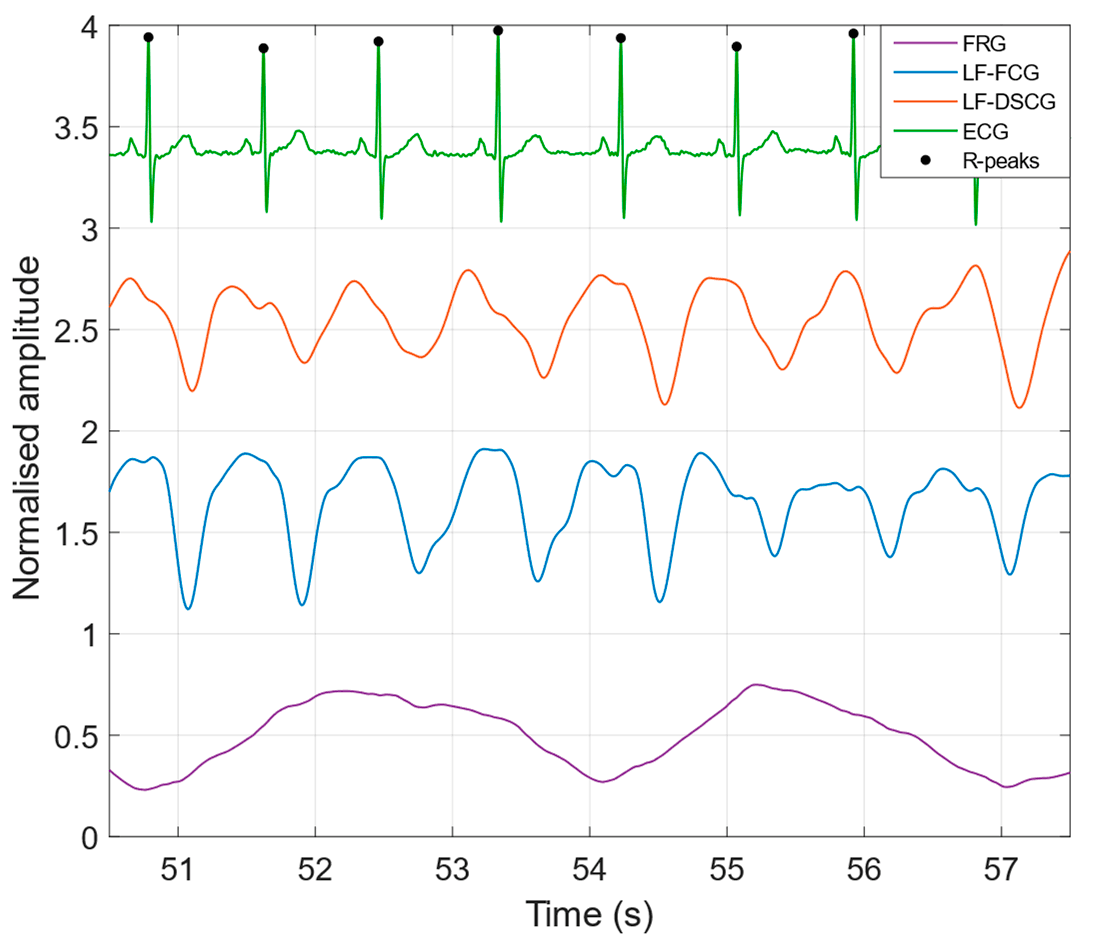
Figure 3. FRG, LF-FCG, LF-DSCG and ECG signals acquired during quiet breathing (subject #2).
Clinical Snapshot
Evidence Rating
Relevance
high Priority