Back to Evidence Hub
Case Study ecg-free-assessment-of-cardiac-valve-events-using-seismocardiography
2024 Release

ECG-Free Assessment of Cardiac Valve Events Using Seismocardiography

Executive Summary

This study introduces an ECG-independent method for detecting aortic valve opening (AO) and mitral valve closure (MC) events using seismocardiography (SCG). By employing a template bank derived from SCG signals of five healthy subjects, the method utilizes normalized cross-correlation for template matching to identify cardiac cycles in unseen SCG signals. The approach achieved an average F1-score of 90.34% for AO detection and 90.20% for MC detection across all subjects, demonstrating its potential for remote cardiovascular monitoring without reliance on ECG data.

This study shows that heart valve events can be detected using body vibrations alone, without the need for ECG, making heart monitoring simpler and more accessible.

Answer Machine Insights

Q: What is the primary innovation of this study?

The study introduces an ECG-independent method for detecting AO and MC events using SCG signals and template matching.

Our research aims to bridge this gap by developing an ECG-independent algorithm for AO and MC detection using SCG signals only, without relying on the templates derived from the same signals under analysis.

Q: How effective is the proposed method in detecting AO and MC events?

The method achieved an average F1-score of 90.34% for AO detection and 90.20% for MC detection across all subjects.

When evaluating the performance of the AO and MC detection algorithm on all subjects, the average precision was 97.02% and 96.79%, the average recall was 86.90% and 86.85%, and the average F1-score was 90.34% and 90.20% for AO and MC detection, respectively.

Key Results

  • Average F1-score for AO detection: 90.34%

  • Average F1-score for MC detection: 90.20%

Visual Evidence
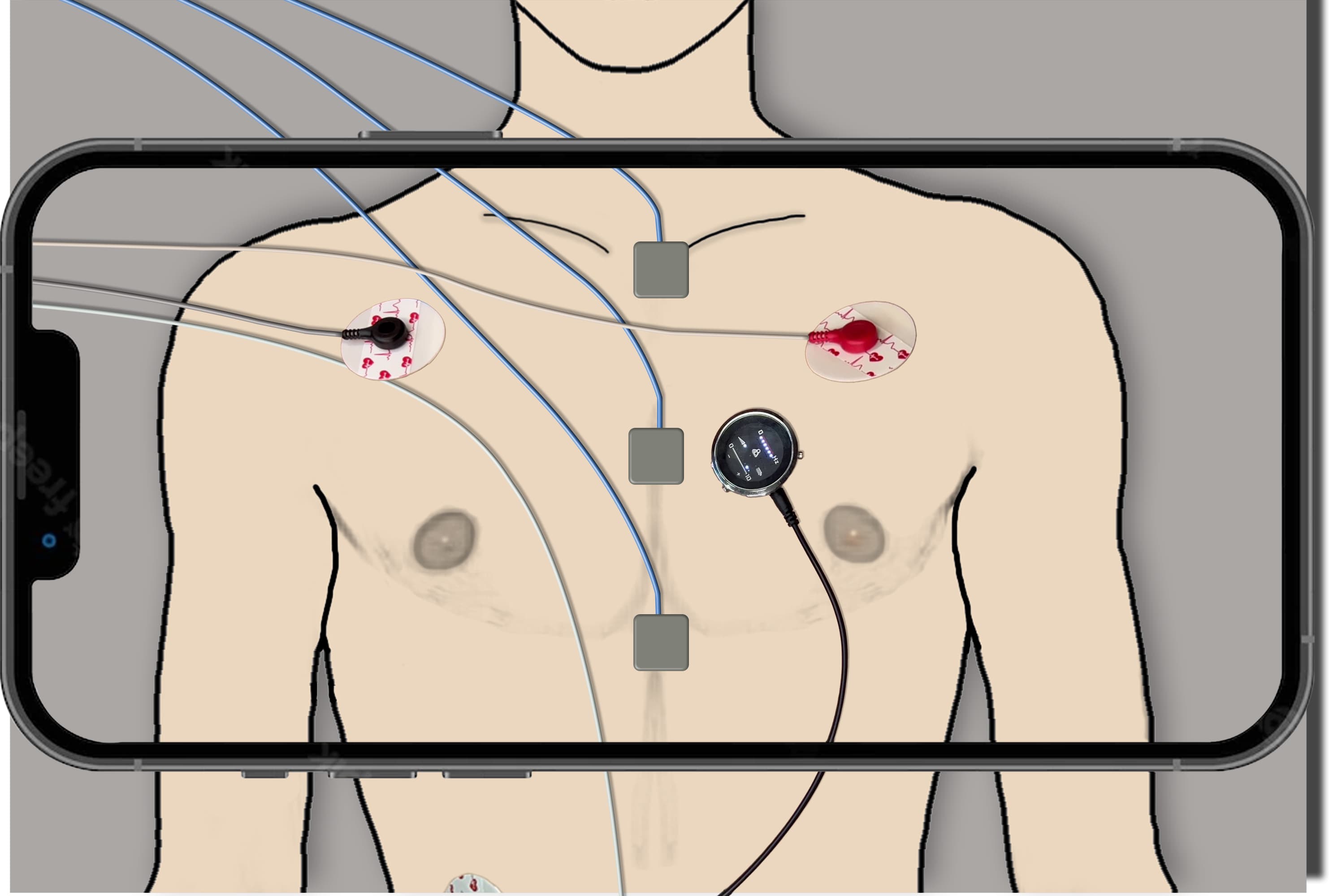
Fig. 1. Data acquisition setup. The sensors include (a) a single-lead ECG, (b) three tri-axial accelerometers, and (c) an electronic stethoscope.

Fig. 1. Data acquisition setup. The sensors include (a) a single-lead ECG, (b) three tri-axial accelerometers, and (c) an electronic stethoscope.

Clinical Snapshot

Evidence Rating

Relevance

high Priority

Confidence

Supporting

Relativity Score

4/5
Rigor
4/5
Novelty
5/5
Impact

Semantic Graph Connections

Similar Methodology

Detecting Aortic Valve-Induced Abnormal Flow with Seismocardiography and Cardiac MRI

Similar Methodology

Monitoring of respiration and cardiorespiratory interactions from multichannel seismocardiography signals

Similar Methodology

Autonomic function testing aboard the ISS using “PNEUMOCARD”

Similar Methodology

Definition of Fiducial Points in the Normal Seismocardiogram

Similar Methodology

Non-contact heart vibration measurement using computer vision-based seismocardiography

Similar Methodology

Multichannel seismocardiography: an imaging modality for investigating heart vibrations

Similar Methodology

A seismocardiography system and a possibility of its use for diagnosis of internal organs diseases using seismocardiogram information analysis

Similar Methodology

Validity and reliability of a clinical non-exercise method for assessment of cardiorespiratory fitness using seismocardiography

Similar Methodology

Universal Pre-Ejection Period Estimation Using Seismocardiography: Quantifying the Effects of Sensor Placement and Regression Algorithms

Similar Methodology

Waveform Similarity Analysis Using Graph Mining for the Optimization of Sensor Positioning in Wearable Seismocardiography

Similar Methodology

High-Accuracy, Unsupervised Annotation of Seismocardiogram Traces for Heart Rate Monitoring

Similar Methodology

Investigating Seismocardiogram Patterns: A Computational Modeling of Cardiac Wall Motion Propagation to the Chest Surface

Similar Methodology

A new algorithm for segmentation of cardiac quiescent phases and cardiac time intervals using seismocardiography

Similar Methodology

Visualization of the Multichannel Seismocardiogram

Similar Methodology

Porcine Model for Validation of Noninvasive Estimation of Pulmonary Hypertension

Similar Methodology

Multi-site cardiac rhythm monitoring via multi-channel SCG system and exercise-induced physiological analysis

Similar Methodology

A Comparison of Heart Pulsations Provided by Forcecardiography and Double Integration of Seismocardiogram

Similar Methodology

A Novel Adaptive Recursive Least Squares Filter to Remove the Motion Artifact in Seismocardiography

Similar Methodology

Heart Rate Variability Analysis on Electrocardiograms, Seismocardiograms and Gyrocardiograms on Healthy Volunteers

Similar Methodology

Heart Rate Variability Analysis on Electrocardiograms, Seismocardiograms and Gyrocardiograms of Healthy Volunteers and Patients with Valvular Heart Diseases

Similar Methodology

ECG-Free Heartbeat Detection in Seismocardiography Signals via Template Matching

Similar Methodology

Three-dimensional apex-seismocardiography